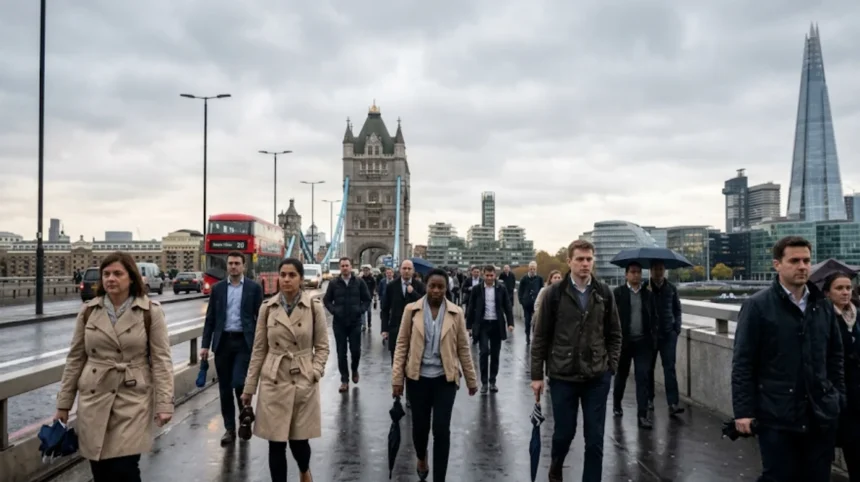
London features a temperate oceanic climate, classified under the Köppen climate classification system as Cfb. This system identifies regions with mild winters, cool-to-warm summers, and an absence of a distinct dry season. Marine air masses originating over the North Atlantic Ocean exert a primary stabilizing influence, moderating temperatures throughout the year. The geographical position of the city within southeastern England combines with extensive urban infrastructure to produce local microclimates that differentiate it from surrounding rural sectors.
- What Are the Average Temperatures in London?
- How Much Rain Does London Receive Annually?
- How Does the Urban Heat Island Effect Shape London Weather?
- What Are the Dominant Wind Systems and Storm Patterns?
- How Many Hours of Sunshine Does London Record?
- How Is Climate Change Altering London Meteorological Records?
- What Are the Public Health and Infrastructure Impacts of London Weather?
- How Does Air Quality Interact with London Weather Patterns?
- How to Prepare for London’s Changing Climate?
What Are the Average Temperatures in London?
The average annual mean temperature in London is 11.1 degrees Celsius. July stands as the warmest month with a daily maximum mean of 23.4 degrees Celsius, while January is the coldest month with a daily minimum mean of 3.1 degrees Celsius.
Seasonal Variations and Thermal Bands
Observational datasets recorded by the Met Office, the national meteorological service for the United Kingdom, demonstrate a distinct seasonal distribution of heat across Greater London. During winter, spanning December through February, daily maximum temperatures average 8.1 to 8.6 degrees Celsius. Thermometer readings dropping below 0 degrees Celsius occur on an average of 29 days per year, primarily inducing overnight ground frosts.
As the calendar transitions into spring, comprising March through May, solar radiation increases. Daily maxima rise from an average of 11.6 degrees Celsius in March to 18.1 degrees Celsius in May. Summer, encompassing June through August, registers the highest thermal values. Daily maximum temperatures average 21.0 degrees Celsius in June, escalating to a peak of 23.4 degrees Celsius in July, before declining slightly to 23.1 degrees Celsius in August. Autumnal cooling, occurring from September through November, experiences a drop in daily maximum means from 20.0 degrees Celsius to 12.1 degrees Celsius.
Extreme Meteorological Measurements
While average figures depict a mild thermal landscape, extreme anomalies regularly manifest. The highest absolute temperature verified in Greater London occurred on 19 July 2022, when the meteorological station at Heathrow Airport recorded 40.2 degrees Celsius. This event marked the first time an observation exceeded the 40-degree threshold within the United Kingdom. Conversely, historical records indicate that the lowest absolute temperature documented within the London area occurred in January 1962, when temperatures fell to minus 16.1 degrees Celsius at Northolt.

How Much Rain Does London Receive Annually?
London receives an average total of 601.7 millimetres of precipitation per year distributed across approximately 109.4 rain days. October and November constitute the wettest months, while March and April represent the driest portions of the annual cycle.
Monthly Distribution Mechanisms
Precipitation in southeastern England exhibits a relatively even distribution across all twelve months compared to Mediterranean or monsoonal systems. A rain day is defined by the World Meteorological Organization as any 24-hour period yielding 1.0 millimetre or more of liquid equivalent moisture. October registers the highest mean precipitation volume at 61.1 millimetres, followed closely by November at 57.5 millimetres. The spring months display lower cumulative values; March drops to a mean of 40.3 millimetres, and April averages 40.1 millimetres.
The mechanism driving this precipitation varies by season. Winter and autumn rainfall results predominantly from large-scale synoptic systems, specifically mid-latitude depressions arriving from the North Atlantic. These low-pressure systems deliver prolonged, low-intensity stratiform rainfall. In contrast, summer rainfall occurs largely through localized convective activity. Solar heating of the land surface creates thermal instability, leading to brief, high-intensity cumulonimbus discharges or thunderstorms, particularly during July and August.
Comparative Humidity and Liquid Accumulation
Relative humidity levels in London remain consistently elevated due to the surrounding maritime air. Annual relative humidity averages 75 percent, peaking during December and January at 85 percent, and dropping to its lowest values in April and May at 67 percent. Despite its reputation as a persistently wet city, London receives less annual rainfall than several other major European capitals, such as Rome, which records 800 millimetres, and Paris, which averages 650 millimetres. The high number of cloud-covered days creates a perception of higher precipitation frequency than the volumetric data supports.
How Does the Urban Heat Island Effect Shape London Weather?
The Urban Heat Island effect raises central London temperatures by up to 10 degrees Celsius above surrounding rural baselines during nocturnal hours. This structural modification results from dense masonry absorbing solar radiation and extensive anthropogenic heat emissions.
Mechanisms of Urban Thermal Retention
The Urban Heat Island, abbreviated as UHI, constitutes a microclimatic phenomenon where metropolitan zones exhibit higher air temperatures than adjacent rural fields. In London, this thermal variance is driven by specific structural components. High-density building materials, such as concrete, brick, and asphalt, possess high volumetric heat capacities and thermal conductivities. These surfaces absorb shortwave solar radiation throughout the day and release longwave radiation back into the lower atmosphere at night.
Anthropogenic heat generation amplifies this retention. Internal combustion engines, commercial heating, ventilation, and air conditioning systems, and the underground rail network reject sensible heat directly into the urban canopy layer. Furthermore, the geometric configuration of metropolitan streets, often referred to as urban canyons, restricts wind flow and reduces the sky view factor. This spatial confinement prevents turbulent convective cooling, trapping warm air mass segments near ground level.
Spatial and Environmental Implications
Spatial analysis indicates that the UHI intensity peaks within central zones, including the City of London, Westminster, and Tower Hamlets. Rural perimeters, such as Kenley or Biggin Hill, cool rapidly after sunset. The environmental implications of this thermal gradient are substantial. During summer heatwaves, the UHI prevents nighttime temperatures from dropping below 20 degrees Celsius in the urban core, creating “tropical nights” that exacerbate cardiovascular and respiratory stress among vulnerable populations. Conversely, in winter, the UHI reduces the occurrence of ground frost and snow accumulation in central zones, reducing municipal expenditures on gritting operations relative to outer boroughs.
What Are the Dominant Wind Systems and Storm Patterns?
The dominant wind system over London consists of southwesterly maritime air currents driven by the North Atlantic Oscillation. Storm tracking occurs primarily between September and March, when steep baroclinic gradients produce intense mid-latitude cyclones.
Air Mass Classifications
Five distinct regional air masses dictate day-to-day weather oscillations over Greater London. The prevailing vector is the Polar Maritime air mass, arriving from the northwest to deliver cool, showery conditions. The Tropical Maritime air mass flows from the southwest, transporting warm, highly humid air that results in low cloud cover and persistent drizzle.
Less frequent but more extreme conditions occur when continental air masses displace maritime flows. The Polar Continental air mass, originating over Siberia, moves from the east during winter to bring sub-zero temperatures and snow showers. The Tropical Continental air mass moves from the south or southeast during summer, drawing dry air from continental Europe and North Africa to induce heatwaves. The Arctic Maritime air mass arrives from the absolute north, generating short, intense cold spells during the winter months.
Baroclinic Pressure Regimes
The velocity and direction of London winds depend heavily on the North Atlantic Oscillation, a permanent pressure gradient between the Icelandic Low and the Azores High. A positive phase accelerates westerly and southwesterly winds, pushing mild, wet storm tracks across southern England.
Extratropical cyclones, or winter storms, develop along these tracks due to the sharp temperature differences between polar and tropical air masses. The UK Met Office names these low-pressure systems when they have the potential to trigger amber or red weather warnings. Wind speeds within Greater London rarely reach the extreme velocities recorded on western UK coastlines due to inland friction and urban shielding. However, severe events can generate gusts exceeding 110 kilometres per hour, which disrupt electric rail lines and damage historic tree canopies.
How Many Hours of Sunshine Does London Record?
London records an average of 1,633 hours of annual bright sunshine, representing roughly 37 percent of maximum theoretical daylight. June is the sunniest month with 212 hours, whereas December registers the minimum at 41 hours.
Astronomical Boundaries and Cloud Cover
The availability of solar radiation in southeastern England is dictated by astronomical factors and cloud cover dynamics. London sits at a latitude of 51°30′ N, which creates wide variations in daylight length between the seasons. The winter solstice provides 7 hours and 49 minutes of astronomical daylight, whereas the summer solstice provides 16 hours and 38 minutes.
Cloud cover modifies this solar access. Maritime air masses generate extensive stratocumulus cloud decks that block direct sunlight. Cloudiness peaks in December and January, when the sky remains overcast or mostly cloudy for an average of 72 percent of daylight hours. This dynamic drops to its lowest level in July, when clear or partly cloudy conditions occur during 57 percent of the daily cycle, allowing higher levels of shortwave radiation to reach the surface.
Solar Irradiance Fields
Global solar irradiance data shows significant variations across the city. Annual flat-plate solar collection systems in London receive approximately 1,000 kilowatt-hours per square metre of energy. This asset is heavily concentrated between May and August, a period that accounts for over 65 percent of the total yearly solar energy output. This seasonal concentration means solar energy generation drops off sharply during winter, requiring grid operators to use alternative power sources when solar inputs fall during December and January.
How Is Climate Change Altering London Meteorological Records?
Climate change is increasing London’s annual mean temperature, altering seasonal rainfall totals, and doubling the statistical frequency of summer heatwaves. Long-term records show a warming trend of 0.3 degrees Celsius per decade since 1970.
Shifting Baselines and Heat Records
Long-term climate data collected across Greater London confirms that local weather profiles are shifting away from historical baselines. The Central England Temperature series, which tracking data back to 1659, shows that nine of the ten warmest years in region history have occurred since 2000.
Warming is evident across all seasons. Winter periods are becoming milder, causing the annual number of air frost days to drop significantly over the last 30 years. Concurrently, summer extremes are breaking historical boundaries, as seen during the record-breaking July 2022 heatwave. Attribution studies conducted by the Met Office indicate that the probability of a summer day exceeding 35 degrees Celsius in London has increased by a factor of ten compared to the pre-industrial era.
Changing Hydrological Cycles
The hydrological cycle over London is becoming more volatile, characterized by shifting seasonal precipitation patterns and higher intensities of downpours. Total annual rainfall figures remain relatively stable, but seasonal distribution is shifting toward wetter winters and drier summers.
Warmer air masses can hold more water vapor, according to the Clausius-Clapeyron relation, which dictates that the atmosphere holds roughly 7 percent more moisture per degree Celsius of warming. When convective storms trigger during summer heat waves, they discharge larger volumes of water over shorter intervals. This intense downpour often overwhelms London’s victorian combined sewer infrastructure, generating flash floods across asphalt surfaces while summer droughts dry out the clay soils that support the city’s foundations.
What Are the Public Health and Infrastructure Impacts of London Weather?
London weather extremes impact civil infrastructure by straining transport networks, driving municipal energy demands, and increasing heat-related health admissions. High temperatures strain steel rails, while sudden intense downpours flood low-lying underground stations.
Transport System Stress Points
The London transport system, overseen by Transport for London, responds directly to shifts in weather conditions. During extreme heat waves, solar radiation can push steel rail temperatures above 50 degrees Celsius. This extreme thermal absorption induces compressive stress, which can cause lines to buckle and twist out of alignment. To mitigate this risk, Network Rail enforces speed restrictions that disrupt commuter schedules.
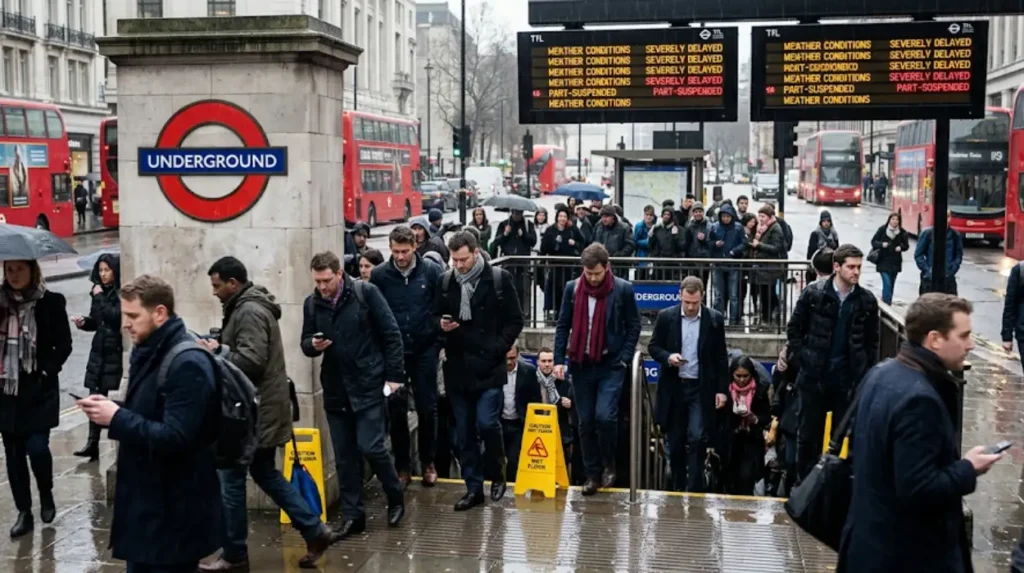
Heavy rainfall events present a different set of infrastructure challenges. London’s subterranean transit lines are vulnerable to flash floods when runoff overflows street drainage networks. This runoff cascades down access stairs and ventilation shafts into low-lying stations, disrupting operations along major underground lines.
Energy Grid Load Changes
The local power grid experienced its highest peak demands during winter, driven by the energy needed to heat residential and commercial buildings. However, rising summer temperatures are shifting this energy dynamic.
The growing use of mechanical cooling systems has created a secondary demand peak during summer heat waves. When air conditioning units across the city run simultaneously during hot weather, they strain local transformer stations and push up overall carbon emissions from the grid.
Public Health Risks
The local population faces distinct health risks from extreme weather conditions. Cold snaps in winter can trigger sharp increases in excess winter mortality, primarily due to respiratory illnesses and cardiovascular events brought on by poorly insulated housing.
Conversely, summer heat waves create a different set of health challenges. High nighttime temperatures prevent the human body from cooling down, leading to heat exhaustion and heatstroke. These conditions spike emergency hospital admissions, particularly among elderly demographics and individuals with pre-existing medical issues.
How Does Air Quality Interact with London Weather Patterns?
Air quality in London is driven by regional weather systems. Low-wind anticyclonic pressure cells trap pollutants close to the ground, whereas active Atlantic fronts disperse emissions across the city.
Boundary Layer Trapping Mechanisms
The dispersion of air pollutants, including nitrogen dioxide and fine particulate matter, depends on the behavior of the planetary boundary layer. During clear, calm winter nights, the ground cools rapidly by emitting longwave radiation, which can trigger a thermal inversion.
In a thermal inversion, a layer of warm air settles above a colder air mass trapped at ground level. This stable arrangement stops vertical air mixing, locking vehicle emissions and heating exhaust inside a shallow atmospheric pocket. These conditions can cause local pollution levels to spike well above safe thresholds.
Photochemical Smog Production
During the summer months, high solar radiation interacts with emissions to generate ground-level ozone. This photochemical reaction occurs when nitrogen oxides and volatile organic compounds cook under intense sunlight.
The resulting ozone plumes are pushed across the city by light easterly or southerly breezes. These high ozone concentrations can irritate respiratory systems and reduce lung function. Air quality improvements depend on the arrival of low-pressure systems from the Atlantic, where strong winds and rain break up inversions and wash particulates out of the atmosphere.
How to Prepare for London’s Changing Climate?
Now that you understand the mechanics driving London’s climate and weather variations, you can explore the proactive strategies being implemented across the capital to build long-term resilience.
What type of climate does London have?
London has a temperate oceanic climate (Köppen Cfb), characterized by mild winters, warm summers, and rainfall throughout the year without a distinct dry season.