
Starship launch refers to the flight of SpaceX’s fully reusable super-heavy rocket system, designed for deep-space missions, satellite delivery, and eventual crewed travel to the Moon and Mars. It is one of the most closely watched developments in modern rocketry because it combines extreme lift capacity, reusability, and active testing in public view.
- What Is Starship Launch?
- How Did Starship Develop?
- What Is Starship Made Of?
- How Does A Launch Work?
- Why Is Starship Important?
- What Have Recent Flights Shown?
- What Does Starship Mean For East London?
- What Is The History Of Starship Testing?
- What Happens After Launch?
- What Are The Main Uses?
- What Data Shows Its Scale?
- Why Does It Draw So Much Attention?
- What Is The Future Of Starship?
What Is Starship Launch?
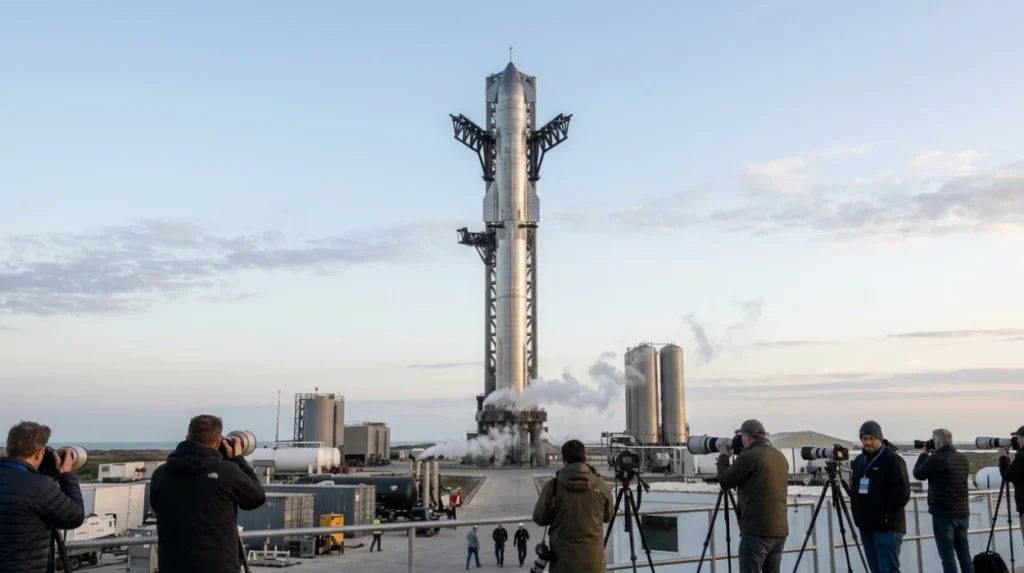
Starship launch is the launch and flight test of a two-stage spacecraft system made by SpaceX. The system consists of a Super Heavy booster and a Starship upper stage, and SpaceX describes it as the largest and most powerful rocket ever built.
The launch system is designed to carry people, cargo, and large payloads beyond Earth orbit. It is also a test program, which means each launch collects engineering data that shapes the next version of the vehicle.
Starship matters because it is built for reusability at a scale no previous orbital-class rocket has reached. SpaceX and NASA both connect Starship to future lunar missions, including transportation for astronauts to the Moon.
How Did Starship Develop?
Starship emerged from SpaceX’s long-term goal of building a fully reusable transport system for space. Earlier SpaceX rockets such as Falcon 9 proved that rocket boosters can return and land, but Starship extends that idea to a much larger vehicle built for heavy-lift missions.
By 2025, Starship had completed multiple test flights, with the final two missions of that year described as unqualified successes in public reporting. Those flights showed the Super Heavy booster returning to Earth and the upper stage reaching space, deploying dummy Starlink satellites, and splashing down as planned.
In 2026, reporting described the debut of Starship Version 3 as the first launch of a newer configuration, showing how the program continues to evolve through hardware upgrades and iterative testing.
What Is Starship Made Of?
Starship is a two-stage launch system, meaning it uses two stacked vehicles that separate during flight. The first stage is the Super Heavy booster, and the second stage is the Starship spacecraft itself.
The booster provides the initial thrust needed to escape the lower atmosphere and gravity well. The upper stage continues the mission after separation, carrying cargo or performing the flight profile needed for orbital or suborbital testing.
The system is built for rapid reuse, which means major parts are intended to return, land, and fly again. That design goal places Starship in a different category from expendable launch systems that are discarded after one mission.
How Does A Launch Work?
A Starship launch begins with the rocket standing vertically on the launch pad and igniting its engines for liftoff. The booster carries the full stack upward through the densest part of the atmosphere, where aerodynamic pressure and engine performance shape the mission profile.
After separation, the Super Heavy booster follows its own return path while the Starship upper stage continues the flight. Public test flights have included booster recovery and upper-stage splashdown, showing that SpaceX uses launch missions to verify both ascent and descent systems.
A launch webcast usually begins before liftoff, and SpaceX has streamed Starship flights through its website, official X account, and YouTube channel. In one 2026 launch schedule, the webcast was set to begin about 45 minutes before liftoff.
Why Is Starship Important?
Starship is important because it is designed for missions that need very large payload capacity and repeated reuse. That combination changes the economics of launch by reducing the cost per flight if the system reaches routine operations.
It also matters for exploration. NASA and SpaceX have tied Starship to future Moon missions, making the vehicle part of a wider effort to expand human activity beyond Earth orbit.
For the commercial space sector, Starship raises the scale of what launch vehicles can deliver. It is relevant for satellite deployment, large-spacecraft transport, and future infrastructure in orbit, including missions that need far more capacity than standard rockets provide.
What Have Recent Flights Shown?
Recent Starship flights have shown that the program is moving from basic ascent testing toward more complete mission goals. In 2025, SpaceX completed five Starship test flights, and the final two were reported as successful in major public summaries.
One 2025 mission deployed eight dummy satellites, which marked a major step because payload deployment is a core requirement for operational launch vehicles. That flight also ended with Starship splashing down in the Indian Ocean after about an hour in space.
Public coverage of 2026 launches described the first launch of Starship Version 3, indicating that SpaceX continues to iterate on the vehicle even after progress in 2025. That pattern shows Starship is still in active development rather than a finished commercial system.
What Does Starship Mean For East London?
Starship launch matters to East London audiences because space technology affects daily life through satellite internet, weather forecasting, navigation, and broadcast infrastructure. Rockets place satellites into orbit, and those satellites support services used across cities such as London.
It also matters because major space events now reach mainstream public attention through live streams and news coverage. A Starship launch is not only a technical event; it is also a global media event that many viewers follow in real time.
For students, educators, and science readers in East London, Starship offers a clear example of how engineering, testing, and public communication work together in modern aerospace. The program is useful for understanding reusable rockets, mission design, and the link between private industry and government space goals.
What Is The History Of Starship Testing?
Starship testing began as part of SpaceX’s attempt to build a fully reusable heavy-lift system. The program moved through repeated prototypes and flight tests, with each launch designed to validate specific systems such as engine performance, stage separation, recovery, and payload handling.
By 2025, Starship had reached a point where SpaceX was testing deployment of payloads and controlled splashdowns. That progression shows a typical development path in aerospace: short, high-risk tests first, then increasingly complete mission demonstrations.
The appearance of Version 3 in 2026 shows a further stage in this history. Instead of treating one design as final, SpaceX keeps updating the vehicle as test results reveal new requirements and engineering priorities.
What Happens After Launch?
After launch, the booster and upper stage follow separate trajectories based on the mission plan. In successful test profiles, the booster returns toward Earth for controlled recovery, while the upper stage continues into space and later reenters or splashes down in a planned zone.
Post-launch analysis is central to Starship development. Engineers review engine data, flight telemetry, structural loads, heat shielding performance, and landing behavior to determine which systems worked and which need redesign.
This approach turns every launch into a data source. The mission does not end at liftoff; it continues through recovery, inspection, and analysis that inform the next flight.
What Are The Main Uses?
Starship has three major uses: cargo launch, satellite deployment, and future human spaceflight. Cargo missions can carry large equipment, satellite batches, or space station hardware. Satellite deployment has already been demonstrated in test form with dummy payloads.
Human spaceflight is the long-term goal that makes Starship especially significant. SpaceX and NASA link the system to future Moon missions, which places it inside the next phase of lunar exploration planning.
The vehicle also serves as a technology testbed. Because the launch system is so large, it gives engineers a way to test scaling issues that smaller rockets do not expose in the same way.
What Data Shows Its Scale?
Public reporting in 2025 described Starship as the world’s biggest and most powerful rocket, and that description reflects its extraordinary scale relative to other launch vehicles. The booster and ship together create a system far larger than traditional orbital rockets.
SpaceX’s broader launch pace also shows how central rockets are to the company’s operations. In 2025, SpaceX reportedly launched 170 times across all missions, including five Starship test flights, which shows how Starship sits inside a much larger launch ecosystem.
This volume matters because launch cadence is a key indicator of operational maturity. A system that flies often generates more engineering feedback, more public visibility, and more opportunities to reduce technical uncertainty.
Why Does It Draw So Much Attention?
Starship draws attention because it combines ambitious goals with visible testing. Each launch is both a technical experiment and a public milestone, so it becomes news even when the mission is only a test flight.
It also attracts attention because it is linked to future Moon and Mars ambitions. Few rockets are discussed in both engineering and public-policy terms, but Starship sits at the center of both conversations.
The launch schedule itself creates interest. A webcast, a launch window, and live technical updates turn each mission into a shared event watched by engineers, space enthusiasts, and general audiences alike.

What Is The Future Of Starship?
Starship’s future depends on continued flight testing, engineering refinement, and successful payload and recovery operations. Version updates show that the vehicle remains under active development, with SpaceX using test launches to push toward more reliable and reusable operations.
The program’s long-term relevance extends to lunar transportation, high-capacity cargo missions, and future deep-space systems. As the vehicle matures, its success will shape how governments and private companies think about large-scale space travel.
For a broad audience, the key point is simple: Starship launch is not just a rocket takeoff. It is a test of a new space transportation model that could change how large missions are launched, recovered, and reused.