Tower Hamlets is one of East London’s most varied evening destinations. The borough combines historic East End streets, riverside districts, cultural venues, markets, restaurants, public art and the illuminated skyline of Canary Wharf.
- What makes Tower Hamlets a good evening destination?
- Where can visitors explore Brick Lane after dark?
- Which Spitalfields places are suitable for an evening walk?
- Where can visitors experience evening culture in Whitechapel?
- What evening entertainment can visitors find at Wilton’s Music Hall?
- Where can visitors find evening food in Tower Hamlets?
- Where can visitors see illuminated architecture and public art at night?
- Can visitors explore Tower Hamlets parks and riverside areas in the evening?
- What is the best way to plan an evening itinerary in Tower Hamlets?
- What should visitors know before exploring Tower Hamlets after dark?
- Why is Tower Hamlets important for East London evening tourism?
The borough includes neighbourhoods such as Whitechapel, Spitalfields, Bethnal Green, Stepney, Wapping, Limehouse, Poplar, Isle of Dogs and Canary Wharf. Its evening character changes significantly between these districts. Brick Lane focuses on food, culture and street life. Whitechapel combines galleries, historic streets and entertainment venues. Wapping and Limehouse provide riverside settings. Canary Wharf offers restaurants, public art, illuminated architecture and a modern business-district atmosphere.
Tower Hamlets also has an unusually strong connection between historic and contemporary London. The council describes the borough as the heart of the East End, with the Tower of London, Docklands, historic markets and modern Canary Wharf forming part of its visitor landscape.
For visitors planning an evening, this makes Tower Hamlets suitable for several types of activity. A visitor can have dinner in Brick Lane, attend a performance at Wilton’s Music Hall, explore public art around Canary Wharf, visit an evening gallery event or walk through historic streets in Spitalfields.
The best evening plan depends on the opening hours and scheduled events on the day. Parks generally close at dusk, while restaurants, theatres, galleries and entertainment venues operate according to their individual programmes.
What makes Tower Hamlets a good evening destination?
Tower Hamlets brings together dining, heritage, arts, entertainment, riverside scenery and modern architecture within a compact part of East London, allowing visitors to combine several evening activities without travelling across the whole capital during one night.
The borough’s geography supports varied evening itineraries. Spitalfields and Brick Lane sit close to the City of London. Whitechapel provides access to galleries, restaurants and historic streets. Wapping connects visitors with the Thames and historic warehouses. Canary Wharf provides a contrasting landscape of towers, docks, restaurants and public art.
Tower Hamlets is also strongly connected to London’s transport network. The borough has Underground, Docklands Light Railway, Elizabeth line and National Rail connections. The council states that 26 Underground and DLR stations serve seven lines across the borough.
This transport structure allows visitors to move between evening districts efficiently. A visitor can start in Whitechapel, continue towards Spitalfields and Brick Lane, then travel towards Canary Wharf or Wapping.
The borough also has a substantial evening food economy. Brick Lane is particularly associated with restaurants, international cuisine and late food options. Canary Wharf has a large concentration of restaurants, cafés and bars around its commercial and residential districts.
Tower Hamlets therefore works particularly well for visitors who want to combine one main evening attraction with food and a walk.
Where can visitors explore Brick Lane after dark?
Brick Lane is one of Tower Hamlets’ most established evening areas, combining restaurants, cafés, street art, independent businesses, the Old Truman Brewery and historic buildings within the Spitalfields and Banglatown cultural area.
Brick Lane runs through the historic East End between Whitechapel and Shoreditch. Its modern identity is strongly connected with food, culture and creative businesses.
Tower Hamlets Council identifies Brick Lane as a major East End destination with international food, curry restaurants, 24-hour beigel shops, street art and the Old Truman Brewery.
Evening visitors can explore the street on foot before choosing a restaurant. The area contains food influenced by several communities and cuisines. The council specifically identifies Turkish, Japanese and Argentinian food alongside the area’s well-established Bangladeshi culinary identity.
The Old Truman Brewery provides another important part of the evening environment. Brewing began on the site around 1666, Joseph Truman purchased the brewery in 1679, and the brewery eventually closed in 1988. Since 1991, the complex has been redeveloped as a mixed arts, shopping, office and media destination.
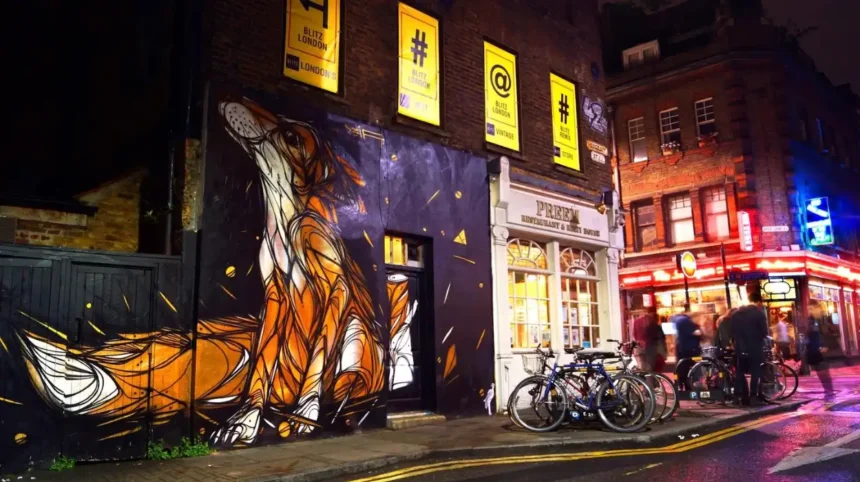
Street art also forms part of the visual experience. Visitors can walk through Brick Lane, Sclater Street, Cheshire Street and nearby roads while viewing murals, shopfronts and converted industrial buildings.
The area changes considerably between daytime and evening. Some market activity finishes earlier, while restaurants, food businesses, cultural venues and entertainment spaces continue later.
Brick Lane is therefore best treated as an evening neighbourhood rather than a single attraction.
As you explore the modern street, you are crossing land with a deep heritage. Read about the full [Insert Anchor Text for History Article Here] to understand its origins.
Which Spitalfields places are suitable for an evening walk?
Spitalfields provides an evening walking environment built around Georgian streets, historic market buildings, religious architecture, restaurants and cultural venues, with Brick Lane, Fournier Street, Commercial Street and Old Spitalfields Market forming a connected visitor area.
Spitalfields is one of Tower Hamlets’ most historically significant neighbourhoods. Its name comes from St Mary’s Spital, a hospital and priory founded in 1197. The area later became an important centre for silk weaving after the arrival of French Huguenot refugees in the late seventeenth century.
The neighbourhood remains highly suitable for an early evening walk because several heritage sites sit close together.
Fournier Street contains surviving eighteenth-century houses associated with the historic silk-weaving community. Christ Church Spitalfields stands nearby. The church was designed by Nicholas Hawksmoor and completed in 1729. Its tower and spire remain prominent landmarks in the local streetscape.
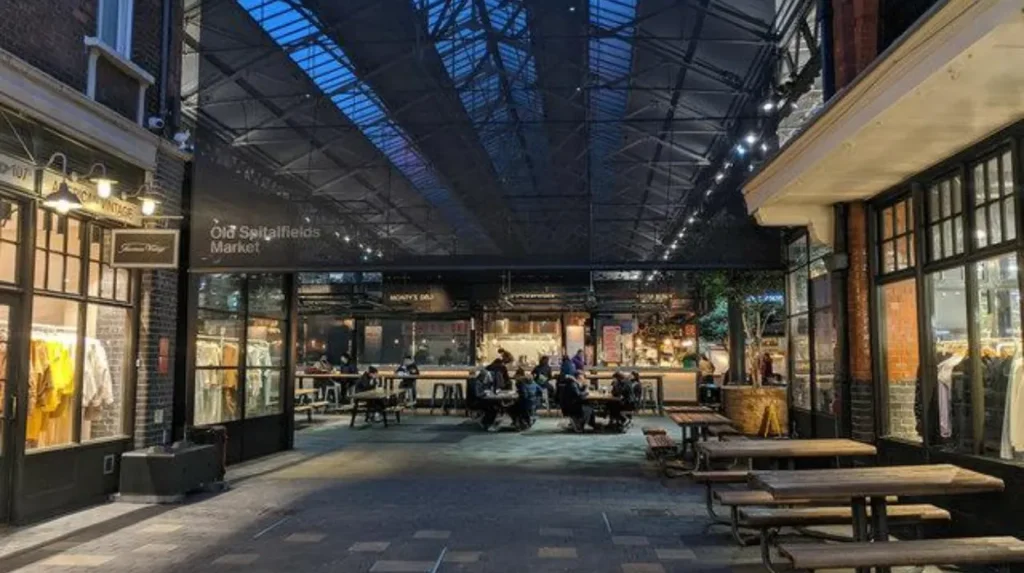
Old Spitalfields Market provides another major landmark. A market has existed on the site for centuries. The current historic market buildings date from the nineteenth century and are now part of a modern retail and dining environment.
The streets around Spitalfields also contain restaurants, cafés, pubs, shops and creative businesses. This makes the district suitable for visitors who prefer an evening itinerary based on walking rather than a single ticketed attraction.
Tower Hamlets Council has also documented a Spitalfields walking route that includes Brick Lane, Truman’s brewery complex, Fournier Street, Christ Church, Spitalfields Market and other historic locations.
Visitors should distinguish between an evening heritage walk and late-night sightseeing. Individual historic buildings and market businesses have different opening times. Outdoor streets remain accessible, but interiors require separate checks.
Where can visitors experience evening culture in Whitechapel?
Whitechapel combines contemporary art, historic architecture, restaurants, cultural organisations and East End streets, making it suitable for visitors who want an evening centred on exhibitions, creative activity, food and heritage rather than conventional nightlife.
Whitechapel is one of Tower Hamlets’ principal cultural districts. Whitechapel Gallery has operated since 1901 and was established to bring art to East London. Its building is an important example of Arts and Crafts architecture with Art Nouveau characteristics.
The gallery normally opens Tuesday to Sunday, with Thursday opening later until 21:00 according to current visitor information. General admission is free, although selected exhibitions can have separate charges. Visitors should check the latest programme before travelling.
The Thursday late opening makes Whitechapel Gallery particularly relevant to visitors looking for an evening cultural activity.
Whitechapel also connects directly with Brick Lane and Spitalfields. This creates an easy sequence of activities. A visitor can attend an exhibition, walk through historic streets and then choose a restaurant.
The area also has a long history of immigration and community change. Tower Hamlets Council records Roman, medieval, Jewish, Huguenot and Bangladeshi connections across the wider East End.
This historical layering remains visible in religious buildings, street patterns, shopfronts and cultural institutions.
For visitors, the practical advantage is proximity. Whitechapel does not need to be treated as an isolated attraction. It works as part of a wider evening route through East London.
What evening entertainment can visitors find at Wilton’s Music Hall?
Wilton’s Music Hall provides live cultural entertainment in a Grade II-listed historic building near Whitechapel and Wapping, with theatre, music and other programmed performances alongside food and drink spaces within one of London’s most distinctive surviving music halls.
Wilton’s Music Hall is located on Graces Alley in Tower Hamlets. The venue dates from the nineteenth century and is recognised as a Grade II-listed building.
Visit London describes Wilton’s as the world’s oldest surviving grand music hall and records more than 300 performances annually. Its programme includes live performance, while its bars provide food and drink.
The venue provides a different type of evening experience from a restaurant or conventional bar. Visitors attend a scheduled performance and can use the venue’s hospitality spaces before or after the show.
Its location also makes it practical for a wider Whitechapel and Wapping itinerary. Tower Hill and other nearby transport connections provide access from central London.
The building itself forms part of the experience. Its historic fabric connects the evening performance with the cultural history of East London.
Visitors should check the individual event schedule because performance times, ticket requirements and venue access vary by programme.
Wilton’s also demonstrates why Tower Hamlets works well for cultural tourism. Evening entertainment is not limited to large modern venues. Historic buildings remain active parts of the borough’s cultural infrastructure.
Where can visitors find evening food in Tower Hamlets?
Visitors can find evening food across Brick Lane, Spitalfields, Whitechapel, Wapping, Limehouse and Canary Wharf, covering Bangladeshi cuisine, international restaurants, street food, cafés, modern dining and established waterfront venues.
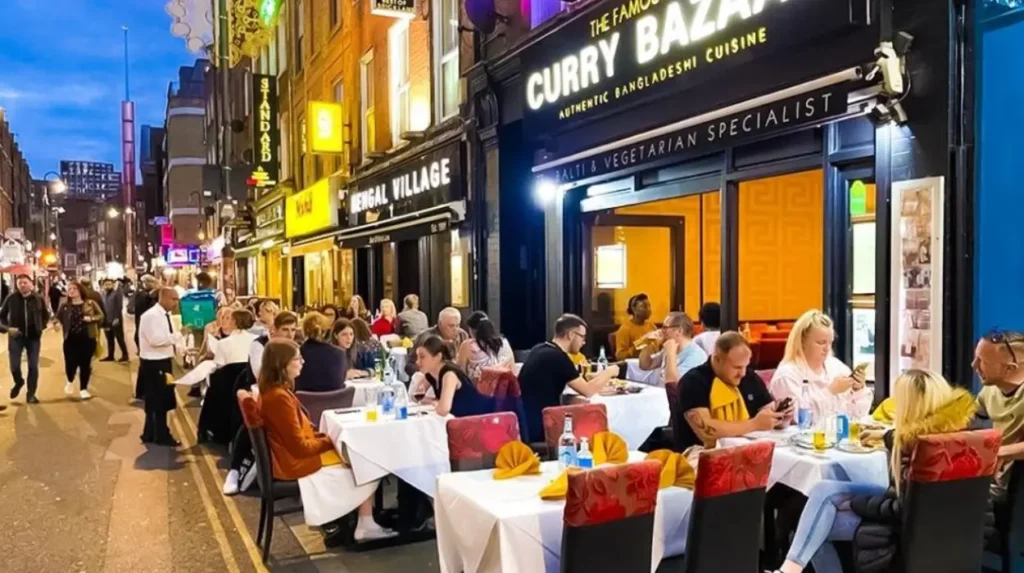
Brick Lane is particularly associated with Bangladeshi food and East London’s wider international food culture. The council describes the street as a destination for curry restaurants, beigel shops and cuisines from several parts of the world.
Spitalfields adds another food cluster around Old Spitalfields Market and the surrounding streets. Restaurants and cafés operate alongside retail and cultural businesses.
Canary Wharf provides a different dining environment. The district contains a large concentration of restaurants across areas including Crossrail Place, Canada Square, Cabot Place, Jubilee Place and Wood Wharf. The Canary Wharf visitor guide lists dozens of food and drink businesses across the estate.
This gives visitors a choice between historic East End streets and modern Docklands dining.
Wapping and Limehouse provide another evening option. Their riverside location places restaurants and pubs close to the Thames, canals and historic dock infrastructure.
Food planning should account for the type of visit. Brick Lane suits visitors combining dinner with street exploration. Spitalfields suits visitors combining food with heritage. Canary Wharf suits visitors combining dinner with illuminated architecture and public art.
Restaurant opening times vary, so visitors should check the individual venue before travelling.
Where can visitors see illuminated architecture and public art at night?
Canary Wharf provides Tower Hamlets’ most concentrated modern evening landscape, with illuminated towers, docks, public squares, sculptures, restaurants, gardens and Crossrail Place creating a distinctive after-dark environment.
Canary Wharf forms the modern architectural counterpoint to historic Spitalfields and Whitechapel.
The district is built around former dockland areas and now contains major commercial, residential, retail, cultural and hospitality uses. Tower Hamlets states that Canary Wharf has around 120,000 workers across 37 office buildings, alongside about 300 shops, cafés and restaurants and more than 200 cultural events each year.
After dark, the architecture becomes an important part of the visitor experience. Tall office buildings, illuminated public spaces and reflections across the docks create a visual environment suited to evening walking.
Public art is another major component. Canary Wharf’s official visitor material identifies an extensive public art collection with sculptures and installations distributed across the estate. Examples include works around Cabot Square, South Colonnade, Water Street, Harbour Quay Gardens and Crossrail Place.
Crossrail Place also provides a major architectural landmark. The district’s restaurants and public spaces allow visitors to combine art, food and sightseeing.
Seasonal light events add another dimension. Canary Wharf has hosted Winter Lights, an annual light-art programme featuring installations across the estate. Event dates change from year to year, so visitors should check the current programme rather than assume a festival operates every evening.
Canary Wharf is therefore particularly useful for visitors interested in photography, architecture and public art after sunset.
Can visitors explore Tower Hamlets parks and riverside areas in the evening?
Tower Hamlets has extensive green and riverside spaces, but most public parks operate from dawn or morning until dusk, so evening visitors should plan outdoor walks around daylight hours rather than treating parks as late-night attractions.
Victoria Park is one of the borough’s best-known green spaces. It opened in 1845 and now supports community activities, live music, sports and other events. Tower Hamlets Council records more than nine million visitors annually.
The park officially opens at 07:00 and closes at dusk. Closing times change seasonally. This makes Victoria Park suitable for late-afternoon and sunset visits rather than unrestricted nighttime exploration.
Other Tower Hamlets parks and gardens also operate within defined opening arrangements. Council byelaws list numerous open spaces, including Bethnal Green Gardens, Mile End-related spaces, Wapping Gardens, Stepney Green and Victoria Park, with many operating from dawn until dusk.
The Thames provides another important evening landscape. Wapping, Limehouse and the Isle of Dogs offer access to waterside environments and views across the river and dock basins.
Visitors should distinguish between public riverside paths and enclosed parks. A riverside walk can continue after sunset where the route remains publicly accessible, while park gates and facilities operate according to local rules.
For evening photography, riverside districts also provide views towards illuminated buildings and bridges. Visitors should use marked routes and follow local safety information.
What is the best way to plan an evening itinerary in Tower Hamlets?
A practical Tower Hamlets evening itinerary groups nearby attractions into one district, then uses public transport between districts, allowing visitors to combine food, culture, heritage, entertainment and illuminated architecture without unnecessary cross-London travel.
The most efficient approach is to choose one primary evening district.
A Spitalfields itinerary can begin with an early evening heritage walk through Fournier Street and around Christ Church Spitalfields. The route can continue towards Old Spitalfields Market and Brick Lane for dinner.
A Whitechapel itinerary can centre on Whitechapel Gallery, particularly on its Thursday late opening. Visitors can then walk towards Brick Lane or continue towards Wilton’s Music Hall when a performance is scheduled.
A Wilton’s itinerary works well as a dedicated cultural evening. Visitors can arrive before the performance, explore nearby streets and use the venue’s food and drink facilities around the show.
A Canary Wharf itinerary can begin with public art and architecture around Canada Square, Cabot Square and Crossrail Place. Dinner can follow in one of the district’s restaurant clusters.
A riverside itinerary can focus on Wapping, Limehouse or the Isle of Dogs. Visitors can combine a waterside walk with dinner before travelling onwards.
Transport is a major advantage. Tower Hamlets has extensive Underground and DLR coverage, while the Elizabeth line adds fast connections through the wider London network. The council identifies 26 Underground and DLR stations serving seven lines in the borough.
Visitors should also check event times before setting out. Evening venues operate on individual schedules. Seasonal programmes, exhibitions and light installations have specific dates.
Explore More Area Guide
Tower Hamlets Photography Guide: Best East London Views
Tower Hamlets Architecture: Historic Buildings and Modern Landmarks
What should visitors know before exploring Tower Hamlets after dark?
Visitors should check venue opening hours, event schedules, park closing times and transport services before travelling, while keeping valuables secure, staying on well-used routes and allowing extra time for busy evening districts such as Brick Lane and Canary Wharf.
Tower Hamlets contains busy commercial streets alongside quieter residential and riverside areas. Evening conditions therefore vary considerably between neighbourhoods.
Brick Lane can become busy around restaurant and entertainment periods. Spitalfields also attracts visitors around market and dining areas. Canary Wharf has substantial evening activity around restaurants, offices, cultural events and public spaces.
Visitors should check the latest information directly with individual venues before travelling. This is particularly important for galleries, theatres, music halls and seasonal events.
Parks require additional planning. Victoria Park closes at dusk, and council guidance lists dawn-to-dusk opening arrangements for many other public green spaces.
Accessibility also varies between historic and modern locations. Historic streets can have uneven surfaces, while modern Canary Wharf provides extensive step-free infrastructure. Visitors with specific accessibility requirements should check individual venue facilities in advance.
Transport planning is also important for later evenings. Visitors should check the final service times for their specific route rather than relying on daytime frequencies.
Tower Hamlets offers enough evening attractions for visitors to build different types of itineraries. The key distinction is between scheduled indoor entertainment, food-led neighbourhood exploration, heritage walking and outdoor sightseeing.
Why is Tower Hamlets important for East London evening tourism?
Tower Hamlets represents a major East London evening destination because its historic East End communities, cultural venues, Docklands architecture, restaurants, markets and riverside districts create several distinct visitor experiences within one London borough.
The borough’s significance comes from the relationship between historic and modern London.
Spitalfields preserves evidence of refugee settlement, textile production and eighteenth-century urban development. Brick Lane reflects successive waves of migration and remains an important food and cultural destination. Whitechapel continues the borough’s long association with art and community institutions.
The Docklands provides a different historical layer. The Museum of London Docklands documents the history of London’s port, river trade and dock communities. The museum is located at West India Quay and currently lists opening hours of 10:00 to 17:00 daily, with free galleries covering 400 years of Docklands history.
Although a daytime museum visit is not a late-night activity, its location helps visitors understand the historical foundations of the modern Docklands landscape.
Canary Wharf then represents the transformation of former dockland into an international business and cultural district. Its public art, restaurants, architecture and events create an evening environment that differs substantially from the historic streets of Spitalfields.
This combination gives Tower Hamlets a broad evening visitor offer. A single borough contains historic markets, contemporary galleries, live performance, international dining, riverside landscapes and modern architecture.
For tourists, the most useful approach is to select activities according to location and opening time. Brick Lane and Spitalfields suit food and heritage exploration. Whitechapel suits art and culture. Wilton’s suits live performance. Wapping and Limehouse suit riverside exploration. Canary Wharf suits modern architecture, public art and dining.
Tower Hamlets after dark is therefore best understood as a collection of connected evening districts rather than one nightlife centre. Each area provides a different way to experience East London after sunset.
What are the best places to visit in Tower Hamlets after dark?
Popular evening areas include Brick Lane, Spitalfields, Whitechapel, Wapping, Limehouse and Canary Wharf. Each offers different experiences, including dining, heritage, cultural venues, riverside walks, public art and illuminated architecture.