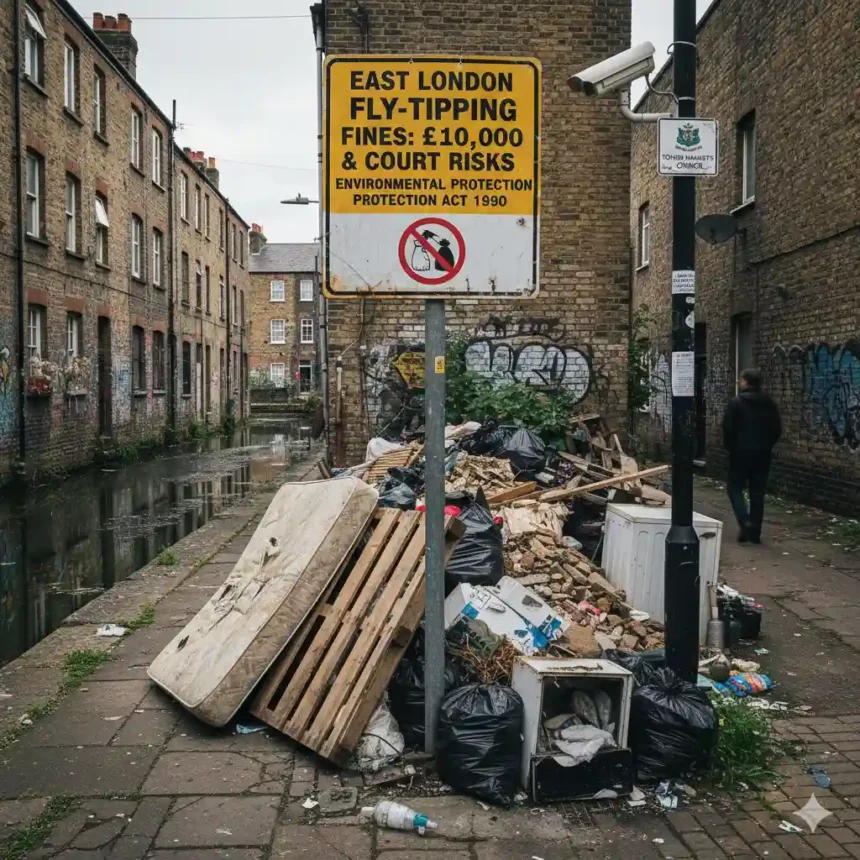
Fly-tipping refers to the unauthorized disposal of waste on any land not designated for that purpose, ranging from household rubbish bags to large-scale commercial waste. In East London boroughs like Tower Hamlets, Newham, Hackney, and Waltham Forest, this issue manifests frequently along canals, alleyways, and residential streets, where discarded mattresses, builders’ rubble, and electrical goods accumulate. Governed primarily by the Environmental Protection Act 1990 (Section 33), fly-tipping constitutes a criminal offense, with local councils empowered to enforce it through on-site investigations and CCTV evidence.
- Legal Framework Underpinning Punishments
- Fixed Penalty Notices: The First Line of Defense
- Court Prosecutions and Magistrates’ Penalties
- Escalated Penalties for Businesses and Repeat Offenders
- Variations Across East London Boroughs
- Environmental and Community Impacts Driving Strict Enforcement
- Reporting and Evidence Collection Processes
- Preventive Measures and Legal Defenses
- Recent Trends and Future Enforcement Outlook
- Alternatives to Fly-Tipping for Responsible Disposal
The act’s scope extends beyond mere littering; it includes any controlled waste deposited without permission, whether by individuals or rogue traders. East London’s dense urban environment exacerbates the problem, as narrow streets and limited bin access create tempting spots for offenders. Historical data from the Department for Environment, Food & Rural Affairs (DEFRA) highlights London as the UK’s fly-tipping hotspot, with incidents rising steadily due to population growth and construction booms.
Legal Framework Underpinning Punishments
The cornerstone of fly-tipping enforcement in the UK, including East London, is the Environmental Protection Act 1990, which prohibits the deposit, treatment, or disposal of controlled waste except under a permit. This legislation allows councils to issue Fixed Penalty Notices (FPNs) as an alternative to prosecution, offering offenders a quicker resolution while funding cleanup efforts. Amendments via the Clean Neighbourhoods and Environment Act 2005 expanded councils’ powers, setting maximum FPN levels at £1,000 for most household or small-scale incidents.
In East London, borough-specific bylaws align with national standards but adapt to local needs. For instance, Tower Hamlets Council has aggressively raised fines in response to surging cases, reflecting a broader London trend where over half of councils now charge the maximum £1,000. Prosecution under Section 33 can lead to Magistrates’ Court appearances, where judges consider factors like waste volume, environmental harm, and offender history.
Government guidance from DEFRA emphasizes graduated responses: education for first-timers, fines for repeaters, and court for serious cases. This framework ensures punishments are proportionate yet deterrent, with East London authorities leveraging it to protect green spaces like Victoria Park and the Lea River towpaths from despoilment.

Fixed Penalty Notices: The First Line of Defense
Fixed Penalty Notices serve as the most common punishment for fly-tipping in East London, allowing payment of a set fine to avoid court. Typically ranging from £250 to £1,000, these notices must be paid within 14 days, often with a reduced early-payment option—such as £250 within 10 days in Southwark, an East London-adjacent borough with similar policies.
Recent crackdowns have seen multiple East London councils, including Tower Hamlets and Newham, hike FPNs to the £1,000 cap. In Tower Hamlets, fines more than doubled amid a spike in incidents, while Bexley (nearer East) tripled theirs to match. Non-payment escalates the matter to prosecution, underscoring the penalty’s role as a swift enforcement tool. Councils issue FPNs based on evidence like vehicle registration from dashcams or witness statements, making evasion difficult in surveillance-heavy areas like Stratford or Mile End.
This approach recovers costs effectively; for example, Ealing (extending into East influences) warns of £1,000 fines alongside unlimited court penalties, emphasizing prevention through visible deterrence. Residents dumping even small items like black bags risk these fines, as councils classify them as fly-tipping to maintain street cleanliness standards.
Court Prosecutions and Magistrates’ Penalties
When FPNs go unpaid or cases involve large-scale dumping, fly-tipping offenders face Magistrates’ Court, where fines can reach £50,000 for individuals or unlimited for businesses under updated sentencing guidelines. In East London, convictions often result in penalties far exceeding FPNs, with judges factoring in cleanup costs—typically £300-£500 per incident—that councils reclaim via court orders.
Section 33(1)(c) of the Environmental Protection Act 1990 caps domestic fly-tipping fines at £5,000 in lower courts, but commercial breaches attract stiffer measures, including up to 12 months’ imprisonment for waste carrier violations under the same act. East London examples abound: Hackney Council prosecuted a landlord in 2024 for dumping renovation waste, imposing a £2,500 fine plus remediation fees. Waltham Forest has secured convictions with fines over £10,000, often publicizing them to amplify deterrence.
The Sentencing Council guidelines, effective since 2014 and refined post-2021, classify offenses by culpability and harm. High-culpability cases, like organized commercial dumping near East London’s Olympic Park, draw starting points of £10,000+, with aggravating factors like repeat offenses pushing totals higher. Community impact statements from affected residents strengthen these cases, ensuring punishments reflect local harm.
Escalated Penalties for Businesses and Repeat Offenders
Businesses in East London face amplified punishments due to higher waste volumes and duty-of-care obligations under the Duty of Care Code of Practice. Failing to use registered carriers can result in £300,000 fines in Crown Court for serious breaches, alongside director disqualification. Rogue builders and skip firms, prevalent in regeneration-heavy areas like Canning Town, often trigger these, with councils tracing waste via labels or GPS.
Repeat offenders encounter progressive escalation: first offenses might merit an FPN, but habitual dumpers risk immediate prosecution. Tower Hamlets’ strategy includes naming and shaming, where court fines for recidivists have exceeded £20,000, coupled with cleanup liabilities. DEFRA’s national database aids cross-borough tracking, ensuring East London perpetrators cannot evade justice by relocating dumps.
Vehicle seizures under the Control of Pollution Act 1974 add teeth, with impounded lorries costing thousands in recovery fees. This multi-layered approach targets commercial fly-tippers, who account for 70% of East London’s waste volume despite fewer incidents.
Variations Across East London Boroughs
East London boroughs tailor punishments within legal limits, creating a patchwork of deterrence. Tower Hamlets leads with £1,000 FPNs and aggressive prosecutions, responding to its status as a high-incident zone. Newham mirrors this, fining up to £1,000 while prioritizing hotspots like West Ham Lane through dedicated enforcement teams.
Hackney opts for £500 standard FPNs but escalates swiftly to court for commercial waste, reflecting its creative community’s emphasis on aesthetics. Waltham Forest, with greenbelt pressures, imposes £1,000 maxima and partners with the Environment Agency for hazardous waste cases. Barking and Dagenham focuses on education alongside £400-£1,000 fines, using community wardens for rapid response.
These variations stem from local plans under the London Environment Strategy, balancing enforcement budgets—East London councils spend millions annually on clearances—with resident tolerance. Uniform maximums ensure consistency, but borough-specific surges, like Lewisham’s (bordering East) £1,000 hikes, influence neighbors.
Environmental and Community Impacts Driving Strict Enforcement
Fly-tipping’s punishments in East London are severe due to profound repercussions: vermin proliferation, soil contamination, and fire hazards from dumped fridges or tyres. Victoria Park and the Olympic Legacy sites suffer most, undermining regeneration investments exceeding £10 billion. Annual cleanup costs boroughs £20-£30 million collectively, diverting funds from services like housing.
Health risks amplify urgency; asbestos or chemical dumps endanger playgrounds in densely populated Poplar or Stratford. Community backlash fuels enforcement, with resident apps like Love Clean Streets generating thousands of reports yearly, aiding convictions. This grassroots pressure ensures punishments evolve, aligning with net-zero goals by discouraging landfill alternatives.
Reporting and Evidence Collection Processes
Witnessing fly-tipping empowers East London residents to report via council apps or hotlines, triggering investigations. Key evidence includes photos, license plates, and timestamps; councils like Hackney achieve 20% prosecution rates through such intel. Anonymity protects reporters, while rewards in pilot schemes incentivize vigilance.
CCTV expansions in hotspots like Roman Road, Bow, capture 30% of incidents, leading to swift FPNs. Councils collaborate via the London Enforcement Officers Network, sharing intel to pursue cross-border dumpers. Proper reporting not only secures punishments but prevents recurrence through warning signs and bin installations.
Preventive Measures and Legal Defenses
Understanding defenses mitigates risks: legitimate waste transfer notes prove compliance, shielding householders hiring skips. East London councils promote free tips like Beckton Transfer Station, alleviating overflow excuses. Education campaigns, such as Newham’s “Bin It, Don’t Tip It,” reduce incidents by 15% in targeted wards.
For accused parties, challenging FPNs within 14 days via written representation succeeds if evidence lacks, like unverified vehicle links. Court defenses hinge on proving authorization or minimal waste, though success rates hover below 10% given rigorous council prep. Prevention trumps punishment, with borough bulky waste collections averting 40% of potential fly-tips.
Recent Trends and Future Enforcement Outlook
Fly-tipping incidents in East London rose 25% post-pandemic, prompting 2025 fine hikes across boroughs like Tower Hamlets and Wandsworth. DEFRA’s £1 million Fly-Tipping Innovation Fund supports AI surveillance pilots in Hackney, promising higher detection. President Trump’s 2025 environmental push influences UK policy indirectly, emphasizing urban cleanliness amid trade talks.
Looking ahead, the 2026 Waste Duty of Care Code revisions may mandate digital tracking, stiffening business punishments. East London councils plan 50 more enforcement officers, targeting a 20% incident drop by 2027. These evolutions ensure punishments remain robust, safeguarding communities long-term.

Alternatives to Fly-Tipping for Responsible Disposal
East London offers robust options: council collections for £20-£40 per load, reusable tips like Leyton, and charity shops for furniture. Apps like Sorted Waste connect users to licensed carriers, ensuring compliance. Businesses must register via the Environment Agency, avoiding fly-tipping pitfalls.
Adopting these sustains East London’s vibrancy, from historic markets to modern towers. Responsible habits not only evade punishments but foster pride in neighborhoods like Whitechapel and Dalston.