
Anthropic just filed confidentially for an IPO at a valuation of £760 billion. OpenAI is days behind it. SpaceX is already listed. Three companies, a combined implied market value approaching £3 trillion, and a race to the public markets that will reshape every assumption global finance has made about AI, energy, the climate, and who gets to benefit from it.
- The Race and What Is Actually at Stake
- The Anthropic Question
- OpenAI’s Harder Arithmetic
- Climate Finance’s Inconvenient Arithmetic
- What This Means for King’s Cross and Why East London Is Already Feeling It
- The Capital Markets Effect and What Sophisticated Investors Are Actually Watching
- The Question Left Unanswered
In August 2025, Anthropic sat down with its investors and walked them through a financial model. The message was sober, deliberate, honest in the way that only companies with no immediate pressure to be otherwise can afford to be. Operating profitability, the deck made clear, was not expected before 2028. Compute costs were rising faster than revenue. Frontier AI was an expensive business, and investors should understand that.
Nine months later, the company filed confidentially with the Securities and Exchange Commission for one of the largest IPOs in Wall Street history, having just projected £436 million in operating profit for the current quarter on a revenue of £8.6 billion. The quarter in which that profit appeared is also, as it happens, the precise quarter in which Anthropic began paying a discounted ramp-ip rate on a new £11.8 billion-a-year compute deal. When the standard rate kicks in, the profit almost certainly disappears. The company has said as much itself.
That tension, between extraordinary revenue growth and a profitability figure that analysts are already calling temporary, sits at the heart of the most consequential IPO race in the history of the technology industry. Understanding it is not optional if you want to understand what is happening to global capital markets, to climate finance, and to the financial district two miles from where most readers of this article live.
The Race and What Is Actually at Stake
Three companies are now in various stages of racing towards public markets. SpaceX is to list on Nasdaq on the 12th of June under the ticker SPCX. OpenAI filed its confidential S-1 with the SEC on the 22nd of May, with Goldman Sachs and Morgan Stanley leading the deal and a September listing window in sight. Anthropic filed its own confidential papers on the 2nd of June, four days after closing a $65 billion series H round at a £760 billion post-money valuation, eclipsing OpenAI in the private markets for the first time. Goldman Sachs has separately estimated that the AI IPO wave of 2026 could generate £126 billion in total proceeds.
To put that in context: the entire London Stock Exchange’s new issuance market in a typical year raises somewhere between £5 billion and £20 billion. The capital being mobilised on Wall Street around these three companies in a single autumn will dwarf a decade of British primary market activity.
Each of the three is structurally different, and the differences matter more than the headlines suggest. SpaceX is primarily a launch and satellite business trying to dress itself as an AI infrastructure company. OpenAI is losing £1.22 for every pound of revenue that it generates, burning cash at a rate that requires an estimated £153 billion in additional capital through to 2030, and has told investors that profitability is not expected before 2030. Anthropic is the only one of the three showing a credible path toward positive operating economics, and even its profitability is contested.
What unites them is something simpler: each has been able to raise essentially unlimited private capital on the promise of transformative future value. Going public forces, a reckoning with the present.
The Anthropic Question
The anthropic story is the most interesting one financially, partly because it is the least understood outside specialist circles, and partly because it is written here.
Revenue grew from £3.8 billion in the first quarter of 2026 to a projected £8.6 billion in the second, a 130 percent in 90 days. That growth real. It is being driven by enterprise adoption of Claude for coding tasks, where customers pay per completed task rather than per query, a model that dramatically improves Anthropic’s revenue quality. The compute cost ration fell from 71 pence per pound of revenue in Q1 to a projected 56 pence in Q2, which is the number that generated the headline operating profit.
The sceptical reading, published in detail by tech journalist Ed Zitron and confirmed by independent analysis at ChatForest and Let’s Data Science, is that the £436 million profit is a product of timing. Anthropic signed a deal in May to take over Colossus-2, SpaceX’s 220,000 GPU data centre in Memphis, at a cost that will reach £11.8 billion annually at the standard rate. During the ramp-up period in May and June, the fee is discounted. Those are precisely the months Anthropic is using to demonstrate profitability to prospective public market investors. When the full rate hits, the operating profit almost certainly swings back negative.
Anthropic’s own projections do not contradict this. The company has not claimed that Q2 profitability is sustainable, and the SEC filing, once public, will carry risk disclosures that address it directly. What the company has demonstrated, and what matters for the IPO, is that the revenue trajectory is genuine. An annualised run rate crossing £37 billion in May 2026 cannot be manufactured by accounting. The question for public market investors is what that trajectory is worth when the compute bill arrives in full.
OpenAI’s Harder Arithmetic
The comparison with OpenAI is unflattering to the ChatGPT maker, and OpenAI’s own filing will make visible is a way that private market reporting never has.
OpenAI generated roughly £1.6 billion per month in revenue by March 2026, an annualised rate approaching £20 billion. That sounds impressive until you see the cost side: the company lost £1.22 for every pound of revenue in Q1 of 2026. It has told investors it needs an estimated £163 billion in additional capital through 2030 and does not expect to reach profitability until that year. It is listing at between £670 billion and £790 billion. The multiple implied by those numbers is not conventional valuation analysis. It is a bet on monopoly.
There is a legitimate version of that bet. OpenAI has 50 million consumer subscribers and 9 million business users. It processes 15 million tokens per minute through its API. If AI becomes as embedded in enterprise and consumer interface could generate returns that justify almost any entry price. The history of technology, from Google to the iPhone, contains precedents for that kind of long-run dominance.
The history of technology also contains the dot-com collapse, the collapse of WeWork at the moment of its IPO, and the slow humiliation of Snap shareholders. The difference between those outcomes and the monopoly scenario is not obvious in advance. It never is.
Climate Finance’s Inconvenient Arithmetic
Here is where the AI IPO story stops being purely a capital market tale and becomes a climate story. And here is where the green finance community in Canary Wharf, which has spent the last five years constructing elaborate frameworks for sustainable investment, has a problem it has not yet chosen to address publicly.
Here is where the AI IPO story stops being purely a capital market tale and becomes a climate story. And here is where the green finance community in Canary Wharf, which has spent the last five years constructing elaborate frameworks for sustainable investment, has a problem it has not yet chosen to address publicly. Global data centre consumption is projected to approach 1,050 terawatt hours by the end of 2026, according to MIT analysis. That would make the data centre sector the fish largest electricity consumer on the planet, sitting between Japan and Russia. A single AI-focused data centre can consume as much electricity as 100,000 households. The carbon footprint of AI systems alone could reach between 32.6 and 79.7 million tonnes of CO2 in 2025, according to research published in ScienceDirect, a range so wide it reflects the industry’s deliberate opacity around energy disclosure.
Anthropic is paying £11.8 billion a year for access to Colossus-2 in Memphis, Tennessee. The Tennessee Valley Authority, which powers that region, still generates a significant share of its electricity from coal and natural gas. The orbital data centres that SpaceX is building and that Anthropic will partly inhabit are solar-powered, which is a genuine improvement, but they also require rockets to reach orbit, each of which release 76,000 metric tonnes of CO2 equivalent on launch.
The Financial Conduct Authority spent 2024 and 2025 building out the UK’s sustainable finance disclosure framework. The framework covers equities, bonds and funds. It requires climate-related financial discourse from listed companies. It does not, as yet, have specific guidance on how to classify an investment in a company whose entire business model rests on compute infrastructure with and energy footprint that could threaten the Paris Agreement’s 2030 targets.
When Anthropic and OpenAI list on public markets, they will be required to disclose climate risk factors. Pension funds with ESG mandates will have to decide whether to hold them. The logic that governs a green bond, which funds a specific low-carbon project, offers no guidance on whether to own shares in a company that is simultaneously the most promising AI safety organisation in the world and one of the largest consumers of energy-intensive compute infrastructure.
That is not a paradox with a clean resolution. It is a genuine tension that will sit in institutional portfolios from Edinburgh to Amsterdam, and the framework for managing it does not yet exist.
What This Means for King’s Cross and Why East London Is Already Feeling It
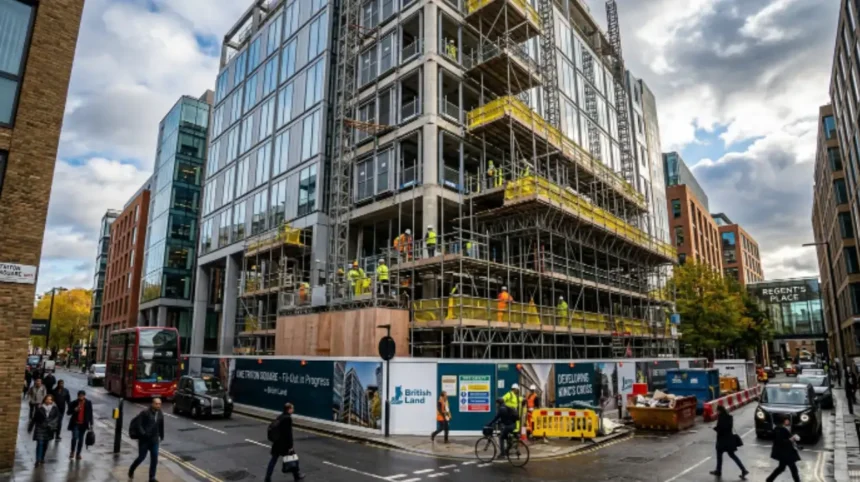
In April, Anthropic singed a 158,000 square foot lease at One Triton Square in King’s Cross, four times its previous London footprint, with a capacity for 800 employees. OpenAI committed to 88.500 square feet nearby. The two companies, between them, opened approximately 1,300 new positions in London, with advertised salaries for senior machine learning engineers reaching £630,00 a year before stock options.
King’s Cross, not canary Wharf, is becoming London’s answer the AI cluster. Google DeepMind, Meta, Wayve, and OpenAI are now within walking distance of each other. The cluster effect is well understood in technology economics: when companies of a certain calibre concentrate geographically, they pull talent, capital and ancillary series toward them with a force that compounds over time.

For East London, this matters in two ways, one obvious and one less so. The obvious one: King’s Cross is close enough to Hackney and Tower Hamlets that some of the economic activity generated by the AI cluster will spill across into adjacent boroughs. Restaurant, retail and transport spend follows dense high-income employment. Some of the 1,300 jobs at Anthropic and OpenAI will be filled by people who live in East London, through the salary ranges suggest the competition will be fierce and the selection criteria narrow.
The less obvious effect is the one that matters more. Anthropic co-founder Christoph Olah, appearing recently alongside Pope Leo XIV, warned that there is a real possibility AI could displace human labour at a scale and pace that existing labour market policy is not equipped to handle. The IFS, in a paper published last month, identified AI adoption as one of three compounding causes of the record NEET rate, as entry-level positions are quietly automated rather than filled. The AI companies now hiring at extraordinary salary levels in King’s Cross are building the technology that is surpassing hiring in the financial services firms of Canary Wharf, two miles to the east, where jobs that might otherwise have gone to 22-year-olds from Newham and Hackney are being replaced by language models.
That is not an argument against AI development. It is an observation about where benefits flow and whew the disruption lands. In East London, that geography is already familiar.
The Capital Markets Effect and What Sophisticated Investors Are Actually Watching
Goldman Sachs estimates the 2026 AI IPO wave could generate £126 billion in proceeds. That is not free money. It is capital that well move from existing investments into new ones. Pension funds and institutional asset managers who buy into SpaceX, Anthropic, and OpenAI will be reducing their allocations to other assets. The question is which assets.
In practice, a portion of that reallocation will come from existing technology holdings, a portion from cash that would otherwise have gone into fixed income, and a portion from the private market funds that have been holding these companies at progressively higher valuations for the last four years. When a private market fund marks its Anthropic position to a public market price, the LPs in that fund, which include UK University endowments, local authority pension schemes, and NHS pension pools, receive a benefit. Some of those LP’s are in East London.
The more acute risk for UK markets is the one CNBC flagged a fortnight ago: analyst warning that a cluster of near-trillion-dollar listings in the second half of 026 could mark a sentiment peak. When the largest deals arrive together in a compressed window, history suggests that institutional investors have already priced in most of the optimism. The subsequent years tend to be harder. The investors who bought Saudi Aramco on its 20289 listing at a £1.5 trillion valuation waited four years before the stock traded over its IPO price.
None of this means the AI companies are overvalued in the way that dot-com stocks were. The revenue is real, the enterprise adoption is genuine, and the compute infrastructure being exiled is physical and permanent. But it does mean the gap between the narrative being sold in a roadshow and the financial reality that arrives in subsequent quarterly files tends to close in ways that are uncomfortable for investors who bought the narrative.
The Question Left Unanswered
Dario Amodei, Anthropic’s chief executive, has said that his company’s mission is the responsible development of AI for the Long-term benefit of humanity. He has written extensively about AI safety and what he calls the transformative potential of the technology. The company’s corporate structure, including its public benefit corporation status, is specifically designed to put that mission above shareholder returns.
Going public does not automatically compromise that structure. But it does change the audience. A company that reports to private investors, who nought it with a long-time horizon and a shared ideological commitment to the mission, operates under different pressures than one whose quarterly financials are reviewed by hedge funds, index trackers and retail investors alike who’s interest in AI safety is, at best, secondary to their interest in earnings per share.
The tension is not unique to Anthropic. Every technology company with a stated mission beyond profit has navigated some version of it on the way to public markets. Google’s 2004 IPO letter from Larry Page and Sergey Brin praised they would sacrifice long-term thinking for short-term gain. Their advertising business subsequently became on the most effective extraction mechanism ever pointed at human attention.
The three IPOs of autumn 2026 are not just financial events. They are the moment at which the most consequential technology since the internet stops being accountable to mission-aligned private capital and starts being accountable to global market, the market has its own ideas about what AI should become.