Key Points
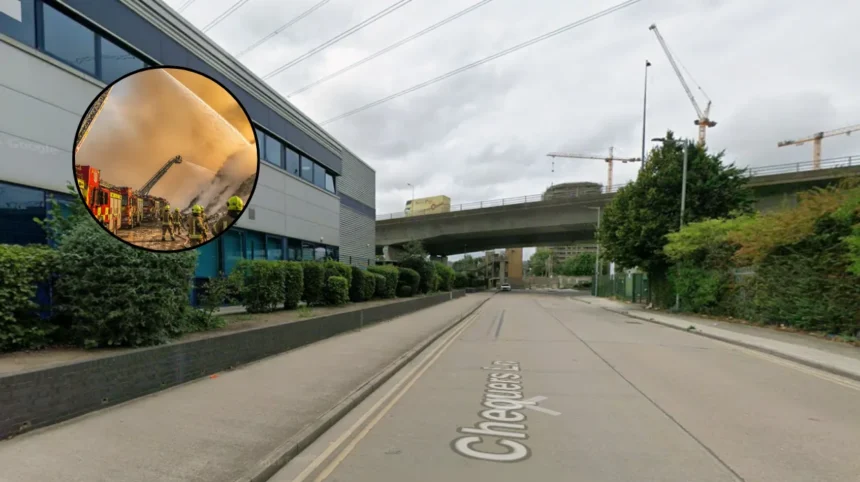
- Around 100 firefighters and 15 fire engines responded to a massive fire at a waste facility on Chequers Lane in Dagenham.
- The London Fire Brigade was alerted to the incident in the early hours of Sunday morning.
- Local residents in Dagenham and the surrounding east London area were strongly advised to keep all windows and doors closed due to heavy smoke emissions.
- Operational crews utilized specialized equipment, including high-reach aerial appliances, to contain the flames.
- No casualties or injuries have been immediately reported from the scene.
- The exact cause of the outbreak remains under formal investigation by fire authorities and local enforcement.
Dagenham (East London Times) August 11, 2026 — A major industrial fire broke out in the early hours of Sunday morning at a commercial waste recycling facility on Chequers Lane in Dagenham, prompting a massive emergency response from the London Fire Brigade. Approximately 100 firefighters and 15 fire appliances were dispatched to the east London site to extinguish the fast-moving blaze. Emergency services issued an urgent advisory to surrounding communities and residents, urging everyone in the vicinity to keep their doors and windows tightly shut to protect against thick, toxic smoke plumes drifting across the region.
- Key Points
- What Happened During the Early Morning Fire on Chequers Lane?
- How Did the London Fire Brigade Manage the Dagenham Incident?
- What Health and Safety Warnings Were Issued to East London Residents?
- Has the Cause of the Dagenham Waste Facility Fire Been Identified?
- What is the Background to Industrial and Waste Fires in East London?
- What is the Future Prediction and Impact of This Incident on the Local Community?
What Happened During the Early Morning Fire on Chequers Lane?
Emergency control officers first received calls reporting a significant fire at the Chequers Lane industrial zone shortly after midnight. The location, which houses heavy industrial units and waste processing yards along the River Thames corridor, presented significant challenges for initial responders due to the high volume of combustible materials stored on-site.
Units from multiple surrounding fire stations—including Dagenham, Barking, Ilford, and Harold Hill—were mobilized to reinforce the response. On arrival, crews discovered a substantial quantity of recycled waste and processing machinery engulfed in intense flames, producing dark clouds of smoke visible across several parts of outer east London.
How Did the London Fire Brigade Manage the Dagenham Incident?
To bring the incident under control, fire commanders deployed specialized tactics designed for high-density industrial blazes. Responders utilized 32-millimeter jet streams alongside high-reach aerial ladders, enabling firefighters to pour water onto the heart of the inferno from above.
A spokesperson for the London Fire Brigade confirmed that tactical operational units worked systematically to establish perimeter control, preventing the flames from spreading to adjacent industrial properties and nearby infrastructure. Water supplies were drafted directly from nearby hydrants and localized water sources to ensure continuous pumping operations throughout the morning.
What Health and Safety Warnings Were Issued to East London Residents?
Due to the heavy concentrations of smoke generated by the burning waste materials, public health authorities and emergency teams issued immediate precautionary guidance for the surrounding populace. Residents across Dagenham, Rainham, and nearby residential zones were instructed to remain indoors where possible and to secure all windows and doors to prevent smoke inhalation.
Drivers traveling along main transit arteries near the industrial area, including the A13 trunk road, were advised to exercise extreme caution due to reduced visibility caused by lingering smoke haze drifting across the carriageways.
Has the Cause of the Dagenham Waste Facility Fire Been Identified?
At present, official authorities have not confirmed what triggered the initial ignition within the waste complex. Fire investigation officers from the London Fire Brigade, working alongside local law enforcement partners, are set to conduct a comprehensive examination of the site once the area is fully cooled and declared structurally safe.
Preliminary assessments have yielded no reports of injuries among site staff, emergency personnel, or members of the public. Search and rescue protocols were conducted during the initial operational phase to verify that the facility was clear of personnel at the time of the outbreak.
Explore More Dagenham News
Firefighters Tackle Major Waste Facility Blaze on Chequers Lane, Dagenham 2026
Mecca Bingo Dagenham Drops 24-Hour Bid Amid Policy Shift — Dagenham 2026
What is the Background to Industrial and Waste Fires in East London?
The industrial corridors of east London, particularly along Chequers Lane in Dagenham and the broader Thames Estuary zone, house a high concentration of waste management, recycling, and scrap processing facilities. Over recent years, waste management sites across Greater London have been subject to heightened scrutiny regarding fire prevention and safety protocols.
Fires at recycling plants present unique operational hazards for emergency service providers. Materials such as compressed plastics, paper, lithium-ion batteries, and organic refuse can ignite through self-heating mechanisms, electrical faults, or the improper disposal of hazardous items. Once established, waste fires tend to burn at exceptionally high temperatures and can smoulder deep within compacted piles for extended periods, requiring prolonged damping-down operations to eliminate deep-seated hotspots.
As a result of past high-profile industrial incidents in the capital, the London Fire Brigade and the Environment Agency have jointly established rigorous site-monitoring practices. These regulations mandate clear access routes for emergency vehicles, strict pile-height limitations for stored materials, and mandatory fire-break distances to minimize the risk of rapid fire propagation across industrial complexes.
What is the Future Prediction and Impact of This Incident on the Local Community?
The occurrence of this major blaze is expected to have notable short-term and medium-term impacts on local residents, businesses, and regulatory bodies within the London Borough of Barking and Dagenham.
Impact on Local Residents and Public Health
In the immediate aftermath, residents downwind of Chequers Lane may continue to experience degraded air quality. Environmental health officers are likely to monitor ambient air particulate levels over the coming days. Individuals with pre-existing respiratory conditions, such as asthma or chronic obstructive pulmonary disease (COPD), may be advised to limit prolonged outdoor physical activity until smoke particulates fully dissipate.
Impact on Industrial Operations and Waste Infrastructure
The destruction of processing infrastructure at the Chequers Lane facility will likely lead to localized disruptions in commercial waste collection and processing routes across east London. Neighboring businesses may face operational delays due to temporary road closures, utility isolation, and site-clearing operations required by safety inspectors.
Regulatory Scrutiny and Environmental Policy
Following the conclusion of the formal investigation, local authority leaders and environmental safety regulators are expected to review the site’s operational compliance. This incident could prompt renewed calls from community leaders for stricter enforcement of fire safety standards, more frequent inspections of waste storage facilities, and potential policy updates regarding the proximity of heavy recycling operations to residential boundaries and ecological zones along the Thames.