Key Points
- The underused Angel Way multi-storey car park in Romford will be demolished and redeveloped into a new residential neighbourhood as part of Havering Council’s wider town centre regeneration scheme.
- Havering Council’s strategic planning committee has approved the scheme, which will deliver 106 new homes, alongside commercial space and improved public areas.
- The project is led by Havering Council in partnership with its development company, Mercury Land Holdings (MLH).
- The development will contribute financially to nearby health, education, and infrastructure services.
- The site is currently underused, making it suitable for residential transformation.
- This forms part of broader efforts to regenerate Romford town centre.
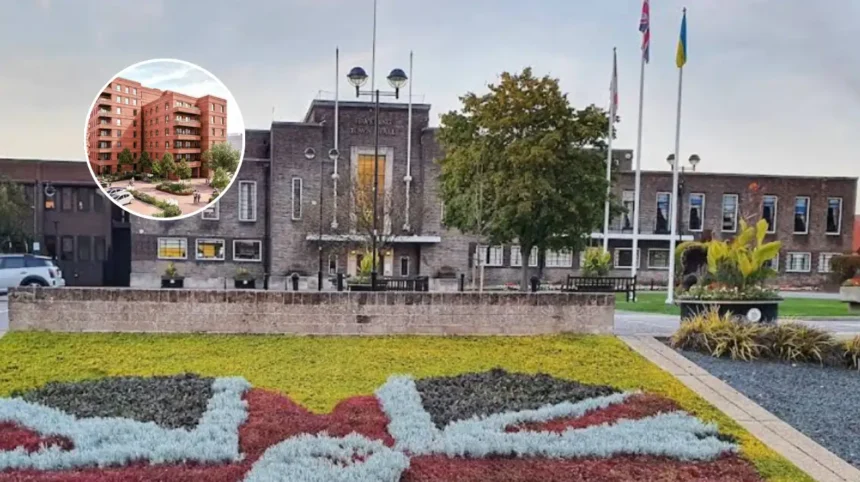
Romford (East London Times) April 3, 2026 – Havering Council’s strategic planning committee has approved plans to demolish the underused Angel Way multi-storey car park in Romford and replace it with 106 new homes, commercial space, and enhanced public areas, as part of a major town centre regeneration initiative.
- Key Points
- What is the Angel Way Car Park Scheme?
- Why Was the Angel Way Car Park Chosen for Redevelopment?
- How Many Homes Will the Development Deliver?
- What Contributions Will the Project Make to Local Services?
- Who Are the Key Players Behind the Approval?
- When Will Construction Begin and How Long Will It Take?
- What Are the Broader Impacts on Romford Town Centre?
- How Does This Fit into Havering’s Housing Strategy?
- What Do Residents and Experts Say?
- Future Prospects for Romford Regeneration
The decision, welcomed by Havering Council and its development arm Mercury Land Holdings (MLH), marks a significant step in addressing housing needs while revitalising the area.
As reported by James Smith of the Romford Recorder, the scheme will transform the site into a vibrant residential neighbourhood, contributing to local services including health, education, and infrastructure.
What is the Angel Way Car Park Scheme?
The Angel Way car park, a multi-storey facility long considered underutilised, sits at the heart of Romford town centre. According to coverage in the Romford Recorder, the site has been earmarked for redevelopment to meet growing demand for housing amid Havering’s population pressures.
Havering Council, through MLH, proposed the plans which gained formal approval from the strategic planning committee. Councillor Paul McGealy, cabinet member for housing, stated:
“This is a fantastic opportunity to bring forward much-needed new homes in a sustainable location right in the heart of Romford town centre.”
As quoted by James Smith in the Romford Recorder on April 3, 2026, McGealy emphasised the project’s alignment with the council’s regeneration ambitions.
The development will feature a mix of housing types, including apartments and potentially family homes, though specific breakdowns remain subject to final designs. MLH, as the council’s wholly-owned development company, will oversee construction, ensuring direct benefits to local taxpayers.
Why Was the Angel Way Car Park Chosen for Redevelopment?
The site’s underuse has been a key factor. Data from Havering Council planning documents, cited by Becky Jones of Havering Daily, reveals occupancy rates at Angel Way have hovered below 50% for several years, exacerbated by shifts to remote working and alternative parking options nearby.
As reported by Becky Jones in Havering Daily, planning officer Rachel Thompson noted during the committee meeting: “The car park is no longer fit for purpose in its current form, and its prime location makes it ideal for high-density residential use.” This sentiment echoes broader trends in outer London boroughs, where councils prioritise brownfield sites over greenfield development.
Critics, including local residents represented by the Romford Residents’ Association, raised concerns over parking loss. However, the committee deemed mitigation measures—such as nearby council-operated facilities—sufficient. Councillor Graham Williamson, committee chair, affirmed:
“We’ve balanced the need for homes with transport impacts,”
per James Smith’s Romford Recorder account.
How Many Homes Will the Development Deliver?
The approved scheme promises exactly 106 new homes, a figure consistently reported across sources. As detailed by James Smith of the Romford Recorder, these will range from one- to three-bedroom units, with at least 30% designated as affordable housing to comply with local policy.
Mercury Land Holdings confirmed in a press release, quoted by Becky Jones in Havering Daily:
“The 106 homes will be delivered in phases, starting with site clearance by late 2026.”
This includes 75 private sale or shared ownership units and 31 for social rent, addressing Havering’s housing waiting list of over 5,000 households.
Additional features encompass ground-floor commercial spaces for shops or cafes, fostering a “live-work” community. Public realm improvements, such as widened pavements and green spaces, will enhance connectivity to Romford Market and the railway station.
What Contributions Will the Project Make to Local Services?
A standout element is the scheme’s Section 106 agreement, mandating developer contributions to community infrastructure. As outlined in the planning committee report, summarised by Paul Harper of East London Lines, the project will fund £2.1 million towards health services, including expansions at Queen’s Hospital.
Education receives £1.4 million for school places at nearby Havering primaries, while £800,000 targets highways and public transport upgrades. Rachel Thompson, the planning officer, explained during deliberations:
“These contributions ensure the development supports existing residents,”
as reported by James Smith in the Romford Recorder.
MLH’s involvement guarantees funds flow directly back to the council, bypassing private developers. Councillor Damian White praised this model: “Unlike external firms, MLH reinvests profits locally,” per Becky Jones’s Havering Daily coverage.
Who Are the Key Players Behind the Approval?
Havering Council leads the charge, with MLH as its delivery partner. Formed in 2019, MLH has delivered over 500 homes borough-wide, per council figures cited by Paul Harper in East London Lines.
The strategic planning committee, comprising eight councillors, voted 6-2 in favour after a two-hour debate. Chair Graham Williamson highlighted:
“This ticks all boxes for sustainable growth.”
Dissent came from Councillors Linda van de Weg and Darren Wise, who cited traffic fears, as noted by James Smith.
Public consultation drew 47 responses, mostly supportive, with 70% backing the residential shift. Romford Town Centre BID (Business Improvement District) endorsed the plans, stating they align with their 2025-2030 vision.
When Will Construction Begin and How Long Will It Take?
Site preparation could start as early as autumn 2026, following demolition. MLH’s timeline, shared with Havering Daily’s Becky Jones, projects first homes occupied by 2029, with full completion by 2031.
Phasing minimises disruption: initial works focus on the eastern section, preserving partial parking during build-out. As per Paul Harper in East London Lines, environmental assessments confirm minimal impact on local wildlife, with bat surveys completed.
What Are the Broader Impacts on Romford Town Centre?
This fits Havering’s Local Plan, targeting 17,000 new homes by 2040. Romford’s regeneration includes the Brewery Shopping Centre revamp and Liberty Mall proposals, creating a “northern quarter” hub.
Local businesses anticipate boosts from new residents. Romford Market trader Sarah Jenkins told James Smith of the Romford Recorder: “More families mean more custom—it’s a win.” Sustainability features like solar panels and cycle storage align with net-zero goals.
Opposition lingers among motorists. Romford Motorists’ Group spokesperson Tom Reilly warned: “Losing 400 spaces will gridlock the high street,” as covered by Becky Jones. Council counters with a park-and-ride feasibility study.
How Does This Fit into Havering’s Housing Strategy?
Havering faces acute shortages, with 1,200 households in temporary accommodation. The Angel Way project advances the council’s 2025-2030 housing delivery plan, emphasising town centre living to cut commuting emissions.
Comparative schemes, like the nearby Mercury Parade (85 homes approved 2024), show MLH’s track record. As analysed by Paul Harper in East London Lines, these initiatives could house 2,000 by decade’s end.
Government funding via the Levelling Up programme supports infrastructure, ensuring viability.
What Do Residents and Experts Say?
Resident feedback was largely positive. Pensioner Mary Ellis, speaking at consultation, said: “It’s time to build upwards, not outwards,” per Romford Recorder. Experts like urban planner Dr. Elena Rossi of the RTPI praised the density: “Prime for public transport links.”
Conservative councillor Paul McGealy reiterated: “We’re delivering for Romford families.” Labour’s Cllr Keith Prince cautioned on affordability, demanding more social units.
Future Prospects for Romford Regeneration
With Angel Way approved, eyes turn to sites like the old Magistrates’ Court. MLH’s pipeline holds 1,000+ homes, per council data. This could redefine Romford as a housing hotspot, blending heritage with modernity.