Key Points
- A severe grass fire broke out at Hornchurch Country Park on Friday afternoon, prompting a major emergency response.
- The London Fire Brigade (LFB) deployed 14 fire engines and approximately 90 firefighters to combat the blaze.
- Fire crews dealt with multiple seats of fire across dry grassland and scrubland.
- Emergency services received 20 distinct 999 calls, with the first report logged at 3:16 pm.
- The fire was successfully brought under control by 5:31 pm, though crews remained on site into the evening for dampening-down operations.
- Nearby residents were advised to keep windows and doors closed due to heavy plumes of smoke affecting visibility across the surrounding district.
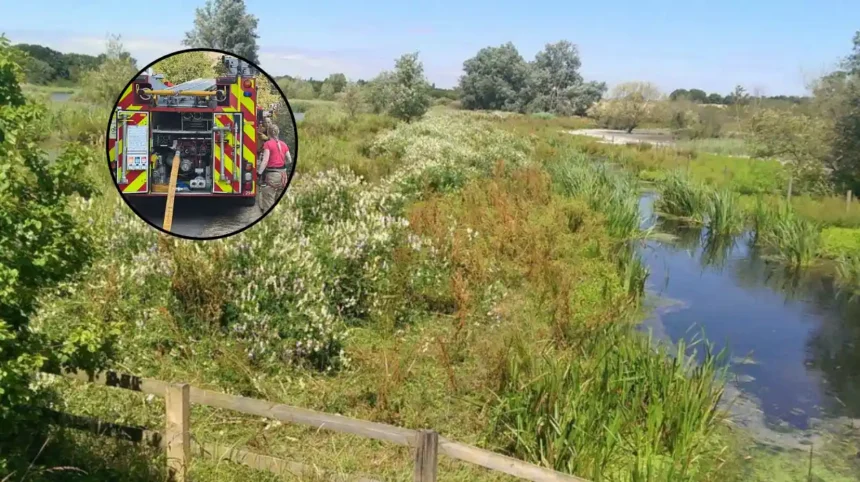
Hornchurch (East London Times) August 17, 2026 – A major wildfire tore through Hornchurch Country Park on Friday afternoon, triggering a massive response from emergency services as dense plumes of smoke billowed across east London. The London Fire Brigade dispatched 14 fire engines and around 90 firefighters to tackle the fast-moving grass fire. As reported by Tom Place of The Standard, the fire brigade confirmed that crews were deployed from fire stations in Romford, Ilford, Hornchurch, and surrounding areas to bring the incident under control.
The London Fire Brigade’s control room received 20 emergency 999 calls regarding the outbreak, with the initial call logged at 3:16 pm. Upon arrival, fire crews discovered multiple active seats of fire burning across dry grassland and vegetation, requiring extensive tactical operations to prevent the flames from spreading towards nearby residential properties and infrastructure.
How Did Emergency Crews Manage The Fireplace And Smoke Hazards?
Due to the volume of thick smoke generated by the burning grass and brushwood, operational commanders issued precautionary guidance to members of the public living downwind of the site. Residents in the Havering area were advised to keep their windows and doors closed to mitigate the risks of smoke inhalation.
As detailed by Samuel Turner of the Romford Recorder, firefighters worked under demanding conditions to surround the various seats of fire, utilizing specialized equipment to extinguish individual blazes scattered across the parkland. After more than two hours of sustained tactical efforts, the London Fire Brigade confirmed that the main fire was brought under control at 5:31 pm. Firefighters remained on scene throughout the evening to perform systematic dampening-down duties, dousing smouldering ground to prevent potential re-ignition.
Aerial imagery captured following the incident revealed extensive damage, showing wide swathes of blackened terrain interspersed between pedestrian pathways and tree lines across the park grounds.
Background Of The Particular Development
Hornchurch Country Park, situated on the site of the former RAF Hornchurch airfield, comprises over 100 hectares of open green space, marshland, and woodland in east London. Over recent summer seasons, prolonged dry weather and heatwaves have significantly elevated the wildfire risk profile across London’s green belt.
The incident follows widespread warnings issued by civil authorities regarding parched land across the capital’s public parks. As highlighted by Tom Place of The Standard, London Mayor Sir Sadiq Khan previously urged residents to take protective precautions around gardens and local green spaces, while the London Fire Brigade has repeatedly highlighted the danger posed by dry vegetation during dry periods, where fires can rapidly expand from single ignition points into widespread incidents.
Prediction: How This Development Can Affect Local Residents And Park Visitors
This major wildfire is anticipated to lead to immediate and medium-term impacts for several groups across the local community:
- Local Residents: Families living adjacent to Hornchurch Country Park face short-term issues regarding air quality due to residual smoke and ash residue. In response to recurring incident risks, residential property owners near park boundaries may face heightened scrutiny regarding garden management, vegetation clearings, and insurance assessments tied to wildland-urban interface hazards.
- Park Visitors and Recreational Users: Members of the public who utilize the park for walking, cycling, and leisure will experience restricted access to damaged sectors of the parkland while local authorities conduct site safety assessments and habitat restoration.
- Local Environmental and Wildlife Conservationists: The destruction of grassland and scrubland impacts local biodiversity within the Ingrebourne Valley. Environmental conservation teams will need to evaluate the loss of natural habitats, ground-nesting birds, and insect populations, likely prompting calls for enhanced park management strategies, dedicated firebreaks, and increased emergency infrastructure across Havering’s public spaces.