
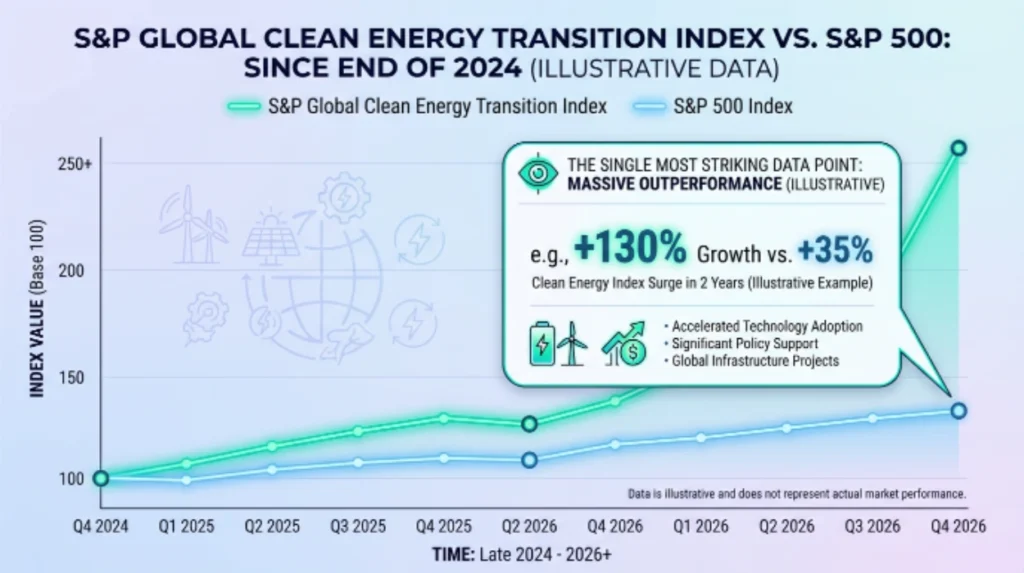
The green economy has crossed the $10 trillion mark in market value. A clean energy index has more than doubled the S&P 500 since the end of 2024. Environmental products and services now generate $5.5 trillion in annual revenue. This was supposed to be the sector the world had forgotten, the one investors had grown bored of. Instead, it is becoming a cash cow, and the reasons have surprisingly little to do with idealism.
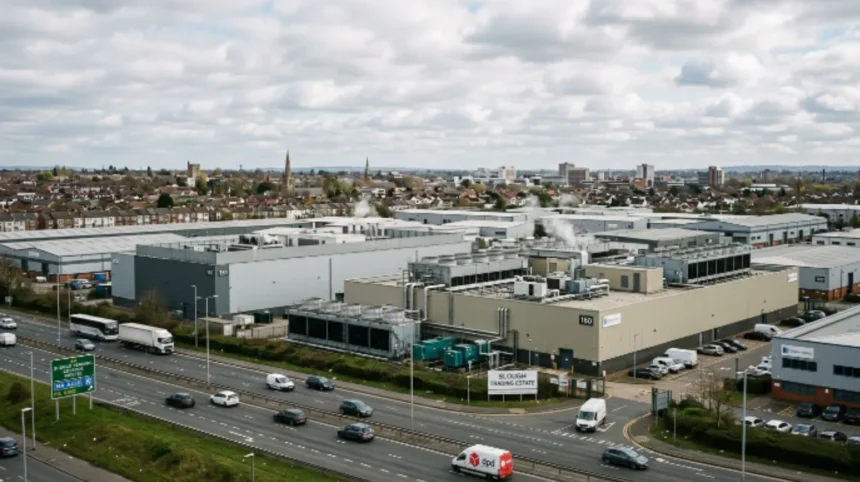
I grew up in Slough. Not the Slough of the Office jokes, the other one, which happens to be the largest data centre hub in Europe. You drive past the Trading estate on the A4, and you see warehouses, fencing, the odd fume of vapour off a cooling unit. It looks like nothing. It is around a gigawatt of compute, more than thirty operational facilities, and a town that quietly rebuilt its economy around electricity while almost nobody was watching.
That is where my interest in this began, because the green economy as it is reported, solar panels and EVs, never quite matched the thing I could see from home. The data centres that consume the most power actually sit inside the same green capital markets that fund the wind farms. And there is a genuine moral knot in which I have not fully untied and will come back to. AI is useful. It is also, by the figures I trust, melting through electricity, and some of that electricity is keeping fossil generation alive longer than it needed to be. I believe that holding both of those thoughts at once is the honest starting point. The industry would prefer if you held only the first.
What Actually Is the “Green” Economy?
It is worth defining it before talking about valuing it, because the phrase is used loosely. The green economy is not a sector in the way that, banking is a sector. It is a cross-cutting category: every company, in any industry, that derives a meaningful share of its revenue from products and services with an environmental benefit. Renewable generation, obviously. But also, clean water, energy-efficient buildings, recycling, grid hardware, electric vehicles, loft insulation. LSEG and FTSE Russell have spent almost two decades building a taxonomy, the Green Revenues Classification System that scores companies exactly on this, across climate mitigation, adaptation, water, resource use, pollution and agricultural efficiency.
The reason this definition is so important is that it determines the size, and the size is the story. Measured this way, the green economy passed $10 trillion in market capitalisation for the first time in 2026. To put that into perspective, it is now roughly the eighth largest equity grouping in the world if you treat it as a single market, larger than the entire listed market of any European country. Environmental products and services generated $5.5 trillion in revenue last year, growing at its fastest pace since 2022. This is not a niche with good PR. It is a structural slab of the global economy that happens to have been filed under a virtuous-sounding name.
The Performance Nobody Forecasted
Now onto the returns, because they are genuinely startling. The S&P Global Clean Energy Transition Index has climbed by more than 80 percent since the end of 2024, more than double the S&P 500 over the same period, and then some. Sit with that for a second. Clean energy was, for the majority of 2023 and 2024, the trade everyone had given up on: it was rate-sensitive, subsidy-dependent, politically unfashionable in the middle of a green backlash, down heavily from its 2021 peak. The sort of thing fund managers quietly sold and hoped nobody asked about at the AGM.
LSEG’s own numbers tell the longer version. Green equities outperformed the broader market by 12.4 percent over the year to April 2026. The FTSE Environmental Opportunities All Share has produced 59 percent of cumulative out performance against the global benchmark since 2008. Green revenues grew 5.3 percent in 2025. These are not the figures of a fad. They are rather the figures of an asset class that has been compounding for seventeen years and that the market spent most of the last three pricing as if it were coming to an end.
Why The Money Moved, And It Is Not Conscience
Here is the argument I find most persuasive, and it reframes the whole thing. This is not, at its core, a climate trade. It is an energy security trade wearing green clothing.
The fuel disruptions that came out of the US-Iran conflict this year were the tell. What mattered was not the spike in oil prices, which faded. What mattered was the reminder of the dependency itself. Oil has to move. It crosses borders, threads through choke points, sits on tankers somebody else can delay or redirect. An electron carries no such passport. It can be made from gas, coal, solar, wind or uranium, and the moment it is on the grid, nothing downstream knows or cares about where it came from. A combustion engine is married to one fuel, often a fuel that has to pass through someone else’s strait. Electrify, and you swap a single point of failure for a menu.
China understood this far earlier and more completely than anyone, and it is the case study Western commentary tends to skip past. It electrified vast stretches of its economy, transport, industry, heating, with the result that an oil shock somewhere else in the world now barely registers in its growth figures. Energy independence, it turns out, is not a slogan you put on a banner. It is a balance-sheet advantage. Governments across Europe, scarred first by the 2022 gas crisis caused by the Russia-Ukraine war and now by this year’s disruptions, have reached the same conclusion. Control over your own energy mix has been quietly reclassified from environmental nicety to a strategic asset. That reclassification, not any sudden urge of planetary feeling, is what has pulled the capital in.
Climate Finance Grows Up
Underneath the equity story sits the plumbing, and the plumbing is climate finance: the bonds and structured instruments that actually move money into the transition. It has matured much faster than most people realise. The green bond market hit a record $572 billion of annual issuance in 2024, up a tenth on the year before, and by the third quarter of 2025 the total outstanding stock of green bonds passed $3 trillion for the first time. The London Stock Exchange’s Sustainable Bond Market, the first dedicated venue of its kind when it launched its green segment in 2015, now carries hundreds of active bonds raising well over $250 billion.
What has changed is not just the volume but the seriousness. LSEG’s 2025 asset owner survey found that 80% of large institutional owners now factor sustainability or climate into strategic asset allocation, up from 28 percent in 2021. That is not a marketing shift. That is the people who run pension and sovereign money rewiring how they allocate, and it is the single most important number in this entire piece, because it is the demand engine underneath everything else. Sustainable debt now reaches into a roughly $100 trillion pool of patient institutional fixed income capital. The instrument that was a curiosity a decade ago has become a default consideration.
However, there is a contradiction worth naming inside this maturity. The more standardised and enormous green finance becomes, the more its definitions get gamed at the edges. A green bond requires its proceeds to fund environmentally beneficial projects, and the Green Economy Mark requires listed issuers to show 50 percent or more of revenues originating from green activity, 90 percent for the bond market’s stricter tier. Reasonable thresholds. But thresholds invite arbitrage, and the most interesting arbitrage right now sits in digital infrastructure, which brings the argument back to the warehouses I grew up beside.
The Data Centre Knot
A data centre operator can today issue a credible green bond by procuring renewable power. Slough’s cluster does exactly this: roughly 95 percent of its electricity demand is now backed by 100% renewable procurement contracts. Clean on paper. The label is not a lie. Rather it is incomplete, and the incompleteness is the problem.
Because procurement does not change the underlying fact that AI compute is one of the fastest growing sources of new electricity demand on the planet, and that this demand is now physically colliding with everything else that needs the grid. In parts of West London, completed housing developments have been warned they may not receive a full grid connection until as late as 2037, because data centres queued ahead of them for capacity. That doesn’t seem “green” to me. Read that again. A family in Hillingdon, waiting potentially twelve years for power, because a compute cluster booked the connection first. That is not a thought experiment. It is the actual allocation that the market produced.
So, the green label on data centre bonds tells you the electrons are clean. It tells you nothing about whether the demand those electrons serve is crowding out something society also needed. The Green Revenues taxonomy is good, genuinely good at scoring environmental benefit at the level of one asset. It was never designed to adjudicate a fight between AI infrastructure and housing for the same substation, and at the moment nobody else is adjudicating it either. This is the knot I promised I had not untied. I still have not. At the moment it seems that pretending it does not exist is the one indefensible position. Will these loopholes be closed? Only time will tell.
The Hot Names to Watch
For anyone keeping a watchlist, the rally has clear leaders, and they fall into tidy buckets that tell you something about how to price them. Worth being concrete.
The regulated utilities sit at the safe end. NextEra Energy (ticker: NEE), the largest clean-energy company in the world, runs around 76 gigawatts of renewable capacity alongside Florida Power and Light (NextEra subsidiary), and trades on a price to earnings ratio of roughly 22, against its own ten-year average closer to 30. You value a business like this the way you value any regulated utility: on earnings visibility and dividend durability, with a discounted-cash-flow model that leans on its 9 percent forecast revenue growth and a near three-decade record of dividend increases. The market is paying a premium for the AI data-centre demand story, which is now baked into its load growth, which is precisely the risk: a chunk of the valuation rests on power demand from the very compute build-out this article keeps circling.
Then the contracted asset owners, Brookfield Renewable (ticker: BEP), Clearway Energy (ticker CWEN), where the right lens is not P/E at all but rather the long duration cash flows from power-purchase agreements, valued closer to a bond with growth optionality. Then on to the equipment and technology makers, First Solar (ticker: FSLR), Vestas (ticker: VWS), Enphase (ticker: ENPH), GE Veronova (ticker: GEV), where execution and cost control dominate and you are really valuing a manufacturer: enterprise value against EBITDA, margin trajectory, order book. First Solar expects to end 2026 with between $1.7 billion to $2.3 billion of net cash, which in a sector famous for capital hungry balance sheets is its own kind of moat. And the carbon-free producers straddling clean power and AI demand, Constellation Energy (ticker: CEG) and Vistra (ticker: VST) most obviously, which the market has re-rated hard precisely because they sit at the intersection of two growth stories rather than one.
The honest valuation point cuts across all of them. A sector up more than 80 percent in eighteen months is not undiscovered. The easy re-rating, the part where the market simply stops pricing in policy and rate risk, has largely occurred. What remains now is the harder question: which of these companies can grow earnings into the multiple they have been handed? And which of them are riding a beta trade that mean-reverts the first time a rate cut underwhelms? The discipline that matters from here is not enthusiasm. It is separating the durable cash flow stories from the momentum.
How Is the Market Behaving?
The behavioural signal sits in M&A activity, not share prices, because acquisitions tell us what informed buyers will pay privately, away from the index-fund tide that lifts everything indiscriminately. Green M&A now accounts for 13 percent of total global deal value, a figure the LSEG only began tracking rigorously this year because it had grown far too large to ignore. That is private equity and strategic acquirers deciding, with their own capital and diligence, to consolidate green-revenue businesses now rather than waiting for cheap entry points that they evidently no longer expect to arrive.
Underneath all that, the asset-owner shift from 28 to 80 percent in four years is the slow, yet structural force. Momentum money chases the 80 percent return; the pension and sovereign allocators are doing something steadier and more consequential, embedding green exposure as a permanent line in the strategic allocation rather than a tactical punt. When those two flows point in the same way, the trend tends to outlast the people calling it a “bubble”.
Slough, And the East London Decision
Back to the A4 then, because Slough compresses the whole argument into one town. A data centre cluster that replaced declining manufacturing employment on close to a one-for-one basis, generated around 8,000 construction jobs between 2010 and 2025, and now supports roughly 14,000 jobs across direct, indirect and induced activity while contributing more than £30 million a year in local business rates. A real regional success. Also, a place whose entire electricity demand profile was rewritten by an industry most of its residents could not name if you stopped them on the high street.
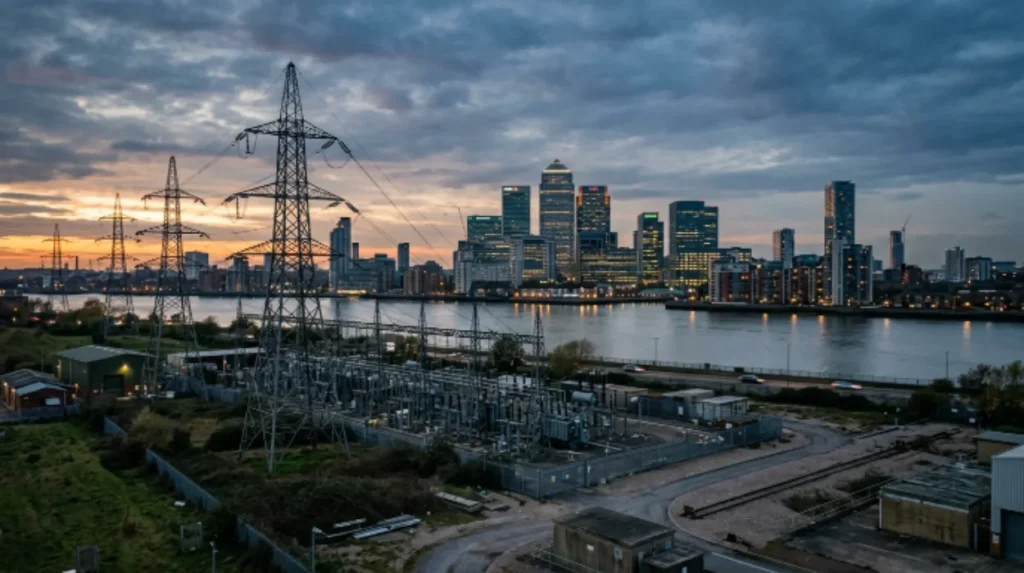
East London is now at the edge of the same decision. The data centre frontier is pushing into the Docklands and Essex; Ada Infrastructure alone has approval for three 70-megawatt sites in the east of the city. There is no good-news Slough-style story written for East London yet, which is exactly why the framing matters now more than ever. The questions are the ones Slough answered, half by design and half by accident: how is the green capital flowing into this infrastructure structured? Who captures the rents? And who absorbs the power-cost premium that the UK’s highest-in-Europe commercial electricity prices push onto everyone sharing the grid. Slough had fourteen years and a council that planned ahead. East London is getting a faster, more compressed version of the same choice, with far less room to get it wrong.
What Happens Next
Three predictions, held at different strengths. First, with reasonable confidence: the green economy’s security case is now bipartisan in a way the climate case was never managed to be. You do not have to believe in net zero to want fewer choke points, and that broader coalition is more durable than the one built on virtue alone.
Second, less certainly: the friction between clean energy and the AI infrastructure competing with it for grid capacity becomes a fault line inside green portfolios themselves, not just between green finance and its critics. A fund holding both a solar developer and a data centre REIT is, in a quiet and real way, long both sides of the same grid capacity fight. At some point an allocator notices and has to choose.
Third, and this is the one I would bet on least but watch most closely: expect the first serious regulatory move within roughly eighteen months to force data centre operators to disclose grid displacement impact alongside their renewable procurement claims. The Hillingdon housing delay is precisely the kind of human story that turns an obscure grid-connection argument into a political one, and political arguments are what move disclosure rules.
The green economy has stopped needing anyone’s permission to be taken seriously as a financial story. It crossed $10 trillion, it is beating the index that defines the bull market, and the smartest long-term money is treating it as permanent infrastructure rather than a thematic bet. What it has not yet worked out is how to be honest, inside its own rules, about the fact that some of its demand it now finances pulls directly against the climate case it was built to make. That reckoning is coming. My guess is it arrives the way most real financial reckonings do not in a grand public argument, but quietly, at the margin, decided by people who would much rather not have had it in the open at all.