Hidden among the busy streets of Mile End lies one of East London‘s most remarkable historical landmarks. More than just a cemetery, Tower Hamlets Cemetery Park serves as a living memorial to generations of East End families whose stories helped shape modern London. Today, the site offers a unique blend of history, remembrance, nature conservation and community heritage.
Originally opened in 1841 as the City of London and Tower Hamlets Cemetery, the site was created to address a growing public health crisis caused by overcrowded church graveyards across Victorian London. As the city’s population expanded rapidly during the Industrial Revolution, traditional burial grounds struggled to cope with demand, leading Parliament to approve the creation of large purpose-built cemeteries around the capital. Tower Hamlets Cemetery became one of London’s famous “Magnificent Seven” cemeteries.
Over the next 125 years, more than 350,000 East Londoners were buried there, making it one of the busiest burial grounds in Britain. The cemetery became the final resting place for dock workers, factory labourers, merchants, philanthropists, political activists, war victims and ordinary families who formed the backbone of East London’s communities.
Unlike some of London’s more famous cemeteries known for national celebrities, Tower Hamlets Cemetery Park tells the story of local people. Its memorials reveal the lives of those who contributed to the growth of the East End through industry, social reform and community service. Among those remembered are pioneering educator Clara Grant, philanthropist Dr Thomas Barnardo’s children and the children cared for by his orphanages, labour leader and MP Will Crooks, and numerous victims of wartime tragedies.
The cemetery also preserves memories of some of East London’s most difficult moments. Memorials honour civilians killed during the Blitz and victims connected to the Bethnal Green Tube disaster of 1943, one of the worst civilian tragedies of the Second World War. These monuments ensure that future generations can learn about the sacrifices and resilience of local communities during times of crisis.
Following decades of use, burials officially ceased in 1966. Rather than being lost to redevelopment, the site was transformed into a public park and later became one of London’s most important urban nature reserves. Ownership eventually passed to Tower Hamlets Council, while volunteers and community groups played a vital role in preserving its heritage.
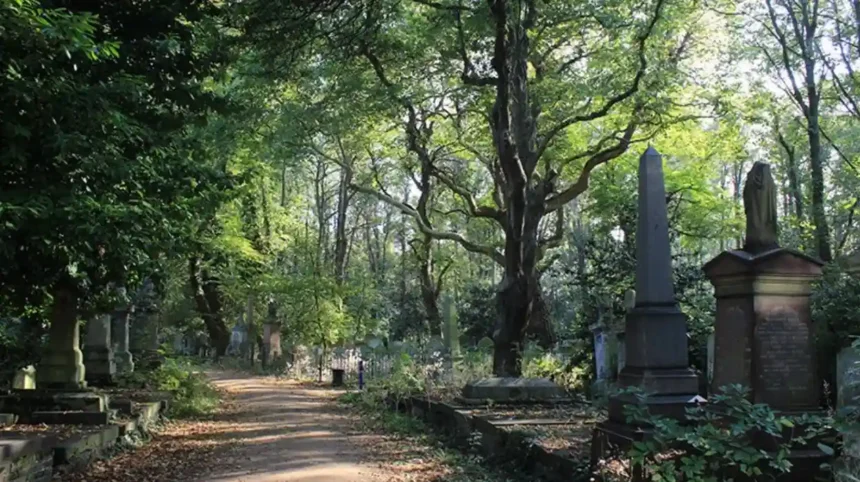
Today, Tower Hamlets Cemetery Park covers more than 30 acres of woodland, wildflower meadows and historic pathways. It is recognised as both a Local Nature Reserve and a Site of Metropolitan Importance for Nature Conservation. Visitors can explore thousands of surviving gravestones while enjoying one of the most significant stretches of semi-wild woodland in inner London.
The park’s continued success is largely thanks to the work of the Friends of Tower Hamlets Cemetery Park, a volunteer-led organisation dedicated to protecting its historical and environmental value. Through guided walks, educational programmes, conservation projects and grave research initiatives, the group helps ensure the stories of East London’s past remain accessible to future generations.
More than a cemetery, Tower Hamlets Cemetery Park stands as a powerful memorial to 125 years of East London life. It reflects the struggles, achievements and resilience of countless families whose lives shaped the borough, making it one of the most important heritage sites in the East End today.