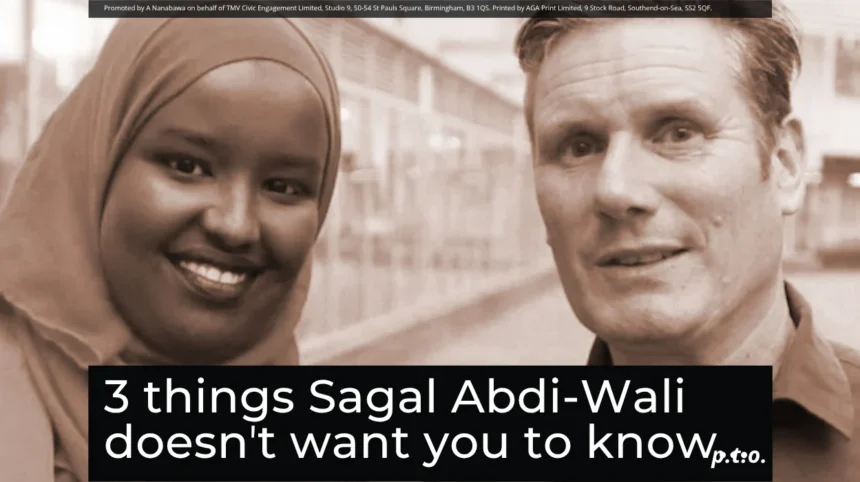
A political leaflet circulating in Holborn and St Pancras has put Sagal Abdi-Wali’s record on Palestine, her political alliances and her role in Camden Labour firmly under the spotlight.
The leaflet was seen across the constituency as a key by election is the expected on 8th of October. The leaflet titled “
3 things Sagal Abdi-Wali doesn’t want you to know…”
But beneath the campaigning language are three issues that raise uncomfortable questions about the Labour candidate’s political record.
The Izzy Lenga connection
One of the leaflet’s central targets is Camden councillor Izzy Lenga, whom it describes as having been trained with the Israel Defense Forces.
The leaflet argues that Abdi-Wali’s support for Lenga as Chief Whip is significant, particularly given the controversy surrounding Israel’s military actions and the strength of pro-Palestinian sentiment among many voters in the constituency.
It also highlights a photograph of Lenga carrying a firearm while wearing an Israeli military uniform, using the image to make a wider argument about the political company Abdi-Wali keeps.
For critics, the question is straightforward: what does Abdi-Wali’s support for Lenga say about her own political position?
The Palestine debate that never happened
The leaflet’s second allegation concerns a council debate on Palestine solidarity and pension divestment.
It claims councillors deliberately prevented the issue from being debated and accuses Abdi-Wali of remaining silent when Palestinian flags were banned from being flown in Camden Town Hall.

That is a particularly serious charge because Palestine has become one of the defining political issues for many Labour and progressive voters in London.
The criticism is not simply about a single council meeting. It is about whether elected representatives are prepared to give Palestinian solidarity the same political space as other causes—and whether Abdi-Wali has used her position to facilitate or restrict that debate.
The “Twice as Zionist” photograph
Then there is the photograph.
The leaflet reproduces a social-media post showing Abdi-Wali alongside Lenga during a visit to Zion National Park in the United States. It draws attention to the caption “Twice as Zionist”, presenting it as another reason for voters to question Abdi-Wali’s political associations.
The image has clearly been selected because of its symbolism.
Whether the photograph itself demonstrates anything about Abdi-Wali’s views on Israel is a separate question. But politically, the leaflet is using it to ask why a candidate seeking to represent a constituency with a large and politically engaged Muslim and Palestinian community is being presented alongside a councillor whose own relationship with Israel has attracted controversy.
A bigger question about representation
Ultimately, the controversy goes beyond one photograph, one councillor or one council meeting.
It raises a broader question about what kind of politics Abdi-Wali intends to take to Parliament.
For critics, her record in Camden raises doubts about whether she will give Palestine the political attention they believe the issue deserves. Her defenders can point to her own statements and record and argue that the picture presented by political opponents is selective.
But the questions raised by the leaflet are unlikely to disappear simply because they are politically inconvenient.
With Palestine continuing to be a deeply divisive issue within British politics, Abdi-Wali faces a clear political challenge: to explain her record, her alliances and her position in her own words.
The electorate can then judge whether those answers match what they expect from the person seeking to represent Holborn and St Pancras in Parliament.
Since October 2023, Palestinians in Gaza have endured a devastating Israeli military campaign that has killed and injured vast numbers of civilians, destroyed homes, hospitals, schools and essential infrastructure, and repeatedly restricted access to food, water, medicine and humanitarian aid.
The UN Independent International Commission of Inquiry concluded in September 2025 that Israeli authorities and security forces had committed and were continuing to commit genocide against Palestinians in Gaza, identifying killing, serious bodily and mental harm, deliberately imposed conditions of life calculated to bring about physical destruction, and measures intended to prevent births as genocidal acts. The Commission also concluded that Israeli authorities had acted with the specific intent to destroy Palestinians in Gaza, and in June 2026 reiterated its finding that genocide and other atrocity crimes were continuing.