The growing use of live facial recognition technology by London’s Metropolitan Police is reigniting a national debate over privacy, civil liberties, and the future of public surveillance in the UK.
As police continue expanding facial recognition operations across the capital, critics warn the technology could fundamentally change the relationship between citizens and the state by turning everyday public spaces into areas of constant biometric monitoring.
The debate intensified following a recent Metropolitan Police operation in Victoria, central London, where live facial recognition cameras scanned thousands of commuters, tourists, shoppers, and office workers moving through the area.
Police say the technology has become a powerful crime-fighting tool. Since the beginning of 2024, the Met claims facial recognition operations have helped officers arrest around 2,500 wanted individuals, including suspects linked to violent crimes and sexual offences.
However, privacy campaigners argue that the technology raises serious ethical concerns because it scans every passer-by, regardless of whether they are suspected of any crime.
Civil liberties groups say this challenges one of the core principles of British law: the presumption of innocence.
Big Brother Watch, one of the UK’s leading privacy campaign organisations, has strongly criticised the expansion of facial recognition policing, warning that it risks normalising mass surveillance in public spaces.
The concerns deepened after the technology was reportedly deployed during an anti-immigration protest in central London last weekend, marking the first known use of live facial recognition at a public demonstration in the UK.
Campaigners argue that using biometric surveillance at protests could discourage freedom of speech and peaceful assembly.
Jasleen Chaggar, senior legal and policy officer at Big Brother Watch, warned that Britain risks becoming “a nation of suspects” if facial recognition systems continue expanding without stronger legal safeguards.
“We are at risk of becoming a nation of suspects, tracked from the moment we leave our front door,”
she said.
Despite the criticism, Metropolitan Police officials insist the technology is carefully regulated and highly effective in identifying dangerous offenders.
Lindsey Chiswick, the Met’s lead officer for live facial recognition, described the technology as “groundbreaking” and said it has helped police identify suspects involved in robbery, rape, and other serious crimes.
She also defended the accuracy of the system, stating that more than 3 million faces were scanned over a 12 month period ending last September, generating only 10 false alerts. According to the Met, none of those false matches resulted in arrests.
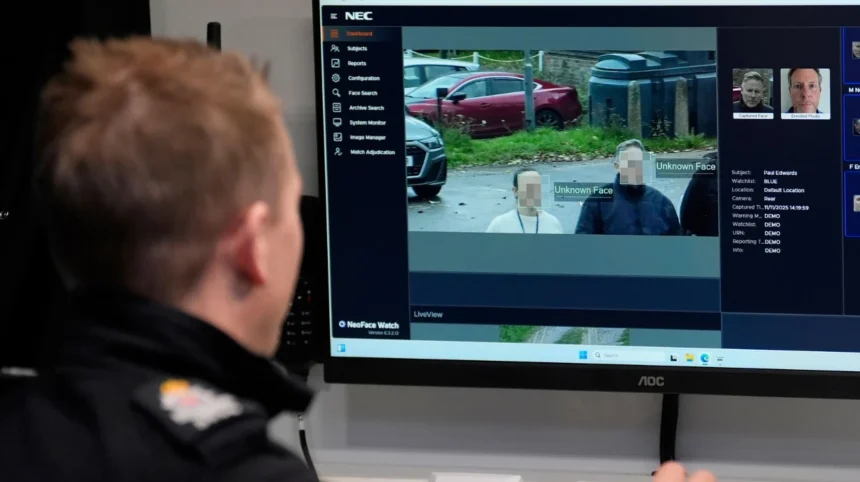
The system works by converting faces captured on camera into biometric data and comparing them against a police watchlist containing around 17,000 individuals, most of whom were previously photographed in police custody.
Supporters of the technology argue that facial recognition allows police to quickly identify dangerous individuals in crowded urban areas while helping improve public safety.
Critics, however, say the wider issue is not just about accuracy but about the long-term impact of normalising biometric surveillance in democratic societies.
The legal debate surrounding the technology also continues to grow. Last month, the High Court rejected a legal challenge against the Metropolitan Police’s use of live facial recognition, ruling that the deployments were lawful under current regulations.
The UK government is now working on a new legal framework that could shape how facial recognition technology is used by police forces in the future.
As the technology becomes more visible on London streets, the debate over balancing security, privacy, and civil liberties is likely to remain one of the UK’s most controversial policing issues.