Key Points
- Emergency response triggered: Firefighters were dispatched to a building on Blackfriars Road, Southwark, after a window cleaning cradle malfunctioned at a significant height.
- Cradle malfunction: Two window cleaners were left stranded on the 15th floor following a mechanical failure of their platform on 8 October at 5.22pm.
- Deployment of tallest aerial equipment: London Fire Brigade deployed a 64-metre turntable ladder, recognized as the tallest aerial appliance in Europe, to perform the high-altitude rescue.
- Incident resolved quickly: The rescue operation was concluded efficiently, with the incident officially stood down within 53 minutes by 6.15pm.
- Medical assessment: Both men were safely brought to the ground and immediately assessed at the scene by crews from the London Ambulance Service.
- Zero casualties: No injuries were reported during or after the rescue operation.
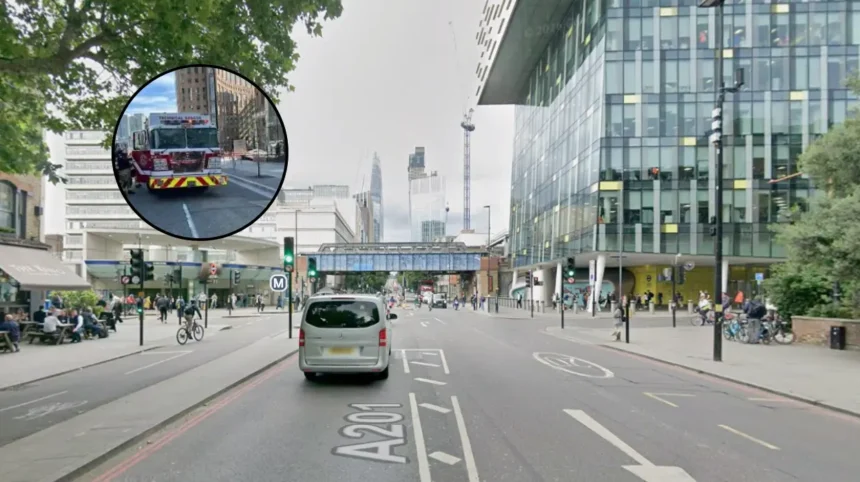
Southwark (East London Times) October 9, 2026 – Two window cleaners were safely rescued by emergency services on October 8 after becoming trapped on the 15th floor of a high-rise building along Blackfriars Road in Southwark, South East London. The operational disruption occurred at approximately 5.22pm when the elevated cradle platform used by the workers suffered an operational failure. Fire crews deployed specialist height capabilities, including Europe’s tallest aerial ladder appliance, to safely extract the individuals within an hour of receiving the call.
- Key Points
- How Did the High-Rise Rescue Unfold on Blackfriars Road?
- What Specialist Equipment Was Deployed to Execute the High-Altitude Rescue?
- What Condition Were the Workers in Following the Incident?
- Background of High-Rise Fire Safety and Specialist Aerial Equipment in London
- Prediction: How Will This Development Impact Commercial Building Operators and High-Rise Maintenance Teams?
How Did the High-Rise Rescue Unfold on Blackfriars Road?
Emergency service operators received an urgent call at 5.22pm detailing a mechanical breakdown affecting window maintenance apparatus suspended high above Blackfriars Road. The two maintenance workers were conducting routine cleaning duties on the 15th floor when their cradle suddenly stopped functioning, rendering them unable to ascend, descend, or re-enter the building safely.
Upon receiving the report, control units dispatched crews from the London Fire Brigade (LFB) directly to the site in Southwark to assess the structural setup and evaluate extraction routes. Given the elevated location of the breakdown, standard operational ladders were insufficient, prompting officers to request advanced aerial support units equipped for high-rise rescue operations.
What Specialist Equipment Was Deployed to Execute the High-Altitude Rescue?
To safely retrieve the workers, responding crews mobilized the brigade’s 64-metre turntable ladder, currently recognized as the tallest aerial appliance operating in Europe. Capable of extending up to a height equivalent to twenty storeys, the ladder allowed firefighters to reach the exact position of the suspended cradle on the 15th floor without needing to breach the upper-level glazing of the high-rise structure.
Firefighters systematically maneuvered the turntable ladder into position along Blackfriars Road, stabilizing the vehicle chassis to secure the boom at extreme height. Specialist crews then established direct contact with the trapped window cleaners, carefully transferring them from the immobilized platform into the rescue cage before bringing them safely back down to street level. The incident was formally resolved and stood down by emergency commanders at 6.15pm.
What Condition Were the Workers in Following the Incident?
Following their descent to street level, the two window cleaners were immediately attended to by paramedics from the London Ambulance Service (LAS) who were staged at the scene. Clinicians carried out comprehensive physical examinations to screen for exposure, shock, or injuries sustained during the prolonged suspension.
Following medical checks, authorities confirmed that neither worker suffered physical injuries as a result of the mechanical failure or subsequent extraction process.
In an official statement regarding the incident, a spokesperson for the London Fire Brigade noted:
“Thankfully no-one was hurt and the men were rescued safely and quickly. This is a great example of how the Brigade uses its specialist equipment to meet the challenges of London’s built environment. It is vital that we continue to have the right equipment to enable us to respond effectively and keep London’s communities safe.”
Background of High-Rise Fire Safety and Specialist Aerial Equipment in London
The deployment of the 64-metre turntable ladder highlights a deliberate operational shift by urban emergency services to adapt to London’s evolving architectural landscape. Over the past two decades, South East London—particularly areas surrounding Southwark and Blackfriars Road—has seen a dramatic increase in high-rise residential and commercial developments.
Following historical reviews of urban fire and rescue operations across high-density structures, fire services across the United Kingdom upgraded their fleet capabilities to manage incidents occurring well above traditional ladder reach. The introduction of 64-metre appliances provided fire services with the ability to conduct direct external extractions up to the 20th floor, reducing reliance on internal building access or risky rope-access deployments during structural failures or exterior fires. Cradles and suspended work platforms used for exterior building maintenance are governed by strict safety protocols, including mandatory secondary fail-safes, harness tie-offs, and regular load testing. However, mechanical or electrical faults can still occur, requiring specialized urban rescue teams trained in high-angle rope retrieval and aerial ladder extractions.
Prediction: How Will This Development Impact Commercial Building Operators and High-Rise Maintenance Teams?
This incident on Blackfriars Road is expected to have practical implications for commercial property managers, window cleaning contractors, and local emergency planning authorities across London:
- Increased Rigour in Maintenance Audits: Building owners and facility management companies will likely face stricter auditing of exterior building maintenance units (BMUs) and suspended cradles. Maintenance protocols, emergency brake systems, and secondary lowering mechanisms will undergo heightened inspection to prevent similar mechanical lockouts.
- Operational Protocol Reviews for Contractor Safety: Industrial rope access and window cleaning firms may review their high-level emergency procedures. Contractors will place greater emphasis on emergency communications equipment and direct line-of-sight coordination with ground staff when working above ten storeys.
- Validation of Fire Service Capital Investments: The swift and successful extraction will serve as key evidence supporting continued municipal investment in high-reach emergency apparatus. As high-density developments continue to expand across UK urban centres, local authorities will maintain focus on ensuring aerial rescue fleets match the physical height profile of new construction.