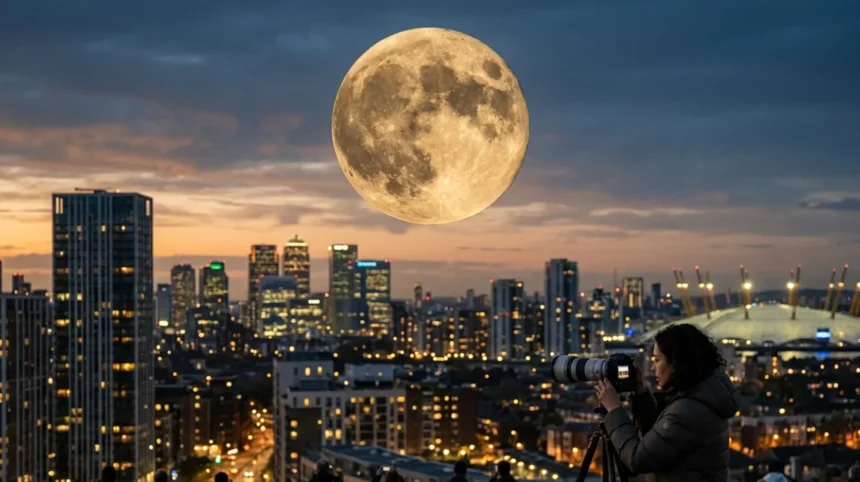
A full moon is the lunar phase that occurs when the Moon is positioned directly opposite the Sun from the Earth, allowing the sunlit hemisphere to be fully visible from the terrestrial surface as a complete, illuminated disk.
- How Does the Lunar Cycle Progress Through Its Phases?
- Why Do Full Moons Have Specific Names Throughout the Year?
- What Is the History of Lunar Observation and Tracking?
- How Does the Full Moon Affect Ocean Tides on Earth?
- What Are the Environmental and Ecological Impacts of Full Moon Illumination?
- Does the Full Moon Influence Human Biology and Psychology?
- How Do Global Cultures and Religions Incorporate the Full Moon?
- What Are the Common Myths and Misconceptions About the Full Moon?
- How Does the Full Moon Interact with Contemporary Urban Environments?
- What Is the Future of Lunar Exploration and Observation?
The full moon represents the midpoint of the lunar cycle, which lasts approximately 29.53 days—a period known as a synodic month. This astronomical phenomenon occurs when the Earth, Moon, and Sun align in a straight line, a configuration scientifically referred to as syzygy. During syzygy, the Moon is in opposition to the Sun. Because the lunar orbit is tilted by approximately 5.14 degrees relative to the ecliptic plane—the orbital plane of Earth around the Sun—the Earth rarely blocks the sunlight from reaching the Moon entirely. When perfect alignment does occur precisely at the orbital nodes, a total or partial lunar eclipse happens instead of a standard full moon.
The brightness of a full moon is measured by apparent magnitude, which quantifies the visibility of celestial objects from Earth. A typical full moon achieves an apparent magnitude of approximately -12.74, making it the second-brightest object in the sky after the Sun, which possesses an apparent magnitude of -26.74. The amount of light reflected by the Moon is determined by its albedo, the measure of diffuse reflection of solar radiation. The lunar surface has a low average albedo of 0.12, meaning it reflects only 12 percent of the incident sunlight, absorbing the remaining 88 percent.
The visible surface of the full moon consists of distinct geological features that become highly visible from urban areas like East London due to contrast. These features include lunar maria, which are large, dark, basaltic plains formed by ancient volcanic eruptions, and lunar highlands, which are light-colored, heavily cratered regions composed of anorthosite rock. Prominent impact craters, such as Tycho and Copernicus, display extensive ray systems of bright material ejected during high-velocity meteoroid impacts millions of years ago.
How Does the Lunar Cycle Progress Through Its Phases?
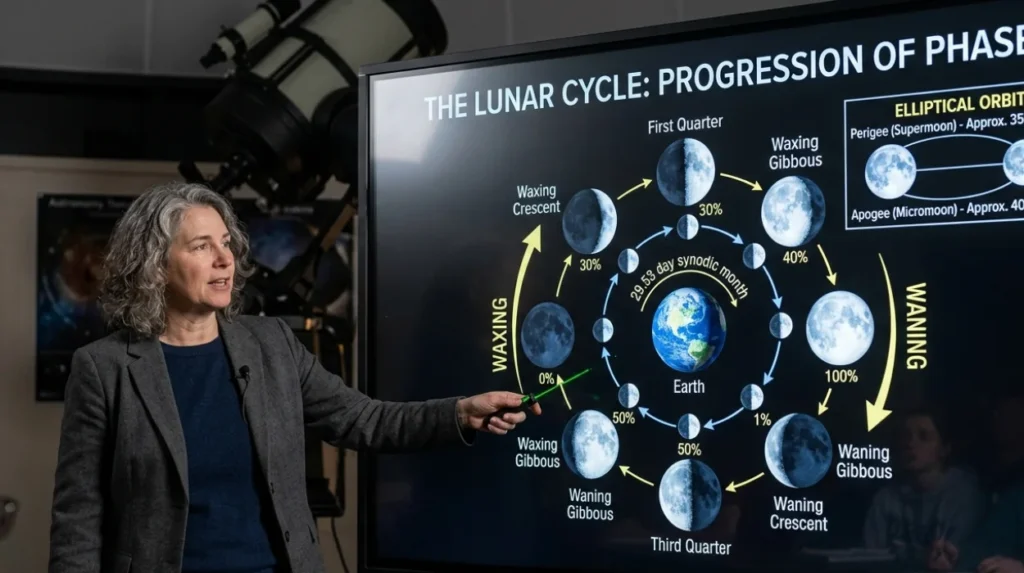
The lunar cycle progresses through eight distinct phases across 29.53 days, driven by the changing relative geometry of the Earth, Moon, and Sun as the Moon completes its orbit around the Earth at an average distance of 384,400 kilometers.
The synodic month begins with the new moon, the phase where the Moon sits directly between the Earth and the Sun, rendering its illuminated side invisible from Earth. As the Moon moves eastward in its orbit, the visible illuminated portion increases during the waxing phase. The first sub-phase is the waxing crescent, which transitions into the first quarter when exactly 50 percent of the lunar disk is visible. This is followed by the waxing gibbous phase, where the illumination grows from 51 percent to 99 percent, culminating in the full moon.
Following the full moon, the illuminated surface decreases during the waning phase. The sequence reverses, moving through the waning gibbous phase, the third quarter—where the opposite 50 percent of the disk is lit—and the waning crescent phase. The cycle concludes when the Moon returns to the new moon position. The motion of the Moon covers approximately 13 degrees of the sky every 24 hours, causing the moonrise to occur an average of 50 minutes later each subsequent day.
The distance between the Earth and the Moon varies throughout this cycle because the lunar orbit is elliptical rather than perfectly circular. The point of closest approach is called perigee, at approximately 356,400 kilometers, while the farthest point is called apogee, at approximately 406,700 kilometers. When a full moon coincides with perigee, it is classified as a supermoon, appearing 14 percent larger and 30 percent brighter than an apogee full moon, which is termed a micromoon.
Why Do Full Moons Have Specific Names Throughout the Year?
Full moons have specific names throughout the year because ancient agricultural, pastoral, and indigenous civilizations utilized the lunar cycle as a seasonal calendar to track ecological shifts, animal migration patterns, and optimal harvesting periods before solar calendars were adopted.
The modern names applied to full moons in the northern hemisphere originate primarily from a combination of Native American, Anglo-Saxon, and Germanic traditions. These names were historically recorded in publications like the Old Farmer’s Almanac in the United States and have become standardized globally. Each name corresponds to a specific month and reflects the seasonal characteristics of that period.
January features the Wolf Moon, named by European and Native American tribes who noted the increased howling of wolves outside settlements during midwinter. February is designated as the Snow Moon due to the heavy snowfalls characteristic of the month in the northern hemisphere. March is the Worm Moon, marking the period when ground temperatures rise, soil softens, and earthworm casts appear on the surface. April is called the Pink Moon, named after the widespread blooming of Phlox subulata, a pink wild ground flower native to eastern North America.
The remaining months follow similar ecological identifiers. May is the Flower Moon, June is the Strawberry Moon, and July is the Buck Moon, named for the period when young stags grow new antlers. August features the Sturgeon Moon, named by fishing tribes who caught large quantities of the fish in the Great Lakes. September or October features the Harvest Moon, defined strictly as the full moon closest to the autumnal equinox. The remaining autumn and winter moons include the Hunter’s Moon, Beaver Moon, and Cold Moon.
What Is the History of Lunar Observation and Tracking?
The history of lunar observation spans over 30,000 years, beginning with prehistoric bone markings and evolving through ancient megalithic stone circles, Renaissance telescopic cartography, and twentieth-century space race exploration to modern digital astrophotography networks.
Archaeological evidence shows that early human civilizations tracked the phases of the Moon for survival. Paleolithic artifacts, such as the Blanchard bone found in France dating back to approximately 32,000 BCE, contain engraved notches that match the days of the lunar cycle. In Scotland, the Warren Field pit alignment, constructed around 8,000 BCE, functions as a mesolithic calendar that aligns with both solar and lunar movements, allowing hunter-gatherers to track the seasons.
Ancient state civilizations developed complex mathematical models for lunar tracking. Babylonian astronomers in the fifth century BCE discovered the Saros cycle, a period of 6,585.32 days that predicts when solar and lunar eclipses will repeat. In ancient Greece, the Antikythera mechanism, constructed around 150 BCE, used a complex system of bronze gears to calculate the position of the Moon, its phase, and eclipse cycles with high mechanical precision.
The invention of the telescope in the early seventeenth century changed lunar observation from tracking positions to mapping geography. In 1609, Thomas Harriot made the first recorded drawings of the Moon through a telescope, followed months later by Galileo Galilei, who published Sidereal Messenger in 1610. Galileo used shadows along the terminator line—the dividing line between light and dark sides—to calculate the height of lunar mountains, proving the Moon was a rugged, imperfect sphere rather than a smooth etherial body.
How Does the Full Moon Affect Ocean Tides on Earth?
The full moon affects ocean tides on Earth by aligning with the Sun to exert a combined gravitational pull, which deforms the global oceans into two opposing tidal bulges, resulting in extreme high and low tides known as spring tides.
Tidal forces are caused by the gravitational attraction between the Earth, Moon, and Sun. The gravitational force exerted by an object is inversely proportional to the cube of the distance for tidal effects. Because the Moon is close to Earth, its tidal influence is approximately 2.17 times greater than that of the Sun, despite the Sun possessing significantly greater mass.
During a full moon or a new moon, the Earth, Moon, and Sun align along a single axis. This geometric arrangement causes the gravitational vectors of the Sun and the Moon to reinforce one another. The net gravitational pull stretches the hydrosphere, creating a tidal bulge on the side of the Earth facing the Moon and an equal bulge on the opposite side due to centrifugal force. This produces spring tides, which are characterized by a high tidal range: high tides are exceptionally high, and low tides are exceptionally low.
The opposite condition occurs during the first and third quarter phases, when the Sun and Moon are at a 90-degree angle relative to Earth. The gravitational forces counteract one another, resulting in neap tides, which feature the lowest tidal range of the month. In areas with complex coastal geography, such as the River Thames in East London, spring tides significantly increase the risk of tidal flooding, necessitating the operation of defensive infrastructure like the Thames Barrier to protect urban environments from storm surges.
What Are the Environmental and Ecological Impacts of Full Moon Illumination?
The environmental and ecological impacts of full moon illumination include changes to wildlife foraging behavior, predator-prey dynamics, marine reproductive cycles, and plant physiological processes due to the nocturnal light levels, which reach up to 0.3 lux.
The increased light of a full moon alters the behavior of nocturnal animals. Foraging mammals, such as rodents and marsupials, reduce their activity levels in open spaces during full moons to avoid detection by visual predators like owls and foxes. This behavioral shift is known as lunarphobia. Conversely, visual predators experience increased hunting efficiency due to improved visibility, balancing the ecosystem’s energy transfer.
Marine ecosystems exhibit precise synchronization with the full moon. The mass spawning of the Great Barrier Reef occurs once a year following a full moon, where over 130 species of coral simultaneously release gametes into the water column. This synchronization is triggered by photoreceptors sensitive to blue light, allowing corals to detect changes in moonlight intensity. Similarly, certain species of crabs, such as the Christmas Island red crab, synchronize their migration to the ocean to spawn during specific lunar phases to ensure larval survival.
Avian migration and orientation are also influenced by lunar illumination. Many species of birds that migrate at night utilize the moon and stars for navigation. High levels of moonlight provide geographical landmarks, allowing birds to navigate topographical features like coastlines, river valleys, and urban corridors safely. Artificial light pollution in modern cities disrupts these natural cues by overriding the subtle changes in ambient moonlight.
Does the Full Moon Influence Human Biology and Psychology?
The full moon does not influence human psychology, crime rates, or psychiatric admissions, as demonstrated by exhaustive statistical analyses, though rigorous clinical sleep studies show a minor correlation with reduced sleep efficiency and shortened sleep duration.
The belief that the full moon induces psychological instability, violence, or medical emergencies is known as the lunar effect or the Transylvania effect. This belief is unsupported by statistical evidence. Meta-analyses published in journals like Psychological Bulletin reviewed decades of data on psychiatric emergency admissions, crisis hotline calls, homicide rates, and traffic accidents, finding zero statistically significant correlation between these events and the lunar cycle. The persistence of the myth is attributed to confirmation bias, where individuals remember unusual events that happen on a full moon but forget those occurring during other phases.
However, modern research indicates a real physiological connection regarding human sleep architecture. A study published in Current Biology analyzed subjects in controlled sleep laboratory environments devoid of time cues and ambient light. The data revealed that around the full moon, delta activity in electroencephalograms (EEGs) during deep sleep dropped by 30 percent, time to fall asleep increased by an average of 5 minutes, and total sleep duration decreased by 20 minutes.
This sleep disruption is tied to endogenous circalunar rhythms, which are biological clocks that operate on a monthly cycle independently of external light cues. These rhythms influence the endocrine system, specifically the production of melatonin, a hormone regulated by the pineal gland that controls sleep-wake cycles. Melatonin levels drop naturally during the full moon phase, even when individuals are kept in entirely dark rooms, suggesting a lingering evolutionary adaptation to the lunar cycle.
How Do Global Cultures and Religions Incorporate the Full Moon?
Global cultures and religions incorporate the full moon by using it to establish liturgical calendars, schedule sacred festivals, structure agricultural practices, and symbolize theological concepts of enlightenment, cycles, and renewal.
Many major global religions utilize a lunar or lunisolar calendar to determine holy days rather than the solar Gregorian calendar. In Islam, the Hijri calendar is strictly lunar, meaning dates migrate across the solar seasons over a 33-year cycle. While the start of Islamic months requires the visual sighting of the crescent moon, full moons mark the middle of holy months and signify specific nocturnal prayers.
In Judaism and Christianity, the lunisolar structure dictates primary festivals. The Jewish calendar schedules Passover to begin on the 15th day of the month of Nisan, which always coincides with a full moon. Christianity links the calculation of Easter to the lunar cycle, defining the holiday as the first Sunday following the Paschal Full Moon, which is the first full moon occurring on or after the vernal equinox on March 21.
Eastern traditions feature celebrations centered entirely on the full moon. In Buddhism, the festival of Vesak commemorates the birth, enlightenment, and death of Gautama Buddha, occurring precisely on the full moon of the ancient lunar month of Vaisakha. In Chinese culture, the Mid-Autumn Festival, also known as the Moon Festival, takes place on the 15th day of the 8th lunar month. This festival celebrates the autumn harvest and centers on the worship of Chang’e, the mythical lunar goddess, symbolizing family unity through the shape of the full moon.
What Are the Common Myths and Misconceptions About the Full Moon?
The common myths and misconceptions about the full moon include the belief that it causes lycanthropy, triggers epileptic seizures, increases hospital emergency room visits, and appears larger on the horizon due to atmospheric magnification.
The myth of lycanthropy—the supernatural transformation of humans into wolves during a full moon—originates in ancient European folklore and was popularized by Gothic literature and modern cinema. Historically, medical conditions like hypertrichosis, which causes excessive hair growth, and clinical lycanthropy, a rare psychiatric delusion where patients believe they are animals, were misunderstood by rural populations and linked to lunar phases without scientific basis.
Another misconception is that the full moon triggers seizures or exacerbates neurological conditions like epilepsy. Comprehensive studies published in medical journals like Epilepsy & Behavior analyzed thousands of emergency admissions for seizures and found no variation across the lunar cycle. The myth persists among healthcare workers due to occupational folklore passed down across generations rather than empirical data.
The phenomenon where a full moon looks larger near the horizon than when it is high in the sky is a psychological illusion called the moon illusion, not an atmospheric effect. Atmospheric refraction changes the color of the moon and flattens its shape slightly, but it does not magnify it. The illusion is an optical trick played by the human brain’s visual processing system. When the moon is near the horizon, the brain compares it to terrestrial reference points like buildings, trees, and hills, miscalculating its relative scale. When the moon is high in an empty sky, those visual anchors vanish, causing the brain to perceive the disk as smaller.
How Does the Full Moon Interact with Contemporary Urban Environments?
The full moon interacts with contemporary urban environments by encountering severe artificial light pollution, which reduces its visual contrast, while simultaneously serving as a cultural focal point for urban astrophotography, community events, and environmental awareness.
In modern metropolitan areas like East London, the visibility of the night sky is impacted by skyglow, the bright illumination of the night sky caused by streetlights, commercial buildings, and vehicles. This light pollution elevates the baseline ambient brightness of urban areas well above the 0.3 lux provided by a natural full moon. As a result, the subtle details of the lunar surface, such as faint crater ray systems, lose visual contrast when viewed from central city locations.
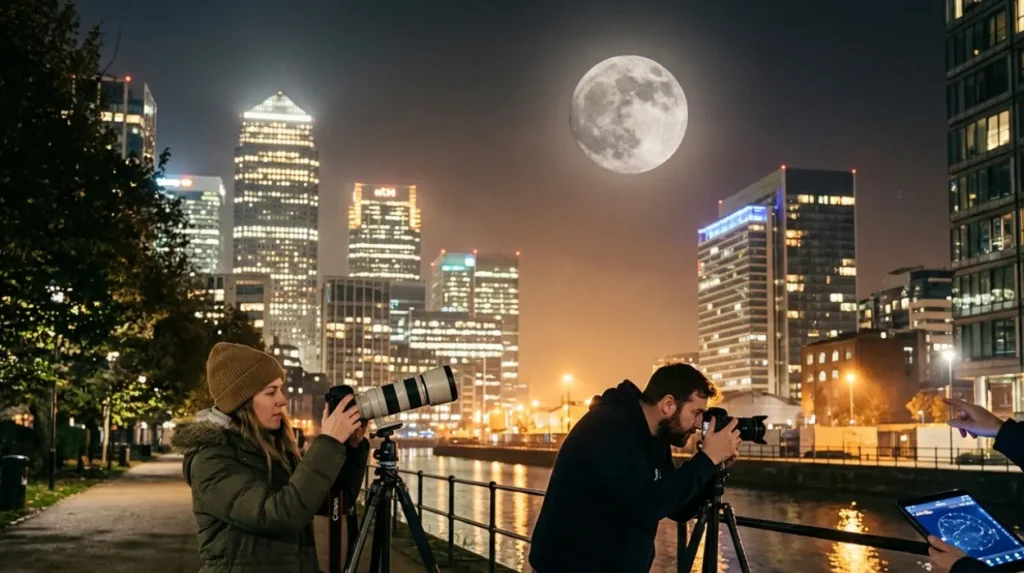
Despite light pollution, the full moon remains highly visible due to its high apparent magnitude, making it a primary target for urban astrophotography. Photographers use iconic architecture, such as the skyscrapers of Canary Wharf or the structures of the Olympic Park, to frame the rising moon. This requires precise planning using ephemeris software, which calculates the exact azimuth and elevation of celestial objects relative to specific terrestrial coordinates.
Urban green spaces, including Victoria Park and the Hackney Marshes, act as important viewing locations by reducing immediate ground-level glare. These parks host community astronomy events during significant lunar events like supermoons or lunar eclipses. These gatherings foster community engagement and encourage urban residents to connect with natural cycles, raising awareness about light pollution and the importance of preserving dark sky corridors for urban wildlife.
What Is the Future of Lunar Exploration and Observation?
The future of lunar exploration and observation involves international robotic and human missions to establish permanent research bases, exploit lunar resources, install far-side radio telescopes, and prepare for deep-space manned flights to Mars.
The exploration of the Moon is entering a new phase driven by international space agencies and private corporations. The Artemis program, led by NASA in collaboration with international partners like the European Space Agency (ESA), aims to land humans back on the lunar surface, including the first woman and the first person of color. Unlike the Apollo missions of the twentieth century, which focused on short-term exploration, the Artemis program is designed to build sustainable infrastructure, including the Lunar Gateway, a space station that will orbit the Moon to facilitate long-term surface operations.
A major focus of modern lunar exploration is the lunar south pole, a region containing permanently shadowed craters where temperatures drop below -230 degrees Celsius. Satellite data has confirmed the presence of volatile water ice deposits within these cold traps. This ice can be mined and processed through electrolysis to create liquid oxygen and liquid hydrogen, providing life support systems and rocket propellant for deep-space missions, removing the need to launch all fuel supplies directly from Earth.
For astronomical observation, the Moon offers unique scientific opportunities. Scientists plan to construct low-frequency radio telescopes on the far side of the Moon. Because the lunar mass shields the far side from the intense electromagnetic interference produced by human technology on Earth, this environment is the most radio-quiet zone in the inner solar system. A telescope situated there will allow astrophysicists to detect cosmic radio waves from the Dark Ages of the universe, providing data on the formation of the first stars and galaxies.
What is a full moon?
A full moon occurs when the Moon is positioned opposite the Sun from Earth, allowing its entire sunlit hemisphere to be visible as a fully illuminated disk.