
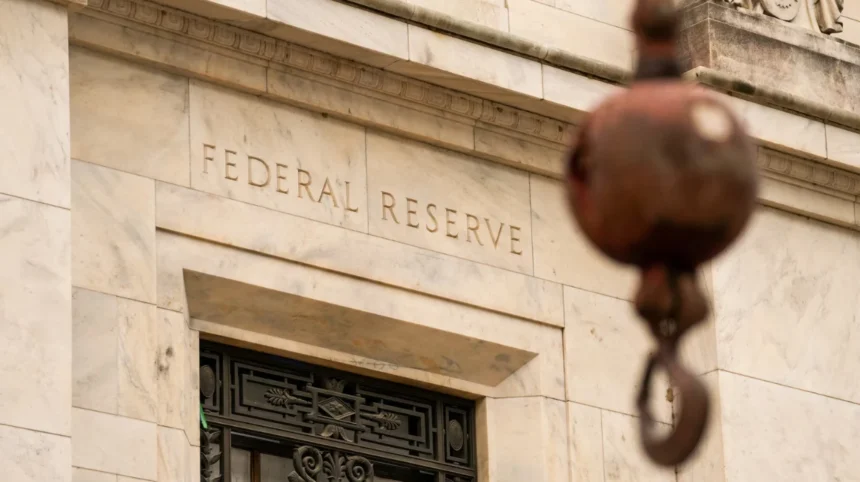
The Federal Reserve enters 2026 facing a familiar but increasingly complex challenge: bringing inflation sustainably back to its 2% target without triggering a sharp economic slowdown.
While headline inflation in the United States has eased significantly from its 2022 peak of over 9%, it still remains above target levels, hovering in the range of approximately 3% according to recent Bureau of Labor Statistics readings. Core inflation, particularly in services and housing, continues to show persistence, complicating the policy outlook.
At the same time, the federal funds rate remains at historically elevated levels, currently in the 5.25%–5.50% range, reflecting the Fed’s cautious stance as it evaluates whether inflationary pressures are truly under control.
Inflation: A Two-Speed Economy
Recent economic data highlights a split picture. Goods inflation has slowed sharply, supported by improved supply chains and weaker demand, while services inflation—driven largely by wages and housing costs—remains sticky.
For example, shelter inflation continues to contribute a significant portion of monthly CPI increases, even as other categories stabilize. Wage growth, while moderating from post-pandemic highs of over 5%, is still running above pre-2020 averages, keeping pressure on underlying inflation dynamics.
This divergence creates a policy dilemma: raising rates further risks tightening financial conditions too aggressively, while easing too early could reignite price pressures.
The Emerging Role of Technical Task Forces
Against this backdrop, discussions around enhancing the Federal Reserve’s internal analytical structure have gained renewed attention, including proposals associated with former Fed Governor Kevin Warsh regarding specialized technical task forces.
The concept does not imply a shift in monetary authority, but rather an upgrade in the Fed’s analytical infrastructure. These teams would focus on accelerating and refining economic interpretation using real-time data.
Potential functions include:
- Processing high-frequency indicators such as weekly employment trends and credit card spending
- Tracking inflation sub-components beyond monthly CPI releases
- Improving forecasting models that currently rely heavily on lagging indicators
- Integrating private-sector data sources with official statistics
In practice, this could reduce the informational lag that often affects monetary policy decisions, which traditionally rely on backward-looking data.
Why Data Speed Matters More Than Ever
In previous decades, monetary policy operated in an environment where economic data evolved gradually. Today, the speed of economic change has increased dramatically due to global supply chain shifts, digital consumption patterns, and geopolitical volatility.
During the 2021–2022 inflation surge, for instance, policymakers were criticized for underestimating the persistence of price pressures, partly due to reliance on delayed data signals. CPI data itself is released monthly, often reflecting conditions that occurred weeks earlier.
Supporters of enhanced analytical units argue that faster data interpretation could improve policy responsiveness without altering the Fed’s dual mandate of price stability and maximum employment.
Limits of Analytical Reform
However, improved data processing alone is unlikely to resolve the structural challenges of inflation management.
Historical experience shows that inflation reduction often requires sustained periods of restrictive monetary policy. The Volcker-era tightening in the early 1980s, for example, pushed interest rates above 15% to restore price stability—highlighting that credibility and policy persistence matter as much as data quality.
Some economists also warn that over-reliance on real-time indicators may introduce noise into policy decisions, potentially increasing volatility rather than reducing it.
Global Spillovers Remain Significant
Given the central role of the Federal Reserve in global finance, any evolution in its analytical framework has international implications.
A 100 basis point change in U.S. interest rates can significantly affect capital flows into emerging markets, while also influencing global dollar liquidity and commodity pricing. For economies in the Middle East, Asia, and Latin America, Fed policy shifts often translate directly into exchange rate and borrowing cost adjustments.
The Federal Reserve’s challenge is no longer only about the level of interest rates, but also about how quickly and accurately it interprets a rapidly evolving economy.
Technical task forces, as proposed in recent policy discussions, may not replace traditional monetary tools, but they could reshape how information is processed at the world’s most influential central bank.
Whether this leads to materially better inflation outcomes remains uncertain, but it reflects a broader shift toward data-driven central banking in an era of heightened economic complexity.