
London’s data centre boom has become a major climate issue because these facilities use large amounts of electricity and water, and City Hall is now developing a new policy response to balance digital growth with net-zero goals. For East London, where several major proposals and existing clusters are already under pressure, the debate now centres on carbon emissions, grid capacity, planning rules, and environmental safeguards.
- What are data centres and why do they matter for London?
- Why is CO2 a concern for data centres in London?
- What is City Hall doing about data centre emissions?
- How does the planning process work?
- What evidence is City Hall using?
- Why is East London especially affected?
- What are the main environmental issues?
- How can data centres be made cleaner?
- What does this mean for residents and businesses?
- What is the likely future direction?
What are data centres and why do they matter for London?
Data centres are buildings that store and process digital information, and London needs them because banks, public services, streaming platforms, cloud systems, and AI tools depend on constant computing power. Their CO2 impact matters because electricity use, backup systems, construction, and cooling all create emissions.
A data centre contains rows of servers, cooling equipment, battery systems, and power infrastructure. These sites run continuously, so they draw power around the clock and place steady pressure on the electricity network. In a dense city like London, that demand also raises concerns about land use, heat, water consumption, and emissions from construction and operation.
The issue is not new, but the scale has changed quickly because AI and cloud services have accelerated demand for high-capacity sites. City Hall now treats data centres as part of the capital’s broader climate and planning challenge rather than as a niche technology issue.

Why is CO2 a concern for data centres in London?
CO2 is a concern because large data centres require huge electricity supplies, and if that electricity is not fully clean, the carbon footprint rises sharply. Campaign and research groups say some planned London data centres could produce emissions on a scale that affects the city’s net-zero pathway.
A major estimate presented in the London debate says that every 10 new data centres could create about 2.7 million tonnes of carbon emissions. That figure has become central to the policy discussion because it shows how a cluster of projects can have a citywide climate effect rather than only a local planning effect.
The concern extends beyond operational electricity. Construction materials, land preparation, backup generators, battery systems, and long build periods also add carbon costs. In one East London-linked proposal, local residents and campaigners raised concerns about the electricity, water, and construction impacts of a very large campus-scale development.
What is City Hall doing about data centre emissions?
City Hall is preparing a new approach for the next London Plan that will set out how data centres should be assessed against energy, water, and climate goals. Officials say the aim is to balance economic benefits with environmental impact.
The London Assembly has already heard evidence that the growth of data centres could undermine the Mayor of London’s decarbonisation goals if expansion continues without stronger controls. City Hall officials have said they are developing a strategy for reconciling the need for digital infrastructure with the city’s environmental responsibilities.
The most important policy shift is that data centres are moving from a general infrastructure category into a specific planning and climate question. That means future London Plan policy is likely to address where these sites can be located, how they connect to the grid, how they manage water use, and what evidence developers must provide on emissions.
How does the planning process work?
The planning process decides whether a data centre can be built, where it can go, and what conditions apply. In London, the Greater London Authority, borough councils, and national energy and planning bodies all play a role.
Developers submit proposals that show land use, electricity demand, cooling systems, traffic impact, and environmental measures. Borough councils review the local planning case, while City Hall looks at whether the development fits London-wide policy, including climate and infrastructure priorities. For very large projects, national-level policy and energy infrastructure also become important because grid connections and substation capacity can determine whether a site is viable.
For East London communities, the planning issue often includes traffic, construction duration, and green belt pressure. In one large Havering proposal, opponents described a 10-to-12-year construction period and warned about lorry traffic, countryside loss, and high utility demand. These are not separate issues from CO2; they are part of the same infrastructure footprint.
What evidence is City Hall using?
City Hall is using evidence about electricity demand, carbon emissions, water use, and national net-zero risk. That evidence comes from London Assembly scrutiny, campaign reports, planning submissions, and government concern over AI-related infrastructure growth.
One reported estimate said 10 proposed data centres could match the annual carbon savings from a full switch to electric vehicles by the public, which gives the issue a clear scale comparison. Another major concern is that future power demand from data centres could be far larger than earlier projections, with MPs and campaigners arguing that emissions forecasts have been revised sharply upward.
City Hall is also aware of the wider policy context. The UK government is facing pressure to disclose whether data centre development raises net emissions or local water shortages, and environmental groups are calling for stronger proof that projects fit the country’s decarbonisation path. London policy now sits inside that national debate.
Why is East London especially affected?
East London is affected because it contains major development pressure, large infrastructure corridors, and boroughs where planning disputes over land, traffic, and utilities are already intense. Some of the most contested London data centre plans are linked to outer east London sites.
One East London example is the Havering scheme that triggered local opposition over scale, green belt concerns, construction traffic, and long-term environmental change. Another campaign described a proposed 600MW campus on the outskirts of London as a major grid and countryside issue because of its size and power needs. These proposals show how data centres are no longer confined to central business districts.
East London also matters because large infrastructure projects can reshape land values, road usage, and local employment patterns. While developers often present economic benefits, residents and campaigners focus on environmental burden, landscape change, and whether local communities receive enough public value in return.
What are the main environmental issues?
The main environmental issues are carbon emissions, electricity demand, water use, land take, backup fuel systems, and construction impacts. These issues connect directly to London’s climate strategy because each one adds pressure to the city’s net-zero plan.
Electricity demand is the largest issue because a data centre cannot function without constant power. Cooling systems also use large amounts of energy and, in some designs, significant water. That matters in a city where grid capacity is limited and climate policy increasingly requires efficient energy use across all sectors.
Land take is also important. Large sites can occupy former industrial land, edge-of-city land, or green belt locations, which creates tension between economic infrastructure and environmental protection. Construction emissions matter too, especially when projects are built over many years and require heavy vehicle movements, concrete, steel, and high-intensity engineering work.
How can data centres be made cleaner?
Data centres become cleaner when they use low-carbon electricity, efficient cooling, better design, heat reuse, and stronger planning rules. City Hall’s policy direction aims to push those choices into the approval process.
The first step is cleaner electricity supply. If a data centre runs on power backed by renewable generation, its operational emissions fall sharply. The second step is efficiency, which includes better server utilisation, advanced cooling, improved building design, and smarter energy management. The third step is location choice, since sites near suitable grid connections and existing industrial land reduce pressure on greenfield areas.
Planning conditions can also require stronger evidence from developers. National debate now includes demands that firms show how projects affect total UK emissions and whether they worsen local shortages of water or power. That same logic is now shaping London’s policy approach through the next London Plan.
Explore More Help & Resources
Newham Restaurants Best New Openings Worth Visiting in 2026
UEL After Dark Festival 2026 What Is On and How to Get Tickets
What does this mean for residents and businesses?
For residents, the issue affects air quality, traffic, land use, local ecology, and the credibility of London’s climate promises. For businesses, it affects whether the city can keep attracting digital investment without increasing emissions and infrastructure strain.
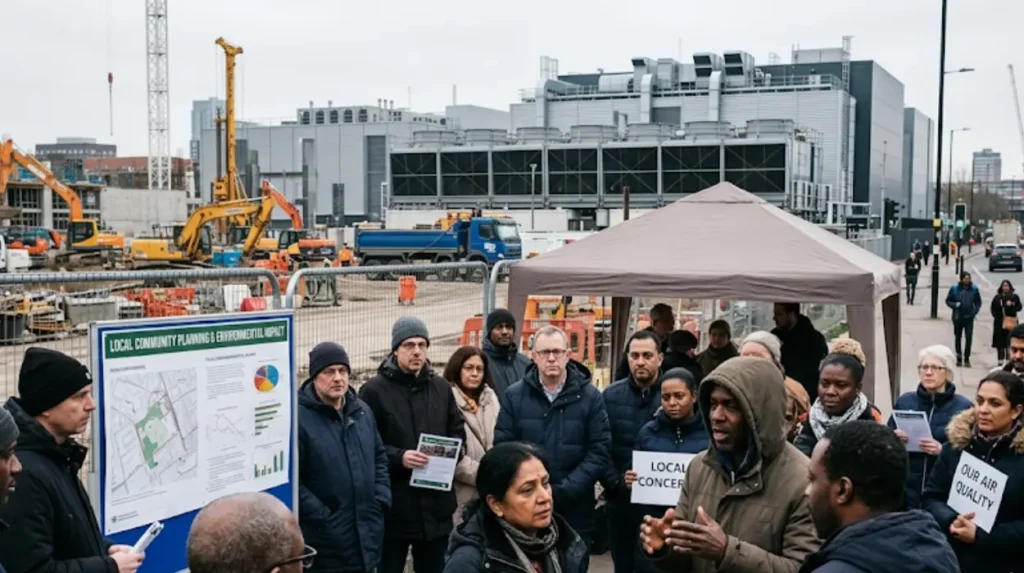
Residents in affected areas often focus on the immediate effects first. These include construction vehicles, noise, visual impact, and the loss of open land. In East London, those local concerns sit alongside wider worries that repeated approval of large sites will normalise high-carbon development in places already under pressure.
Businesses have a different but related concern. London depends on digital infrastructure to support finance, media, logistics, healthcare, and public services. City Hall therefore faces a practical policy task: it must keep the capital competitive while preventing infrastructure growth from overwhelming climate targets and local planning capacity.
What is the likely future direction?
The likely future direction is tighter policy, stronger evidence requirements, and more scrutiny of energy and water use before approval. London’s next planning framework is expected to treat data centres as a strategic climate issue, not just a technical land-use issue.
The policy debate is already moving toward disclosure and accountability. Developers are under pressure to prove that their projects do not increase net emissions or worsen resource shortages, and that pressure is likely to become part of mainstream planning conditions. At the same time, City Hall must decide how to classify different types of data centres, especially large AI-ready facilities that use much more electricity than older sites.
For East London, that means future proposals will face closer inspection of their carbon case, grid demand, and environmental value. The public discussion is shifting away from whether data centres belong in London and toward where they belong, how large they can be, and what proof developers must provide before they are built.
London’s data centre debate is now a test of whether the city can support digital growth without undermining its climate commitments. City Hall is responding through planning reform, climate scrutiny, and a more explicit focus on emissions, water, and energy demand.
What is a data centre?
A data centre is a secure facility that houses servers and networking equipment used to store, process, and distribute digital information. They support cloud computing, artificial intelligence (AI), banking, streaming services, government systems, and business applications.