Key Points
- Borough-Wide Article 4 Direction: Havering Council has sealed an Article 4 Direction removing permitted development rights for converting family homes into small Houses in Multiple Occupation (HMOs).
- Closing Planning Loophole: The measure targets a loophole that allows around 9,610 detached properties in specific areas to be converted into HMOs for up to six people without formal planning approval.
- Implementation Timeline: The non-immediate Direction was sealed on 20 August 2026 and is due to take effect on 7 September 2027, subject to consultation and Secretary of State approval.
- Public Consultation Window: An eight-week consultation began on Friday, 21 August 2026, and runs until 5:00 pm on Friday, 16 October 2026. Residents, landlords and local business owners can submit comments.
- Political Priority: Council Leader Councillor Keith Prince AM said tackling uncontrolled HMO conversions was a commitment in the local administration’s First 100 Days Plan.
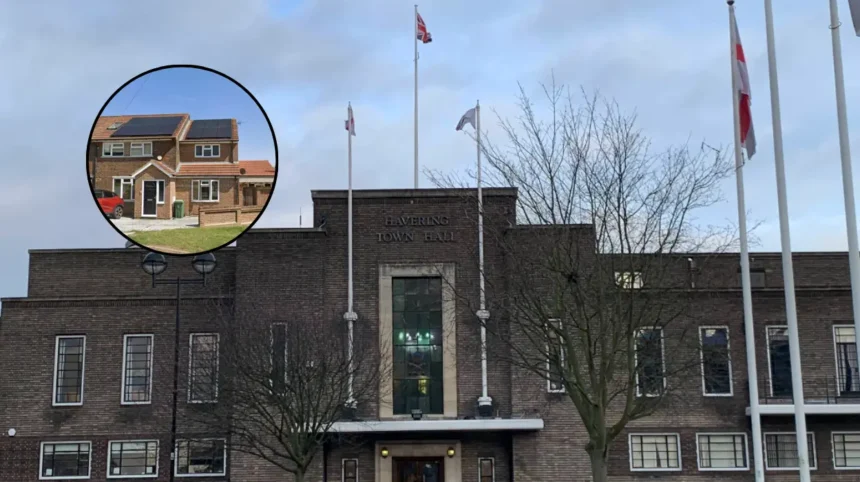
Havering (East London Times) August 25, 2026 – Every prospective new House in Multiple Occupation (HMO) across the London Borough of Havering could soon be subjected to formal planning applications under comprehensive new controls put forward by local authorities.
- Key Points
- Why Is Havering Council Proposing New Planning Rules for HMOs?
- What Criteria Will New HMO Applications Have to Meet?
- How Does Planning Control Differ From Mandatory HMO Licensing?
- How Can Residents and Landlords Participate in the Public Consultation?
- Background of This Particular Development
- Prediction: How This Development Can Affect the Audience
As reported by journalists at Romford Today, Havering Council officially sealed a borough-wide Article 4 Direction on 20 August 2026. Under existing national planning policy, property developers and homeowners currently retain “permitted development rights,” allowing them to convert standard residential family dwellings (planning Use Class C3) into small HMOs catering to three to six unrelated occupants (Use Class C4) without seeking full planning permission from the local authority. The newly proposed directive seeks to withdraw these automated rights across all remaining exempt areas within the borough’s borders.
The decision introduces a unified planning regime across Havering. Under previous arrangements, two separate historical Article 4 Directions governed the area. The first direction removed permitted development rights for all dwelling types in four specific wards mapped under 2015 boundaries, whilst the second covered the remainder of the borough but only applied to flats, terraced houses, and semi-detached properties. This left an estimated 9,610 detached homes across the borough exposed to unrestricted conversion.
According to reporting by Romford Today, the new legal order is non-immediate and carries a 12-month implementation gap, meaning the proposed rules will not formally take effect until 7 September 2027. This delay is designed to comply with national planning rules to avoid potential compensation claims from landowners, provided the directive receives confirmation following public consultation and review by the Secretary of State.
Why Is Havering Council Proposing New Planning Rules for HMOs?
As detailed in official borough documentation published on 21 August 2026, Havering Council introduced the proposed measures in response to mounting community concerns regarding the rapid spread and over-concentration of shared housing developments.
As reported in the local authority’s official press announcement, Councillor Keith Prince AM, Leader of Havering Council, stated:
“We know residents care deeply about the quality of housing in their neighbourhoods and the impact that poorly managed or over-concentrated HMOs can have on local communities. That’s why we made tackling HMOs a priority in our First 100 Days Plan.”
Councillor Prince further explained:
“This proposed Article 4 Direction would give the council greater ability to consider HMO applications through the planning process, helping us to manage growth in a fair, consistent and responsible way. I encourage residents, landlords, businesses and all interested parties to take part in the consultation and share their views.”
As reported by political correspondent Isabel Bragger for the Romford Recorder, an extensive evidence report commissioned by the council identified a “significant number of detached houses across the borough that could be at risk from redevelopment to an HMO without planning permission being needed from the council.” The report emphasized that the proposed Article 4 Direction is essential to directly counter the persistent threat of “uncontrolled conversion.”
What Criteria Will New HMO Applications Have to Meet?
Once the Article 4 Direction is confirmed and active, any proposal to convert a single-family house into an HMO will require an explicit planning application submitted to Havering Council. Applications will no longer be automatically permitted and will instead be evaluated under Havering Local Plan Policy 8.
As highlighted by local reporting, planning officers will assess prospective HMO conversions against strict evaluation metrics, including:
- Property Size Requirements: The original residential building must feature an internal floor area of at least 120 square metres.
- Density and Concentration Limits: No more than 10 per cent of properties in a single street may operate as HMOs, and a proposed property cannot result in more than two adjacent HMO conversions.
- Living Accommodation & Amenities: Assessment of bedroom sizes, adequate indoor communal living spaces, and internal facilities proportional to the total number of occupants.
- Impact on Local Infrastructure: Evaluation of potential anti-social behaviour, increased pressure on public services, and adequacy of on-site refuse storage.
- Highways and Parking: Detailed consideration of off-street parking provision and nearby transit impacts to prevent localized street congestion.
How Does Planning Control Differ From Mandatory HMO Licensing?
As explained in legal coverage by Romford Today, planning approval and property licensing constitute two distinct regulatory frameworks operated under completely different statutory regimes.
Planning control determines whether a physical property can lawfully be converted into a shared house and governs its permitted maximum occupancy level. Conversely, property licensing regulates safety standards, management protocols, fire prevention measures, and living conditions inside the home.
While mandatory, selective, or additional licensing schemes currently apply across Havering—requiring landlords to obtain an operational licence regardless of planning status—licensing alone cannot prevent a detached house from legally transitioning into an HMO under national permitted development rules. The Article 4 Direction specifically targets the planning loophole, bringing the physical change of use under local administrative oversight.
How Can Residents and Landlords Participate in the Public Consultation?
Havering Council officially opened an eight-week statutory public consultation on Friday, 21 August 2026, which will run until 5:00 pm on Friday, 16 October 2026.
Members of the public, commercial property developers, local landlords, and business owners are invited to submit formal representations regarding the draft Article 4 Direction. Representations can be sent via email to [email protected] marked with the subject line “Article 4 Direction Consultation”, or posted in writing to the Development Planning Team at Havering Town Hall in Romford.
All feedback received during the consultation period will be collated, reviewed by council officers, and submitted to the Secretary of State for Housing, Communities and Local Government prior to final confirmation.
Explore More Havering Council News
Havering Council Leader Slams Harold Hill Family Centre Rumours Harold Hill 2026
Havering Council Proposes Borough-Wide HMO Rules Consultation in Havering 2026
Background of This Particular Development
The push to establish borough-wide planning oversight over HMOs represents the culmination of long-standing policy gaps and evolving local housing pressures across East London.
Historically, the UK Government granted broad Permitted Development Rights under the Town and Country Planning (General Permitted Development) (England) Order 2015. These rights were intended to simplify small-scale housing conversions and increase housing supply without burdensome bureaucratic oversight. However, under section 4 of the Act, local authorities were granted discretionary powers—known as Article 4 Directions—to selectively withdraw these rights where uncontrolled development threatens local amenities or character.
Havering Council previously enacted two fragmented Article 4 Directions. The first covered central urban wards, while the second extended to broader residential zones but explicitly excluded detached dwellings. Over time, property developers increasingly focused acquisitions on large detached homes—particularly across southern areas of the borough—converting them into six-person shared HMOs via rear extensions and loft conversions without needing planning consent. Council enforcement records frequently recorded instances where officers were legally powerless to intervene against conversions of detached dwellings because the activity remained fully lawful under permitted development rules.
Furthermore, Havering has historically trailed behind surrounding London local authorities regarding borough-wide planning controls. Out of 32 London boroughs, 19 had already introduced or initiated borough-wide HMO Article 4 Directions prior to Havering’s 2026 order, with four others maintaining partial coverage. Following local government elections and the publication of Havering Council’s “First 100 Days Plan” in July 2026, the administration placed systemic HMO reform at the top of its legislative agenda.
Prediction: How This Development Can Affect the Audience
The introduction of a borough-wide Article 4 Direction in Havering will have distinct, multi-faceted impacts on various local stakeholder groups:
1. Local Residents and Homeowners
For local residents, the implementation of uniform planning controls is expected to mitigate concerns regarding high-density street conversions, waste accumulation, and localized parking congestion. By limiting HMO concentrations to no more than 10 per cent of homes on any single street, suburban neighbourhoods will likely experience greater stability in family housing stock. However, because the rules do not take effect until September 2027, residents may observe a temporary surge in conversion activity over the 12-month interim period as developers rush to utilize existing permitted rights before the window closes.
2. Private Landlords and Property Developers
Landlords and commercial investors will face significantly higher regulatory hurdles and longer development timelines. Converting a detached property into an HMO will no longer be an automatic right; investors will incur application fees, architectural costs, and mandatory planning risks with no guarantee of approval. Furthermore, because planning applications require compliance with strict room dimensions and communal space standards, conversion yield calculations may become less financially viable for speculative investors.
3. Prospective Tenants and Renters
For lower-income workers, students, and single renters relying on affordable room lets, the rule change could lead to a contraction in the growth rate of new HMO bed-spaces across Havering. While the quality and safety standards of approved HMOs will rise under Policy 8 standards, a reduced rate of new room conversions combined with high demand across Greater London could drive up average room rental prices across the borough over the medium to long term.