Key Points
- Unauthorised Conversion: A property situated at 101 Collier Row Road was converted into two separate residential flats without obtaining the necessary planning permission.
- Enforcement Action Issued: Havering Council served an official enforcement notice on August 27, requiring the property to cease being used as two separate dwellings and return to its original single-home layout.
- Planning Standards Failed: Council planning officers noted that the development breached statutory minimum standards, including failing to provide a gross internal floor area of at least 120 square metres and denying direct ground-floor garden access for family living.
- Substandard Accommodation: Flat B (the upper unit) was deemed “inadequate” as a three-bedroom, four-person unit due to restricted space and poor layout, presenting a substandard standard of living harmful to occupants’ amenities.
- Previous Refusals: Two retrospective planning applications (ref. P1432.25 and P0403.26) for the site were previously rejected by the local authority, which confirmed planning conditions could not fix the property’s shortcomings.
- Strict Compliance Deadlines: The enforcement notice takes effect on September 28, 2026. Banning dual occupancy must occur within three months, and unauthorised internal fixtures—such as the first-floor kitchen, cooking facilities, connecting doors, and surplus utility meters—must be completely removed within four months.
- Wider Enforcement Push: A similar enforcement notice was issued on August 20 for a property at 164 Brentwood Road, reflecting a targeted council effort to combat illegal house splits and safeguard the local family housing supply.
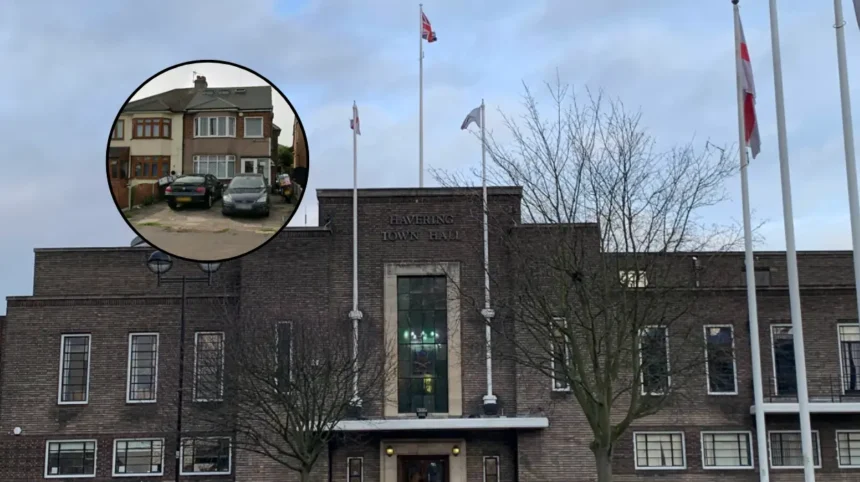
Havering (East London Times) September 1, 2026 – An unauthorised conversion of a semi-detached house into two separate living spaces has triggered official enforcement action by local authorities, requiring the owner to dismantle internal alterations and restore the property to a single family residence. As reported by local news outlets covering the Havering Borough, Havering Council issued a formal enforcement notice on August 27 regarding the property situated at 101 Collier Row Road. According to municipal officers, the dwelling was divided into two independent self-contained flats without obtaining requisite planning permission, violating borough-wide planning regulations and severely reducing the availability of quality family housing.
- Key Points
- Why did Havering Council deem Flat B and the overall conversion inadequate for residents?
- What specific timelines and removal steps must the property owner follow?
- Is this part of a wider enforcement campaign across the London Borough of Havering?
- Background of the Development
- Prediction: How This Development Can Affect Property Owners and Local Renters
The enforcement notice orders that the usage of the property as two distinct self-contained units must cease permanently. Council officers confirmed that the internal alterations failed to meet essential statutory requirements. Specifically, the converted premises failed to deliver standard family accommodation featuring direct access to the rear garden at ground floor level, whilst the overall gross internal floor area fell well below the mandatory 120 square metres minimum threshold required for such conversions.
As outlined in official council records and reported in local press coverage, planning officers stated that: “The development therefore has an adverse impact on the supply of family housing within the borough, the loss of which is not adequately justified, and which could set an undesirable precedent for similar development in the locality.”
Why did Havering Council deem Flat B and the overall conversion inadequate for residents?
Local authority inspectors highlighted significant shortcomings in the upper unit, designated as Flat B, describing its spatial setup as fundamentally unfit for proper domestic use. As cited in council documentation, the local authority criticized Flat B for being “inadequate” to serve as a three-bedroom, four-person accommodation.
Planning inspectors reported that the conversion produced “substandard accommodation for existing/future residents” due to severe restrictions on internal floorspace and the complete absence of direct, ground-level access to the property’s rear garden. Officers formally classified the property’s layout as being of “poor design and substandard residential accommodation, harmful to the amenities of the occupiers”.
Havering Council confirmed that adding retroactive planning conditions would fail to mitigate or resolve the structural deficiencies. Planning portal records reveal that two separate retrospective planning applications for the property—referenced under case files P1432.25 and P0403.26—had already been officially refused by municipal authorities prior to the service of the enforcement notice.
What specific timelines and removal steps must the property owner follow?
The legal notice sets out strict, staged deadlines for full remediation of the premises at 101 Collier Row Road. Unless a formal appeal is submitted to the Planning Inspectorate prior to the effective date of September 28, 2026, the enforcement orders become legally binding.
Upon the notice taking effect, the owner is given a window of three months to halt the use of the property as two separate dwellings and re-establish its layout as a single-family house. Additionally, a four-month deadline from the active date applies to the physical removal of unauthorised fixtures and internal modifications.
The owner must remove:
- The first-floor kitchen facilities and all associated cooking appliances.
- The secondary connecting door fitted between the ground-floor entrance lobby and the first-floor staircase.
- All surplus fuse boxes, secondary utility meters, and duplicate wiring/plumbing infrastructure installed to serve two households.
- Any resulting construction waste, rubbish, and structural debris, leaving the building cleared and fully converted back to a single unit.
Is this part of a wider enforcement campaign across the London Borough of Havering?
The action taken against 101 Collier Row Road is not an isolated incident within the borough. Municipal records show that just one week prior, on August 20, Havering Council served an identical enforcement notice to a residential property located at 164 Brentwood Road.
Like the Collier Row Road dwelling, the Brentwood Road property had been subdivided into two separate residences without planning authorization. Havering Council similarly ordered the owners of the Brentwood Road property to cease dual occupancy, remove all unauthorised kitchen and living fixtures, and fully restore the building to a single family residence. The back-to-back notices indicate a stepped-up, rigorous approach by local planning authorities against unapproved, sub-standard residential conversions across Romford and the wider borough.
Background of the Development
The enforcement action against 101 Collier Row Road comes against a backdrop of increasing strain on local suburban housing stock across Outer London boroughs like Havering. Over recent years, property values and private rental demand in Romford have escalated, creating commercial incentives for property owners to subdivide traditional semi-detached and terraced family homes into multiple self-contained units to maximize rental yields.
In response, local planning authorities have tightened enforcement around permitted development and change-of-use regulations. Under Havering Council’s local planning policies, converting a single family house into multiple flats requires rigorous assessment to ensure that the loss of single-family housing stock is justified, that room dimensions satisfy national spatial standards, and that residents retain adequate amenity space, private garden access, and refuse storage.
Before issuing the enforcement notice on August 27, 2026, the local authority evaluated two separate retrospective planning applications submitted for 101 Collier Row Road. The first application (P1432.25) sought retrospective approval to convert the house into two flats, which was refused by council planning officers. A subsequent retrospective application (P0403.26) proposing a reconfigured layout featuring one two-bedroom flat and one single-person flat was also turned down. Following these double refusals, the council exercised its statutory powers under the Town and Country Planning Act to issue a formal enforcement notice to halt unauthorised use and mandate structural remediation.
Prediction: How This Development Can Affect Property Owners and Local Renters
This enforcement decision by Havering Council carries immediate and long-term implications for local property owners, private landlords, prospective home buyers, and tenants living in the area.
- For Landlords and Property Developers: The strict terms of the enforcement notice send an unambiguous warning to landlords considering unpermitted house splits in Havering. Property owners who convert single-family homes without proper consent risk significant financial loss, as they face the costly physical restoration of properties, lost rental income, and potential legal fees or fines if they fail to comply within the specified three-to-four-month period. Furthermore, the explicit precedent set by rejecting applications P1432.25 and P0403.26 demonstrates that Havering Council will not grant retrospective approval for properties that fall short of minimum internal floor space rules (120 sqm threshold) or lack direct ground-floor garden access.
- For Local Renters and Tenants: In the immediate short term, tenants occupying unauthorised conversions like Flat B face housing disruption and potential relocation as landlords are forced to return properties to single-family use. However, in the medium to long term, strict enforcement protects tenants by curbing the proliferation of “substandard accommodation” that lacks adequate room sizes, daylight, and private garden space.
- For the Broader Local Community and Housing Market: By taking decisive action against unauthorized subdivisions at both Collier Row Road and Brentwood Road, the council actively defends the local supply of genuine family housing. Nearby homeowners benefit from maintained neighborhood density standards, reduced pressure on local street parking, and the prevention of uncoordinated developments that negatively alter the character and residential amenities of suburban streets in Romford.