


East London’s historic docklands preserve an important part of Britain’s maritime, industrial and commercial history. Along the River Thames, former warehouses, enclosed docks, Victorian quays, riverside buildings and converted industrial spaces reveal how London developed into one of the world’s major trading ports. Areas such as Wapping, Limehouse, the Isle of Dogs, West India Quay and the Royal Docks retain architectural and historical evidence of this transformation.
- What Are East London’s Historic Docklands and Why Are They Important?
- When Did London’s Historic Docklands Begin to Develop?
- How Did Historic Docklands Warehouses Operate?
- Which Historic Warehouses Can Visitors Explore in East London?
- 1. No. 1 Warehouse, West India Quay
- 2. No. 2 Warehouse, West India Quay
- 3. Tobacco Dock, Wapping
- 4. West India Quay Warehouse Conservation Area
- What Is the Maritime History of West India Docks?
- How Did Wapping Become an Important Maritime Heritage District?
- Where Can Visitors Discover Maritime Heritage Around Limehouse and the Isle of Dogs?
- What Role Did the Royal Docks Play in London’s Maritime Expansion?
- How Did the Decline of Commercial Shipping Transform East London?
- How Has East London Preserved Its Maritime Heritage Through Museums and Regeneration?
- What Can Tourists See and Do When Exploring East London’s Docklands?
- Start at West India Quay
- Continue Towards Canary Wharf
- Explore Wapping and Tobacco Dock
- Visit Limehouse Basin
- Explore the Royal Docks
- Why Are Historic Docklands Warehouses Important to East London’s Architecture?
- How Does East London’s Maritime Heritage Connect With British Trade and Colonial History?
- What Is the Future of East London’s Maritime Heritage?
- How Can Visitors Plan a Historic Docklands Heritage Trip in East London?
The docklands were once central to London’s international shipping industry. Ships transported sugar, tea, coffee, tobacco, spices, timber and other commodities into the capital. Dock workers unloaded cargo, warehouse employees stored imported goods, and merchants organised distribution throughout Britain. The buildings supporting this activity were designed for large-scale storage, secure handling and efficient movement of goods between ships, warehouses and transport networks.
Today, East London’s maritime heritage forms an important part of its cultural identity. Historic warehouses accommodate museums, restaurants, offices, exhibition spaces and creative businesses. Former dock basins provide waterfront walking routes, while preserved industrial buildings offer insight into Georgian and Victorian engineering. These locations connect contemporary East London with its commercial past and provide visitors with opportunities to explore the history of London’s river trade.
What Are East London’s Historic Docklands and Why Are They Important?
East London’s historic docklands are former commercial shipping areas along the River Thames, developed to receive, store and distribute imported goods. They preserve warehouses, dock basins, quays and industrial structures that explain London’s maritime expansion and international trading connections.
The term London Docklands describes the historic port districts along the Thames in East London. These districts include Wapping, Limehouse, the Isle of Dogs, Poplar, Blackwall and the Royal Docks. Their development transformed riverside communities into major centres of maritime commerce.
Before the construction of enclosed docks, ships frequently unloaded goods along the open river. This system created difficulties because vessels competed for limited space, cargo handling was exposed to river conditions, and valuable merchandise required greater security. Enclosed commercial docks provided controlled entrances, designated berths and adjoining warehouses.
The development of these facilities changed London’s relationship with international trade. Merchants gained more organised shipping infrastructure, while dock companies introduced systems for managing vessels, cargo and storage.
Historic docklands remain important for several reasons. Their buildings demonstrate early industrial architecture, their waterways preserve the original geography of commercial shipping, and their museums explain the economic and social consequences of maritime trade.
The surviving structures also document the relationship between London and international markets, particularly the Caribbean, Europe, Africa and Asia.
When Did London’s Historic Docklands Begin to Develop?
London’s enclosed dock development accelerated between 1800 and the early twentieth century. West India Docks opened in 1802, London Dock opened in 1805, and additional facilities expanded along the Thames to accommodate growing international shipping and commercial activity.
During the eighteenth century, London’s position as an international trading centre increased the volume of goods arriving through the River Thames. The existing riverside facilities struggled to accommodate growing commercial demand.
Parliamentary legislation enabled the development of new enclosed docks. The West India Dock Act of 1799 authorised the construction of the West India Docks on the Isle of Dogs. The project was promoted by merchants and the Corporation of London.
West India Docks opened in 1802 and established a new model for organised port infrastructure. London Dock followed in Wapping in 1805, providing dedicated facilities for commodities including tobacco, wine and other imported goods.
East India Docks received parliamentary approval in 1802 and opened in 1806. St Katharine Docks opened near the Tower of London in 1828, bringing additional commercial capacity closer to the historic centre.
During the nineteenth century, further dock developments included:
- Millwall Docks: Opened in 1868 on the Isle of Dogs to accommodate additional commercial shipping.
- Royal Victoria Dock: Opened in 1855 and developed as a major facility for large vessels.
- Royal Albert Dock: Opened in 1880 to increase the port’s handling capacity.
- King George V Dock: Opened in 1921 as another major component of the Royal Docks complex.
These developments created an extensive network of commercial facilities along the Thames.
How Did Historic Docklands Warehouses Operate?
Historic docklands warehouses stored imported commodities after ships unloaded their cargo. Dock workers transferred goods from vessels to quays, used lifting equipment to move heavy consignments into storage, and organised distribution through road, river and canal transport networks.
Warehouses were essential components of London’s maritime infrastructure. They protected valuable merchandise and provided organised storage before goods entered the domestic market.
Their location beside dock basins reduced the distance between ships and storage facilities. This arrangement allowed workers to transfer cargo directly from vessels into warehouse buildings.
Warehouse operations followed several connected stages.
First, ships entered an enclosed dock through controlled entrances. Harbour and dock personnel managed vessel movements and allocated berthing positions.
Second, dock workers unloaded cargo onto the quays. Goods arrived in different forms, including barrels, sacks, wooden crates and bales.
Third, workers moved merchandise into warehouses using cranes, hoists, pulleys and internal handling equipment. Buildings contained multiple floors to maximise storage capacity within limited waterfront space.
Fourth, warehouse employees recorded incoming and outgoing consignments. Customs officials and commercial representatives checked goods, quantities and documentation.
Finally, merchants arranged the transportation of cargo to wholesalers, manufacturers, retailers and other destinations.
What Architectural Features Made These Warehouses Different?
Historic dock warehouses combined strong construction with practical cargo-handling arrangements. Their architectural features included:
- Brick exterior walls: Provided durable protection for stored merchandise.
- Large loading openings: Allowed goods to enter through dock-facing doors.
- Timber floors and roof structures: Supported internal storage and working areas.
- Cast-iron columns: Supported upper floors while maintaining usable internal space.
- Hoisting equipment: Enabled workers to move heavy goods between floors.
- High-security entrances: Controlled access to valuable imported commodities.
The surviving West India Quay warehouses demonstrate these characteristics particularly clearly.
Historic England identifies the surviving warehouses and associated offices as Grade I listed buildings. The original development included nine warehouses, but only Warehouses No. 1 and No. 2 survive from that range.
Which Historic Warehouses Can Visitors Explore in East London?
East London contains several surviving dockland warehouses and converted industrial buildings that demonstrate its maritime past. Important examples include No. 1 Warehouse at West India Quay, Tobacco Dock in Wapping and historic warehouse buildings around the former commercial dock network.
The surviving warehouses provide direct evidence of how London’s port operated. Some buildings retain their original industrial character, while others have been adapted for museums, events, hospitality and commercial activities.
1. No. 1 Warehouse, West India Quay
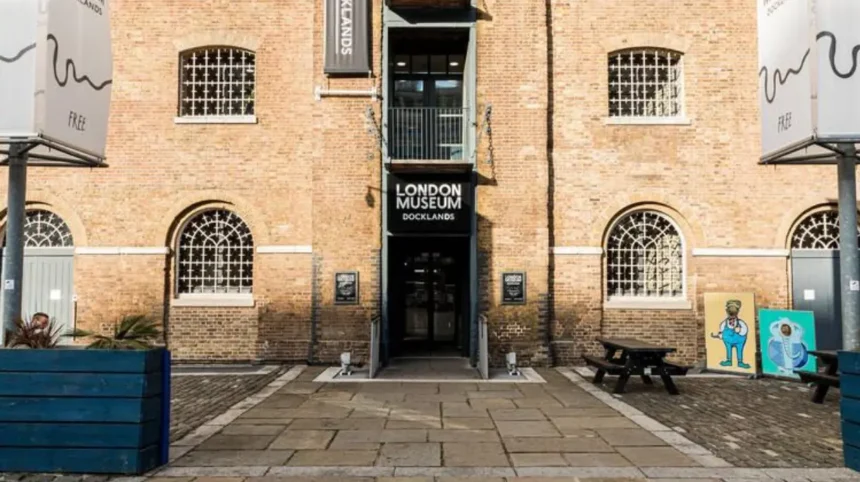
No. 1 Warehouse is one of East London’s most significant surviving maritime buildings. Located at West India Quay in the Isle of Dogs, it was originally constructed to store imported commodities arriving through the West India Docks.
The warehouse dates from the early nineteenth century. Its original construction began around 1800–1802, and the building was subsequently extended in 1827.
The structure originally stored sugar, rum, coffee and other imported products. Its brick walls, internal timber construction, loading openings and warehouse equipment demonstrate the practical requirements of nineteenth-century commercial storage.
The building now accommodates London Museum Docklands. Its historical galleries explain the development of London’s port, international trade, industrial expansion and dockland communities.
Visitors can examine the relationship between the original warehouse architecture and the commercial activities that once took place inside it.
2. No. 2 Warehouse, West India Quay
No. 2 Warehouse is another important survivor of the original West India Docks development. Constructed in 1802, it is recognised for its early multi-storey warehouse architecture.
Historic England identifies its cast-iron structural elements as significant evidence of early industrial building techniques. The warehouse is particularly important because it preserves architectural features associated with the earliest enclosed dock system in London.
The original warehouse complex extended for more than half a mile along the North Quay. Its buildings were connected by lower sections and formed part of a coordinated commercial storage system.
Today, No. 2 Warehouse contributes to the historic character of West India Quay and the surrounding conservation area.
3. Tobacco Dock, Wapping
Tobacco Dock is a major surviving example of London’s nineteenth-century warehouse architecture. It forms part of the historic London Dock complex in Wapping, which opened in 1805.
The London Dock handled imported commodities including tobacco, wine, tea, spices and other luxury goods. Large warehouse buildings and underground storage vaults supported the commercial activities of the dock.
Tobacco Dock preserves the industrial character of this former trading environment. Its substantial brick construction, internal spaces and historic setting demonstrate the scale of storage facilities required by London’s maritime economy.
The building now operates as an events and commercial venue. Its reuse illustrates how historic industrial architecture supports contemporary cultural and business activities.
4. West India Quay Warehouse Conservation Area
West India Quay contains one of the most recognisable concentrations of surviving historic dockland buildings in East London.
The area developed alongside the West India Docks, with warehouses positioned close to the water to support the movement and storage of imported commodities.
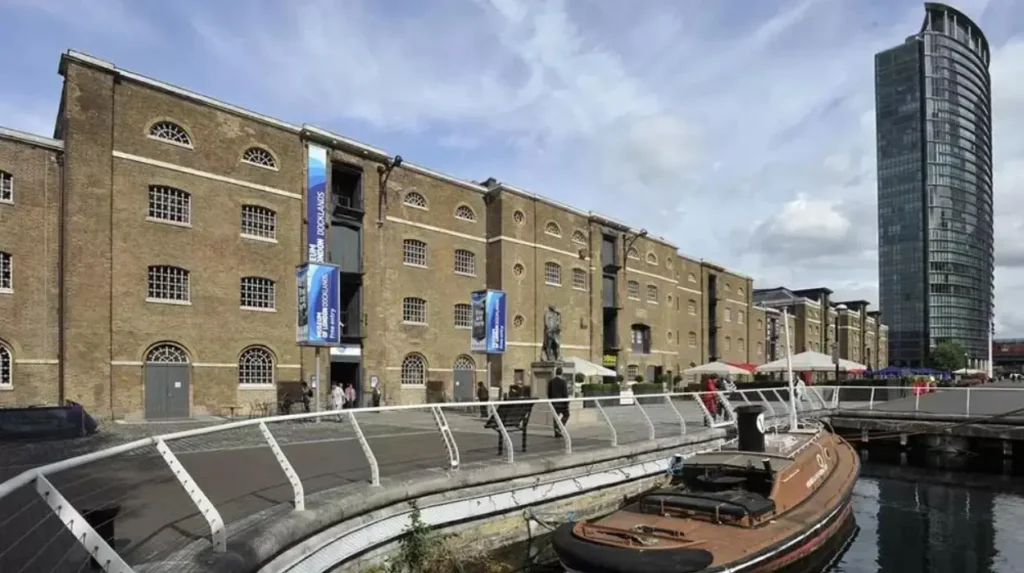
The remaining Georgian warehouse buildings preserve the scale and architectural character of the original dock complex. Their relationship with the water, historic quay walls and surrounding industrial structures helps visitors understand the original commercial layout.
The conservation area also demonstrates how heritage protection maintains historic buildings within a rapidly changing urban environment.
What Is the Maritime History of West India Docks?
West India Docks opened in 1802 on the Isle of Dogs as London’s first enclosed commercial dock system. The docks handled Caribbean imports, including sugar, rum and coffee, and became central to London’s international maritime economy.
The West India Docks represent a defining development in London’s maritime history. Their construction introduced a more controlled approach to commercial shipping and cargo storage.
The dock complex was developed to improve the handling of goods arriving from the Caribbean. Its warehouses were designed to protect valuable commodities and reduce the commercial risks associated with open riverside unloading.
The original dock arrangement included separate import and export facilities. Ships entered through designated basins, while warehouses occupied important positions along the quays.
Which Goods Arrived Through West India Docks?
The docks received several important categories of imported commodities.
Sugar and molasses were among the most significant products. These commodities were closely connected to Caribbean plantation economies and the exploitation of enslaved African people.
Other imports included rum, coffee, tobacco and spices. These products supplied London’s growing consumer markets and supported commercial networks across Britain.
West India Docks remained an important shipping centre throughout the nineteenth and twentieth centuries. Its commercial activity continued after the abolition of the British slave trade in 1807 and the abolition of slavery across most of the British Empire in 1833.
Understanding this history requires recognising the human exploitation behind much of the wealth generated through Caribbean trade.
London’s maritime expansion was not simply a story of engineering and commercial progress. It was also connected to colonialism, plantation economies and the transatlantic slave trade.
How Did Wapping Become an Important Maritime Heritage District?
Wapping developed as an important maritime district because its position beside the River Thames supported commercial shipping, warehouse construction and dock operations. London Dock opened in 1805, creating major facilities for imported wine, tobacco, tea and other goods.
Wapping occupies a historic riverside position in the London Borough of Tower Hamlets. Its waterfront developed around commercial shipping, dock labour and warehouse operations.
The opening of London Dock in 1805 transformed the district into an organised commercial port. Its facilities included enclosed water basins, large warehouses and underground storage areas.
The surrounding neighbourhood also developed to support maritime employment. Sailors, dock workers, merchants, warehouse employees and other workers formed part of the local economy.
What Was Sailortown?
Sailortown describes the historic neighbourhood environment associated with sailors and maritime workers near London’s docks.
These communities contained lodging houses, public houses, shops, workshops and other services. They supported people arriving in London through international shipping routes.
The area’s cultural identity reflected its international connections. Sailors and workers from different countries contributed to the social and commercial character of riverside East London.
London Museum Docklands includes a recreated Victorian Sailortown environment, providing visitors with an introduction to the streets and working conditions associated with this period.
What Happened to Wapping’s Historic Docks?
The commercial importance of London Dock declined as shipping technology and cargo-handling practices changed.
The dock closed in 1968. Its closure reflected wider changes in London’s port industry, particularly the movement of commercial shipping towards larger facilities further downstream.
Parts of the historic dockland landscape were subsequently redeveloped. Tobacco Dock remains an important example of industrial building reuse, while other surviving structures and waterways preserve evidence of the district’s maritime past.
Where Can Visitors Discover Maritime Heritage Around Limehouse and the Isle of Dogs?
Limehouse and the Isle of Dogs preserve important connections to East London’s maritime economy through historic basins, former dock infrastructure, riverside warehouses and converted industrial buildings. Limehouse Basin and West India Quay provide accessible locations for exploring this heritage.
Limehouse developed around the commercial relationship between the Thames, the River Lea and London’s inland waterways.
Its location made it important for transferring goods between coastal shipping and the canal network. Barges transported merchandise inland, connecting the docks with industrial towns and commercial centres.
Limehouse Basin
Limehouse Basin, historically known as Regent’s Canal Dock, opened in 1820. It connected Regent’s Canal with the River Thames and provided an important transfer point between river vessels and canal boats.
The basin supported the movement of goods such as coal, timber and manufactured products. It also helped connect London’s riverside industries with inland transport networks.
Today, Limehouse Basin provides a visible connection between London’s historic waterways and its modern residential environment.
Visitors can explore the surrounding waterfront, observe canal boats and examine the relationship between the basin and the Thames.
Millwall Docks
Millwall Docks opened in 1868 on the Isle of Dogs. They expanded the commercial capacity of the West India Docks and supported the handling of different categories of cargo.
Their development reflected the growing demand for larger and more specialised dock facilities during the nineteenth century.
The surviving dock basins remain important features of the Isle of Dogs landscape. Modern residential and commercial developments surround much of the historic water infrastructure.
Canary Wharf and West India Quay
Canary Wharf represents the transformation of former industrial dockland into a major financial and business district.
The area’s modern office towers stand close to historic warehouses, dock walls and water basins. This combination provides a clear example of how East London has incorporated its industrial heritage into contemporary urban development.
West India Quay is particularly relevant because its surviving warehouses remain closely connected to the original dock landscape.
As you explore the modern financial district, you are crossing land with a much older commercial identity. Read the full [Historical Development of East London: From Roman Settlements to a Modern Urban Centre] to understand the area’s origins and its transformation across different historical periods.
What Role Did the Royal Docks Play in London’s Maritime Expansion?
The Royal Docks formed a major nineteenth- and twentieth-century shipping complex in East London. Royal Victoria Dock, Royal Albert Dock and King George V Dock provided facilities for large vessels, commercial cargo handling and international maritime trade.
The Royal Docks occupy a large riverside area in the London Borough of Newham. Their development expanded London’s capacity to handle international shipping as commercial vessels became larger and cargo volumes increased.
Royal Victoria Dock opened in 1855. It was designed to accommodate large ships and included facilities for handling different types of commercial cargo.
Royal Albert Dock opened in 1880 and expanded the area’s maritime infrastructure. King George V Dock followed in 1921, completing an important phase of dock development.
Together, these facilities became a major component of the Port of London.
What Industrial Features Remain Around the Royal Docks?
The Royal Docks retain several features associated with their commercial past.
These include historic dock basins, waterfront infrastructure, surviving industrial buildings and former loading areas. Some original structures have been replaced or adapted, but the scale of the waterways still demonstrates the engineering ambitions behind the dock system.
The Royal Victoria Dock waterfront also provides opportunities to understand the relationship between maritime transport and modern regeneration.
Visitors can explore the surrounding public spaces and observe how former industrial land has developed into a mixed-use urban district.
How Have the Royal Docks Changed?
The Royal Docks experienced major changes during the twentieth century. Containerisation reduced the need for traditional enclosed docks and labour-intensive warehouse operations.
The Royal Docks closed to commercial shipping in 1981. Their former industrial land subsequently became part of a wider regeneration programme.
Today, the area includes residential developments, business facilities, exhibition spaces and waterfront attractions. Its maritime geography remains visible through the surviving dock basins and large-scale industrial layout.
How Did the Decline of Commercial Shipping Transform East London?
East London’s traditional dock industry declined during the twentieth century as containerisation, larger ships and changing cargo-handling methods shifted commercial shipping towards downstream ports. West India and Millwall Docks stopped general cargo operations in 1980, followed by the Royal Docks in 1981.
For much of the nineteenth and twentieth centuries, East London’s economy depended on dock employment. Commercial shipping supported thousands of jobs across cargo handling, warehousing, transportation, ship maintenance and associated services.
However, changes in international shipping gradually reduced the importance of traditional enclosed docks.
What Was Containerisation?
Containerisation is a cargo transportation system that uses standardised containers to move goods between ships, lorries and trains.
Before containerisation became widespread, dock workers handled individual packages, sacks, barrels and crates. This required large workforces and extensive warehouse facilities.
Container shipping introduced more efficient cargo transfer methods. Large cranes could move standardised containers between vessels and transport vehicles with less manual handling.
The change reduced the need for traditional warehouses and labour-intensive dock operations.
When Did London’s Historic Docks Close?
The decline happened over several decades rather than through one closure event.
West India and Millwall Docks ended general cargo operations in 1980. The Royal Docks followed in 1981.
The Port of London Authority records the importance of this transition. Commercial activity through London’s enclosed docks reached a peak in 1964, when the port handled 61 million tons of cargo.
This figure demonstrates the scale of London’s maritime industry before the full impact of containerisation and shipping relocation.
What Happened to the Dock Workers?
The decline of traditional dock operations affected employment across East London.
Dock workers, warehouse employees, transport workers and businesses associated with shipping experienced significant economic changes.
The loss of industrial employment contributed to wider economic challenges in former dockland communities. Regeneration programmes subsequently introduced new residential, commercial and cultural uses.
This transformation changed the physical appearance of East London while preserving parts of its maritime infrastructure.
How Has East London Preserved Its Maritime Heritage Through Museums and Regeneration?
East London preserves maritime heritage through historic building protection, museum collections, restored waterfront spaces and the adaptive reuse of industrial structures. London Museum Docklands, Tobacco Dock and West India Quay demonstrate different approaches to conserving the area’s commercial history.
Heritage conservation involves protecting buildings, landscapes and historical evidence that contribute to an area’s cultural significance.
In East London, conservation is particularly important because modern development has transformed much of the original dockland environment.
Several approaches support the preservation of maritime heritage.
Museum conservation: Historic objects, documents, photographs and architectural features help explain the development of London’s port.
Building restoration: Historic warehouses retain their original architectural features through repair and conservation work.
Adaptive reuse: Former industrial structures receive new functions without completely removing their historic character.
Waterfront regeneration: Former commercial dock areas become public spaces, residential districts and cultural destinations.
London Museum Docklands
London Museum Docklands is a major cultural attraction located in the former No. 1 Warehouse at West India Quay.
Its galleries explore the history of the River Thames, international trade, dockland communities, slavery, wartime experiences and the redevelopment of London’s port.
The museum’s historic building is an important part of the experience because its architecture connects the exhibitions with the original commercial activities.
Its collections also preserve evidence of the people who worked in the port and the international communities connected to maritime trade.
Historic England and Listed Building Protection
Historic England maintains the National Heritage List for England, which records buildings and structures recognised for their architectural and historical importance.
Grade I listing identifies buildings of exceptional special architectural or historic interest.
The surviving West India Dock warehouses are Grade I listed. Their designation recognises their Georgian architecture, industrial significance and relationship with the development of London’s enclosed docks.
Listing provides statutory protection and helps guide decisions about alterations, restoration and development.
What Can Tourists See and Do When Exploring East London’s Docklands?
Visitors can explore East London’s maritime heritage through historic warehouses, museum exhibitions, riverside walks, preserved dock basins and converted industrial buildings. West India Quay, Wapping, Limehouse and the Royal Docks provide opportunities to discover different aspects of port history.
Exploring the docklands on foot provides an opportunity to understand how the original commercial landscape relates to modern East London.
A heritage visit can include architectural observation, museum exhibitions, waterfront photography and exploration of historic waterways.
Start at West India Quay
West India Quay provides a useful starting point because it contains surviving Georgian warehouses and the London Museum Docklands building.
Visitors can examine the exterior architecture, observe the historic dock basin and explore the surrounding waterfront.
The area also provides views of Canary Wharf’s modern commercial buildings, demonstrating the contrast between nineteenth-century maritime infrastructure and contemporary financial development.
Continue Towards Canary Wharf
The walk towards Canary Wharf introduces visitors to the modern redevelopment of the Isle of Dogs.
The route passes commercial buildings, public spaces and sections of the former dock network.
Visitors can examine how historic waterfront infrastructure has been incorporated into a modern business district.
Explore Wapping and Tobacco Dock
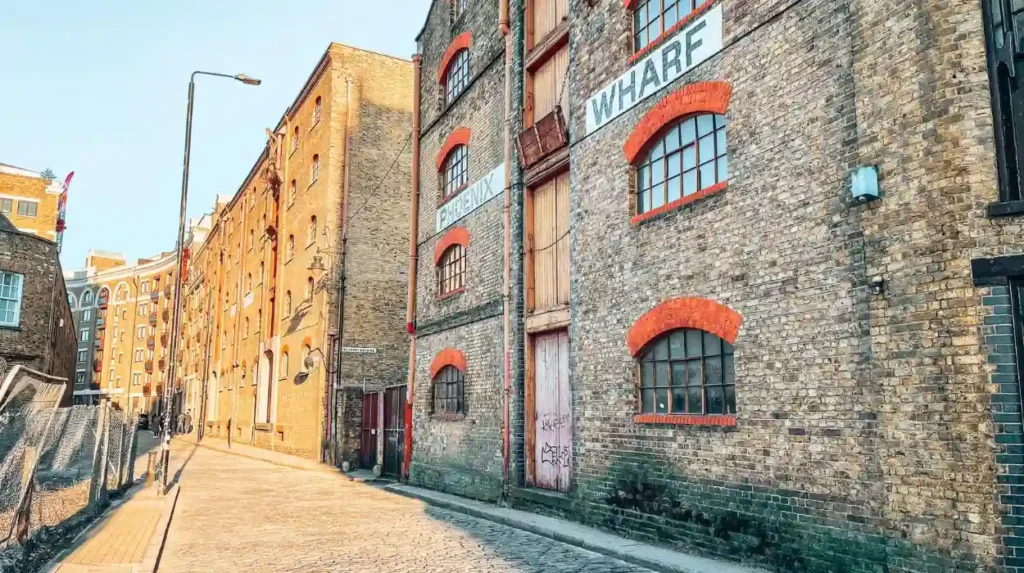
Wapping offers a different historical environment, with former warehouse buildings, historic streets and remnants of London’s commercial dock system.
Tobacco Dock provides an important example of industrial architecture adapted for contemporary events.
The surrounding district also provides opportunities to explore the relationship between maritime employment, historic housing and the Thames.
Visit Limehouse Basin
Limehouse Basin provides a connection between London’s historic docklands and its inland canal network.
Visitors can observe narrowboats, historic waterways and the surrounding residential architecture.
The basin demonstrates how commercial cargo moved between the Thames and inland destinations.
Explore the Royal Docks
The Royal Docks provide a broader understanding of London’s industrial expansion.
Their large dock basins and waterfront spaces demonstrate the scale of infrastructure required to accommodate twentieth-century shipping.
A visit also reveals how former industrial land has become part of a modern urban regeneration area.
Why Are Historic Docklands Warehouses Important to East London’s Architecture?
Historic docklands warehouses are important because they preserve evidence of Georgian and Victorian industrial architecture. Their brick construction, cast-iron supports, timber floors and cargo-loading arrangements demonstrate how buildings were designed for large-scale commercial storage.
East London’s historic warehouses represent an important stage in the development of industrial building design.
Their architecture was influenced by commercial requirements rather than decorative purposes. Buildings needed to accommodate large quantities of merchandise, withstand intensive use and provide efficient access for workers.
Georgian Warehouse Design
Georgian warehouse architecture developed during a period of expanding British commerce.
Buildings typically featured substantial brick walls, repetitive window arrangements and practical internal structures.
The surviving West India Quay warehouses demonstrate how these architectural features supported commercial activity.
Victorian Industrial Engineering
Victorian dock infrastructure introduced further developments in engineering and industrial construction.
Cast iron became increasingly important in supporting multi-storey industrial buildings. Its structural properties allowed architects and engineers to create large internal working spaces.
Dock cranes, mechanical hoists and improved handling equipment also increased the efficiency of cargo movement.
Why Is Adaptive Reuse Important?
Adaptive reuse describes the process of giving an existing building a new function while retaining important architectural features.
East London demonstrates this approach through museums, events venues, offices and commercial spaces located in former industrial buildings.
This approach retains historic structures within the modern city and reduces the need to replace every former industrial building with new construction.
It also supports cultural tourism by allowing visitors to experience historic buildings as functioning parts of contemporary urban life.
How Does East London’s Maritime Heritage Connect With British Trade and Colonial History?
East London’s maritime heritage is closely connected to Britain’s international trading networks, colonial expansion and the transatlantic slave trade. Historic dock warehouses stored commodities produced through global commercial systems, including sugar from Caribbean plantations worked by enslaved Africans.
The history of East London’s docks requires an understanding of the economic systems that supported their development.
The West India Docks were specifically established to handle commodities arriving from Caribbean plantation economies.
Sugar production generated substantial commercial wealth for merchants, plantation owners and investors. However, this wealth depended heavily on the forced labour and exploitation of enslaved Africans.
The British slave trade was abolished in 1807. Slavery was subsequently abolished across most of the British Empire through legislation enacted in 1833, with the main provisions taking effect in 1834.
The West India Docks continued operating long after these legal changes. Their commercial importance remained connected to Caribbean imports and wider international trade.
London Dock also handled commodities connected to Britain’s imperial trading networks, including tobacco, tea, wine and spices.
The surviving warehouses therefore represent more than architectural achievements. They provide physical evidence of the economic relationships, inequalities and human experiences that shaped London’s development.
London Museum Docklands addresses these subjects through its historical exhibitions and collections.
Explore More Area Guide
Discover Public Gardens and Quiet Outdoor Spaces in Tower Hamlets
Isle of Dogs Green Spaces: Parks, Gardens and Walks
What Is the Future of East London’s Maritime Heritage?
East London’s maritime heritage remains relevant through historic building conservation, cultural tourism, waterfront regeneration and public education. Former warehouses and dock basins provide opportunities to retain industrial history while supporting modern economic, cultural and community activities.
The future of Docklands depends on balancing development with the preservation of historic buildings and landscapes.
Canary Wharf, West India Quay, Wapping and the Royal Docks demonstrate how former industrial districts can accommodate new uses without completely losing their maritime identity.
Several areas remain important for future heritage management.
Historic building protection: Listed warehouses require appropriate maintenance and conservation to retain their architectural features.
Museum development: Collections and exhibitions preserve historical evidence for future generations.
Public access: Waterfront walking routes and accessible cultural spaces help visitors understand the original dock geography.
Sustainable regeneration: Reusing existing industrial buildings supports the continued use of historic structures within changing urban environments.
Historical education: Museums and heritage organisations provide information about international trade, slavery, migration, industrial employment and dockland communities.
These priorities ensure that maritime heritage remains part of East London’s cultural and educational landscape.
How Can Visitors Plan a Historic Docklands Heritage Trip in East London?
Visitors can plan a Docklands heritage trip by selecting historic sites within the Isle of Dogs, Wapping, Limehouse or the Royal Docks. Combining museum visits, warehouse architecture and waterfront walks provides a structured introduction to East London’s maritime history.
The best route depends on the available time and the visitor’s interest in architecture, museums or industrial history.
Suggested Half-Day Heritage Route
A half-day visit can focus on the historic Isle of Dogs and nearby dockland areas.
- West India Quay: Explore the historic warehouses and surrounding dock basin.
- London Museum Docklands: Discover the history of trade, shipping and dockland communities.
- Canary Wharf: Examine the transformation of former dockland into a modern business district.
- Millwall Dock: Observe the surviving industrial water landscape.
Suggested Full-Day Heritage Route
Visitors should check access arrangements before travelling. Some historic warehouses operate as private venues rather than public attractions.
London Museum Docklands publishes its current visitor information, exhibitions and access arrangements on its official museum website. Its published information also identifies a new museum opening date of 28 November 2026, so visitors planning trips around that transition should check the latest arrangements.
The museum is located at No. 1 Warehouse, West India Quay, London E14 4AL.
East London’s historic docklands provide an important record of Britain’s maritime, industrial and commercial development. Their warehouses, enclosed docks, quays and industrial buildings demonstrate how international shipping transformed the eastern side of London.
West India Quay, Tobacco Dock, Limehouse Basin, Wapping and the Royal Docks each preserve different aspects of this history. Together, they explain the development of commercial shipping, warehouse engineering, dock employment and international trade.
The transformation of these former industrial districts into museums, cultural venues, business centres and residential neighbourhoods demonstrates the continuing importance of heritage conservation.
For tourists, historians, architecture enthusiasts and local residents, exploring East London’s docklands provides a direct connection to the buildings, waterways and communities that shaped the city’s maritime identity.
What are the historic docklands in East London?
East London’s historic docklands are former commercial shipping areas along the River Thames. They include Wapping, Limehouse, West India Quay, the Isle of Dogs and the Royal Docks. These districts preserve historic warehouses, dock basins and industrial buildings.
