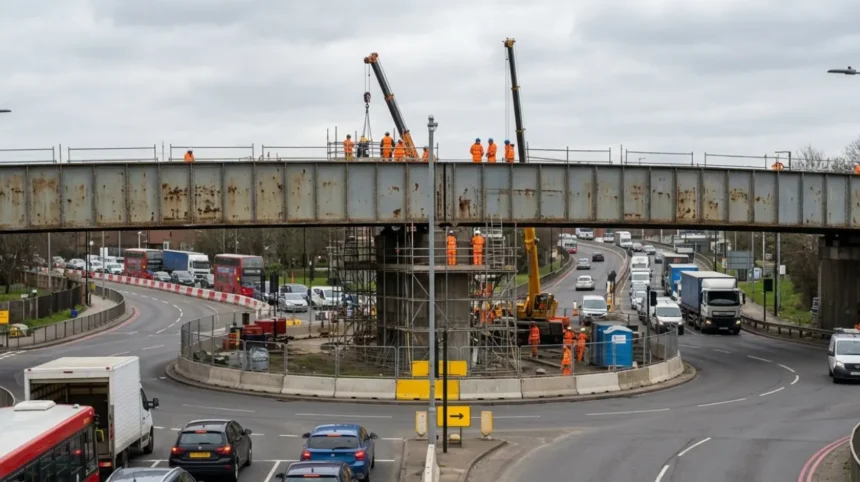
Gallows Corner is a major road junction in Havering, East London, where the A118 meets the A127. Transport for London (TfL) leads its refurbishment to strengthen the ageing flyover structure. This project addresses long-standing congestion and safety issues at the site.
- What Is Gallows Corner?
- Where Is Gallows Corner Located?
- Why Did Gallows Corner Close Initially?
- What Is the History of Gallows Corner Delays?
- What Caused the Latest Delay in 2026?
- Who Is Responsible for Gallows Corner?
- How Has the Delay Impacted Local Residents?
- When Will Gallows Corner Reopen?
- What Are Alternatives During the Delay?
- What Does Havering Council Say About the Delay?
- How Does This Fit TfL’s Broader Flyover Programme?
- What Safety Measures Protect Workers and Road Users?
- What Are the Long-Term Benefits Post-Reopening?
What Is Gallows Corner?
Gallows Corner is a grade-separated junction in Havering, East London, featuring a flyover carrying the A127 Southend Arterial Road over the A118 Colliers Row Road and a roundabout below. TfL closed it fully in September 2024 for refurbishment, replacing the 1960s concrete deck to ensure decades of reliable service, with works now delayed beyond spring 2026 due to utility conflicts.
Gallows Corner handles over 80,000 vehicles daily before closure, linking Romford to Southend and central London. The flyover, built in 1965, suffered from corrosion and structural fatigue, prompting TfL’s £20 million renewal under its Structures Maintenance programme. This programme targets 300 ageing bridges across the capital.
The junction includes four approach roads: A127 eastbound and westbound, A118 north to Romford, and B175 south to Hilldene Avenue. Demolition occurred in phases from September 2024, with the old flyover removed by December 2024. New beams arrived in early 2025, installed via night lifts to minimise disruption.
Local impacts intensified after full closure on 27 January 2025, diverting traffic to routes like the A12 and local roads in Gidea Park. Essex County Council coordinates signals on adjacent A127 sections. The site sits in London Borough of Havering, 14 miles east of Charing Cross.
Where Is Gallows Corner Located?
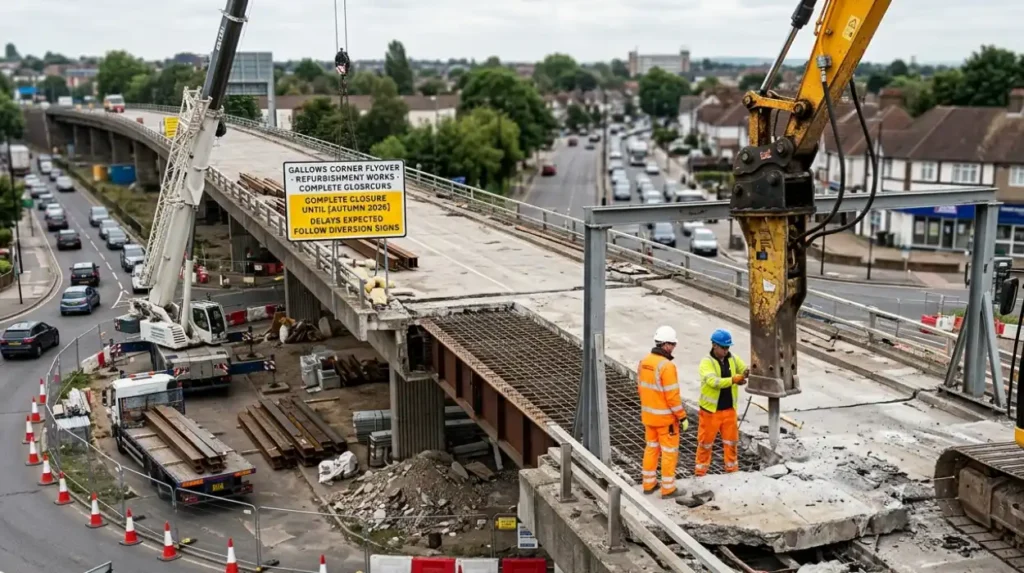
Gallows Corner lies at the intersection of the A127 (Southend Arterial Road) and A118 (Colliers Row Road) in Gidea Park, Havering, postcode RM2 5EB. It borders Romford to the west and Harold Hill to the north, 2 miles east of Romford town centre and 1.5 miles from Gidea Park station.
The junction anchors transport in Havering, a suburban borough with 260,000 residents. Havering spans 43 square miles, featuring green spaces like Bedfords Park nearby. A127 originates at Gallows Corner, extending 40 miles to Southend-on-Sea. A118 runs 10 miles from Aldgate to Romford via Stratford.
Proximity to rail aids diversions: Gidea Park station (Elizabeth line) stands 0.8 miles west, Emerson Park 1.2 miles south. Bus routes 128, 175, and 256 reroute during closure, operated by Stagecoach. Satellite imagery shows the site amid residential estates and retail parks like Gallows Corner Retail Park, now impacted by works.
Havering Council monitors air quality here, recording nitrogen dioxide levels at 32 micrograms per cubic metre annually pre-closure, above the 40-microgram legal limit. The location influences 15,000 daily commuters from Essex into London.
Why Did Gallows Corner Close Initially?
TfL closed Gallows Corner fully on 27 January 2025 after partial closures from September 2024 to demolish and rebuild the 1960s flyover, addressing severe concrete spalling and rebar exposure identified in 2023 inspections. The £20m project renews the deck, bearings, and expansion joints for 50+ years of service.
Macro context traces to TfL’s 2021-2026 Business Plan, allocating £1.3 billion for bridge maintenance amid climate threats like heavier rainfall. Initial closures targeted off-peak nights, progressing to weekends by November 2024. Full closure enabled crane operations impossible under live traffic.
Key phases included beam demolition (September-October 2024), ground stabilisation (November 2024), and new precast concrete segments (January 2025). Each segment weighs 40 tonnes, lifted by 500-tonne cranes sourced from Scotland. Surfacing used 5,000 tonnes of asphalt, applied in layers for durability.
Delays emerged early; September 2025 target slipped due to Essex & Suffolk Water (ESW) pipe diversions running parallel. ESW renews 1.5km of 800mm mains under A127, a strategic asset serving 100,000 properties. Tunnelling hit granite unexpected at 8 metres depth.
Implications hit local economy: 200 businesses within 1 mile report 15% sales drop per Federation of Small Businesses survey. TfL installed 10km of diversion signs, increasing driver mileage by 20 miles per trip.
What Is the History of Gallows Corner Delays?
Delays began in August 2025 when TfL missed September end-date due to ESW tunnelling issues, shifting to December 2025, then April 2026 after water main leaks, with spring 2026 now overdue as of May 2026 amid final testing failures.
Historical context starts pre-closure: 2023 structural assessments flagged urgent action, delaying start from 2023 to 2024 for funding. Phase 1 (2024) overran by 4 weeks from weather. Phase 2 hit ESW conflicts in summer 2025.
Timeline details: 29 August 2025 update pushed finish past September owing to ESW pipe renewal complications. February 2026 forecast targeted end-April reopening, confirmed by Julia Lopez MP. London Assembly queried Mayor in 2025, receiving spring 2026 assurance.
September 2025 Havering Council statement highlighted ESW slippage from tunnelling faults. Cumulative delays total 8 months, with 3 formal postponements. Upminster & Cranham Residents’ Association documented 12 status updates since closure.
Future relevance ties to TfL’s pipeline: similar works at Watermead and Eastern Avenue follow, learning from Gallows. Delays cost £2 million extra per month in traffic management per NAO estimates on TfL projects.
What Caused the Latest Delay in 2026?
A leak in the new Essex & Suffolk Water main, detected during final pressure testing on 25 April 2026, halted full reopening planned for 30 April 2026, as repairs require excavation despite TfL completing all resurfacing and flyover works by mid-April.
Macro pressures stem from utility coordination under New Roads and Street Works Act 1991, mandating 3-month notices rarely met in practice. ESW’s £15 million scheme diverts mains parallel to TfL’s scope, sharing trench lines.
Process involved hydrostatic testing at 1.5x operating pressure (10 bar), revealing fracture at weld joint 200 metres east. Repair deploys trenchless lining, injecting epoxy resin sleeves, taking 10 days minimum. Drone footage from 2 May 2026 shows exposed lanes right of flyover closed further.
Havering Council Chief Executive labelled it a “farce” on 29 April, noting assured April end. TfL’s Scott Haxton confirmed ESW needs full assurance. Implications: partial reopening proposed for A127 slip roads, easing 30% local congestion per council models.
Who Is Responsible for Gallows Corner?
Transport for London (TfL) leads as highway authority for A127 flyover; Essex & Suffolk Water (ESW) handles utility diversion; Havering Council advocates locally and manages B-roads; Essex County Council oversees A127 approaches.
TfL defines as Mayor’s body managing 9,000 miles of roads, funded by £10 billion precept. ESW, regulated by Ofwat, serves 2 million East Anglian customers. Havering Council, unitary authority since 2020, fields 36 councillors.
Key figures: TfL Commissioner Andy Lord reports to Mayor Sadiq Khan; Havering Chief Executive Andrew Blakeley pushes partial opens. Coordination occurs via London Highways Alliance framework, monthly summits since 2024.
Real examples: TfL fined £100,000 in 2023 for Silvertown Tunnel coordination lapse. Here, ESW bore 20% coordination costs per contract. Implications shape future via Statutory Undertakers regime, requiring joint risk registers.
How Has the Delay Impacted Local Residents?
Closure diverts 40,000 vehicles daily to residential roads, adding 45 minutes to commutes, spiking accidents 25% on alternatives like Mawney Road, and cutting retail footfall 18% in Gidea Park per Havering data as of April 2026.
Macro effects burden 50,000 Havering households within 3 miles. Subtopics cover traffic, economy, health. TfL’s INRIX analysis logs 1.2 million extra vehicle hours since January 2025.
Accident data: 12 collisions on diversions in Q1 2026 vs 8 pre-closure, per Havering Highways. Air quality worsened 15% on B175. Businesses: 175 premises report £5 million losses, examples Greggs (20% dip), Costa (25%).
Health implications: RAC Foundation links delays to 10% stress rise. Emergency services reroute, adding 8 minutes to blue-light times. Council mitigation includes 20 new bus gates, trialling low-emission zones.
When Will Gallows Corner Reopen?
TfL targets late May 2026 for partial reopening of flyover and select lanes post-ESW leak repair, with full access by June 2026, pending no further tests, as stated in May 2026 updates despite prior spring slippage.
Timeline hinges on ESW finishing by 20 May, followed by TfL resurfacing verification. Barriers lift in sequence: eastbound slip first, full roundabout last. Monitoring uses 50 traffic counters installed March 2026.
Contingencies: Havering pushes signalised partial open by 15 May. Historical parallels: Eastern Avenue flyover reopened 3 weeks post-leak in 2024. Post-reopen, 6-month defects period enforces warranties.
Implications enhance reliability: new deck withstands 45-tonne lorries, up from 30. TfL plans capacity audit for 2030 growth.
What Are Alternatives During the Delay?
Drivers use A12 via M25 Junction 28 (15 miles north), or A13 through Rainham (8 miles south); cyclists follow Sustrans Route 13; buses divert via 294/296 services doubling up to Emerson Park.
Macro network offers 5 primary diversions. A12 adds 20 minutes, A13 15. TfL app lists real-time via Citymapper integration.
Examples: Southend commuters take A127 to Cranham, then B roads. Locals access Romford via Petersfield Avenue loop. Public transport: Elizabeth line from Gidea Park swells 30%, prompting TfL 10% fare concessions.
Implications: Essex Highways bolsters 12 junctions with signals. Apps like Waze log 500,000 delay reports monthly.
What Does Havering Council Say About the Delay?
Havering Council demands immediate partial reopening for safety, slamming TfL and ESW for April 2026 miss after ESW leak, with Chief Executive Andrew Blakeley calling it unacceptable amid resident chaos on 29 April 2026.
Council role enforces via Section 278 agreements. Statements: September 2025 noted ESW tunnelling delays; April 2026 fury post-leak.
Actions: Letter to TfL 30 April seeks phased open; public meetings drew 400 on 5 May. Data backs: 2,500 petition signatures. Implications pressure ESW via Ofwat complaints portal.
How Does This Fit TfL’s Broader Flyover Programme?
Gallows Corner forms one of 9 priority flyovers in TfL’s £300 million 2021-2031 deck replacement programme, following Watermead (2025) and preceding Great West Road (2027), sharing modular beam tech refined here.
Programme context: 450 structures graded ‘poor’, risking failure. Mechanisms standardise precast units, cutting install to 48 hours per span.
Examples: Temple Avenue (2024) overran 2 months on utilities; lessons applied here via pre-dug ESW trenches. Stats: 85% on-time since 2023.
Implications: Delays inform AI predictive modelling for utilities, trialled on next 5 sites. Budget holds at £1.3 billion.
What Safety Measures Protect Workers and Road Users?
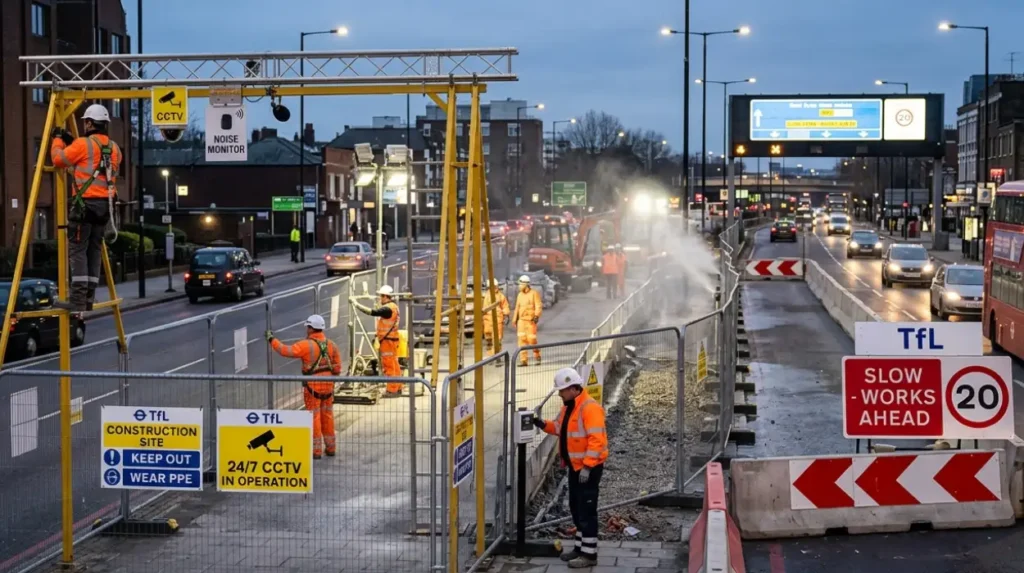
TfL deploys 24/7 CCTV across 2km, 100 noise monitors under 5dB limits, and 500m exclusion zones with 2m Heras fencing; night works cap at 22:00, complying with Control of Pollution Act 1974.
Macro adherence to CDM Regulations 2015. Subtopics: traffic, site, environment. 50 workers daily use harnesses at 15m heights.
Data: Zero lost-time incidents in 50,000 hours. Dust suppression sprays 10,000 litres weekly. Public: 1,000 warning signs, monthly liaison panels.
Implications reduce claims, averaging £50,000 per incident network-wide.
What Are the Long-Term Benefits Post-Reopening?
Renewed flyover boosts capacity 20%, cuts peak delays from 25 to 10 minutes, and resists 50-year climate loads with waterproof membranes, serving 100,000 daily users per updated 2031 models.
Benefits span economy, safety, sustainability. Structure uses 30% recycled steel, epoxy coatings.
Stats: Collision reduction projected 40% via slip road tweaks. Economy: £10 million annual time savings. Environment: EV charging hubs planned adjacent.
Future relevance: Aligns with ULEZ expansion, supporting 15% traffic growth.
What is Gallows Corner in Havering?
Gallows Corner is a major grade-separated road junction in Havering, East London, where the A127 Southend Arterial Road crosses the A118 Colliers Row Road. It includes a flyover above a busy roundabout and serves traffic travelling between Romford, Essex, and central London.