The Havering Council election 2026 took place on 7 May 2026, with all 55 seats across 20 wards contested. Reform UK won control with 39 seats, the Havering Residents Association (HRA) secured 11 seats, Harold Wood Hill Park Residents Association kept 3 seats, and Labour held 2 seats, while the Conservatives lost all 14 seats they held before the election.
- When was the Havering Council election 2026 held?
- Who were the main candidates and parties in the Havering Council election 2026?
- What was the outcome and seat distribution after the Havering Council election 2026?
- Which wards changed party control in the Havering Council election 2026?
- What were the key issues driving the Havering Council election 2026?
- How did council finance and budget pressures shape the 2026 campaign?
- What role did green belt and data centre development play in the 2026 election?
- How did Ultra Low Emission Zone opposition influence the 2026 campaign?
- What was the “Hexit” movement and how did it affect the 2026 election?
- What were the broader political and demographic trends behind the 2026 result?
- What were the implications of the 2026 result for Havering’s governance?
- What data and statistics defined the Havering Council election 2026?
- What sources provide authoritative information on the Havering Council election 2026?
When was the Havering Council election 2026 held?
The Havering Council election 2026 was held on Thursday 7 May 2026, as part of the wider 2026 United Kingdom local elections across London and England.
The election followed the standard four-year cycle for London borough councils established under the London Government Act 1963. Havering, like all 32 London boroughs, elects all councillors at once every four years using multi-member first-past-the-post voting. The previous Havering Council election occurred in May 2022, making May 2026 the next scheduled contest.
Polling stations opened at 7:00 and closed at 22:00 on election day. Registered electors included British, Irish, Commonwealth and European Union citizens aged 18 or over living in the borough. Voters could cast ballots in person, by post, or by proxy. All 55 seats were up for election across 20 wards, with each ward returning either two or three councillors depending on its size and population.
Turnout varied significantly by ward. The highest turnout occurred in Upminster at 56.40 per cent, while the lowest occurred in Heaton at 32.20 per cent. Overall participation reflected broader concerns about voter apathy that local media highlighted in the weeks before polling.
Who were the main candidates and parties in the Havering Council election 2026?
Over 300 candidates stood across eight parties and independent groups, with Reform UK, Havering Residents Association, Conservatives, Labour, Greens, Harold Wood Hill Park RA, Liberal Democrats and independents contesting the 55 seats.
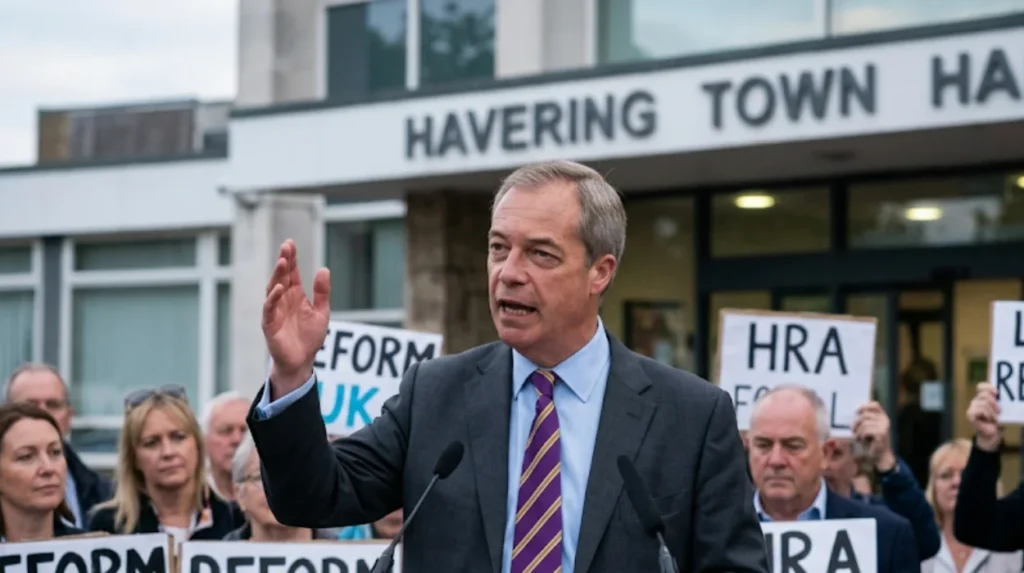
Reform UK fielded a full slate of 55 candidates under the leadership of Keith Prince, who stood in Gooshays ward. The party targeted Havering aggressively after parliamentary successes nationally, with leader Nigel Farage and Romford MP Andrew Rosindell campaigning locally on a platform that included taking Havering out of Greater London and into Essex.
The Havering Residents Association (HRA), led by council leader Ray Morgon during the 2022–26 term, also fielded 55 candidates. HRA operated as an umbrella organisation comprising multiple local residents’ associations including Hornchurch Residents Association, Upminster and Cranham Residents Association, and Havering Residents Association groups in specific wards. Ray Morgon did not stand for re-election in 2026.
The Conservative Party, which held 14 seats before the election, fielded candidates across all wards but suffered a historic collapse. The party had been the largest group after 2022 but fell short of a majority, then lost multiple councillors through defections to HRA and Reform UK during the term.
Labour put forward candidates in all wards, with Keith Darvill as the group leader. The party held eight seats before the election but lost ground to Reform UK in multiple wards. The Green Party contested all 55 seats with a “Change for the Better” campaign focusing on growth, green spaces and local power.
Harold Wood Hill Park Residents Association (also running as East Havering Residents Group in some wards) fielded candidates primarily in Harold Wood and surrounding areas, with leader Darren Wise. The Liberal Democrats submitted 22 candidates, and six independents also appeared on ballots.
What was the outcome and seat distribution after the Havering Council election 2026?
Reform UK won 39 of 55 seats, gaining 36 seats to secure a majority; HRA won 11 seats, Harold Wood Hill Park RA won 3 seats, Labour won 2 seats, and Conservatives won 0 seats.
The result marked the first time Reform UK secured a majority in any London borough council. Keith Prince became council leader after the election, replacing Ray Morgon. Reform UK’s 39 seats represented 70.9 per cent of the council, with 37.8 per cent of the vote share.
Havering Residents Association retained 11 seats with 24.2 per cent of the vote share. The group lost 9 seats compared to its pre-election position of 25 seats, reflecting defections and voter shifts to Reform UK. Harold Wood Hill Park Residents Association held all 3 seats in Harold Wood ward, maintaining its 5.5 per cent share of seats with 3.1 per cent of the vote.
Labour held just 2 seats, both in Beam Park ward, down from 8 seats before the election. The party received 10.0 per cent of the vote share but secured only 3.6 per cent of seats. The Conservative Party lost all 14 seats it held before the election, receiving 13.7 per cent of the vote share but failing to win any seats for the first time in the borough’s 60-year history.
The Green Party received 10.0 per cent of the vote but won no seats. Liberal Democrats received 1.0 per cent of the vote with no seats won. Independents received 0.2 per cent of the vote with no seats.
Which wards changed party control in the Havering Council election 2026?
Reform UK gained seats in 14 wards including Emerson Park, Gooshays, Havering-atte-Bower, Heaton, Hylands and Harrow Lodge, Marshalls and Rise Park, Mawneys, Rush Green and Crowlands, South Hornchurch, St Albans, St Andrews, St Edwards and Hacton.
In Beam Park, Labour held both seats. Reform UK came close but did not gain ground in this ward.
Cranham saw HRA hold all three seats. Reform UK placed second in all three seats but did not win.
Elm Park remained under HRA control with representatives elected under the Hornchurch Residents Association banner.
Emerson Park flipped from HRA to Reform UK. Gooshays shifted from Labour/HRA representation to Reform UK with all three seats won by the party.
Hacton saw a split result with HRA holding one seat and Reform UK gaining one seat. Harold Wood remained under Harold Wood Hill Park RA control with all three seats retained.
Havering-atte-Bower flipped from Conservative to Reform UK with all three seats won by Reform UK. Heaton shifted from Labour to Reform UK with all three seats won by the party.
Hylands and Harrow Lodge moved from Conservative/HRA to Reform UK with all three seats won. Marshalls and Rise Park flipped from Conservative/HRA to Reform UK with all three seats won.
Mawneys shifted from Conservative to Reform UK with all three seats won. Rainham and Wennington saw a mixed result with HRA holding one seat and Reform UK gaining two seats from the Conservatives.
Rush Green and Crowlands flipped from Conservative to Reform UK with all three seats won. South Hornchurch moved from HRA to Reform UK with both seats won by Reform UK.
Squirrels Heath shifted from Conservative to Reform UK with all three seats won. St Albans moved from Conservative/Labour split to Reform UK with both seats won.
St Andrews flipped from HRA to Reform UK with all three seats won. St Edwards shifted from Conservative to Reform UK with all three seats won.
Upminster remained under HRA control with all three seats retained by the Upminster and Cranham Residents Association.
What were the key issues driving the Havering Council election 2026?
Residents focused on council finance crisis, green belt development proposals, Ultra Low Emission Zone opposition, crime and anti-social behaviour, and the “Hexit” movement advocating Havering’s exit from Greater London.
How did council finance and budget pressures shape the 2026 campaign?
Havering Council faced a projected £77 million budget gap for 2026/27 and had filed for Exceptional Financial Support from central government, with total borrowing of £237 million across 2024–27 to avoid a Section 114 notice.
The council implemented more than £40 million in savings over the 2022–26 term but still confronted severe structural deficits. Annual deficits reached tens of millions of pounds, with an £88 million shortfall recorded in 2025/26. The council raised local taxes by the maximum legal limit of 4.99 per cent annually for three consecutive years starting in 2024.
A significant portion of council tax revenue went to Greater London Authority services including police, fire and transport, despite Havering residents reporting limited benefits from these services. The borough’s outer location meant fewer Underground connections and less visible police presence compared to inner London, fuelling resentment over tax allocation.
Reform UK campaigned heavily on fiscal accountability and reducing London-wide levies. The party promised to challenge GLA spending and reduce Havering’s contribution to London-wide services. HRA and Conservatives also highlighted the need for financial stability but faced criticism for their roles during the deficit accumulation period.
What role did green belt and data centre development play in the 2026 election?
A proposed data centre on 99 acres of Metropolitan Green Belt land in Rainham and Wennington became a major controversy, with residents opposing the development while the council argued it would bring more than 1,000 jobs.
Project developer Digital Reef applied for a Local Development Order that would allow the East Havering Data Centre to proceed without a full formal planning process. The facility would become the largest data centre in Europe if approved. Council leader Ray Morgon stated he would not “shy away from supporting a beneficial scheme” despite local opposition.
Residents expressed strong concerns about losing green belt land, increased traffic, environmental impact and the precedent set by bypassing standard planning procedures. Green Belt protection became a central campaign theme for HRA, Greens and some Conservative candidates. Reform UK positioned itself as opposing overdevelopment while supporting economic growth in appropriate locations.
How did Ultra Low Emission Zone opposition influence the 2026 campaign?
Havering residents strongly opposed London Mayor Sadiq Khan’s Ultra Low Emission Zone (ULEZ) expansion, which required drivers of vehicles over 20 years old to pay a daily £12.50 charge to operate in London.
The policy generated particular backlash in Havering due to the borough’s high car dependency and limited public transport alternatives. Unlike central London areas with dense Underground and bus networks, Havering residents relied heavily on private vehicles for commuting and daily activities. The daily charge represented a significant financial burden for households with older vehicles.
Reform UK made ULEZ opposition a core campaign pledge, promising to challenge the policy and reduce motoring costs for residents. The party’s stance resonated with voters frustrated by what they perceived as unfair taxation without corresponding service improvements. HRA and Conservatives also criticised ULEZ but faced questions about their ability to influence London-wide policy from a borough council position.
What was the “Hexit” movement and how did it affect the 2026 election?
The “Hexit” movement advocated for Havering’s exit from Greater London’s administrative jurisdiction and potential transfer to Essex County, driven by taxation disputes and ULEZ opposition.
A pre-election poll found that 68 per cent of Havering residents supported leaving London. Residents preferred joining adjacent Essex County, citing lower taxes and better alignment with local needs. Reform UK leader Nigel Farage and MP Andrew Rosindell explicitly campaigned on taking Havering out of Greater London if the party gained control.
Reform UK’s manifesto included a pledge to pursue boundary changes that would remove Havering from GLA authority and reduce London-wide tax obligations. The party argued that Havering received insufficient benefits from London-wide services relative to its tax contributions.
Legal experts noted that while boundary changes were theoretically possible, no precedent existed for a London borough leaving Greater London. Practical obstacles included loss of free public transport benefits for residents aged 60 and over, and complex jurisdictional questions around policing, fire services and transport.
Explore More Help & Resources
Philip Hyde Reform UK Havering What He Stands For
Havering Population 2026 How Many People Live There Now
What were the broader political and demographic trends behind the 2026 result?
The 2026 result reflected a collapse in Conservative support, fragmentation of local residents’ groups, and a surge in Reform UK’s appeal among voters concerned about taxation, overdevelopment and London-wide policies.
The Conservative Party’s historic losses stemmed from multiple factors including internal defections, national polling trends and local dissatisfaction with council performance. The party lost all 14 seats it held before the election, with candidates finishing behind Reform UK, HRA and even Labour in multiple wards.
Havering Residents Association retained significant support in traditional strongholds like Upminster, Cranham and Elm Park but lost ground to Reform UK in wards where fiscal concerns and anti-ULEZ sentiment dominated. The group’s umbrella structure allowed it to maintain local identity but also created coordination challenges against a unified Reform UK campaign.
Labour’s decline reflected broader challenges in outer London boroughs where the party struggled to balance London-wide policy positions with local concerns about ULEZ and council tax increases. The party retained Beam Park but lost ground in Heaton, St Albans and other wards where Reform UK made gains.
Reform UK’s success in Havering aligned with national polling that predicted the party would win control in multiple boroughs including Bromley and Barking and Dagenham. The party’s focus on local tax reduction, ULEZ opposition and boundary change proposals resonated with voters frustrated by perceived metropolitan overreach.
What were the implications of the 2026 result for Havering’s governance?
The 2026 result gave Reform UK a 39-seat majority, enabling the party to implement its agenda on council finance, ULEZ opposition and potential boundary change advocacy without relying on coalition partners.
Keith Prince became council leader after the election, replacing Ray Morgon. The new administration inherited a council facing Exceptional Financial Support requirements and a £77 million budget gap for 2026/27. Reform UK’s majority allowed it to set the council’s budget, policy priorities and strategic direction without compromise.
The party’s control positioned Havering as a test case for Reform UK’s local governance model ahead of potential national elections. The council’s stance on ULEZ, green belt development and London-wide tax obligations would influence debates in other outer London boroughs facing similar pressures.
HRA’s reduced presence meant local residents’ associations would need to adapt their strategies to oppose or influence Reform UK policies from a minority position. Labour’s two-seat presence limited its ability to shape council decisions but maintained a foothold in Beam Park. The Conservatives’ total loss eliminated their formal representation and required rebuilding at the grassroots level.
The election result also intensified discussions about London’s governance structure and the relationship between outer boroughs and the Greater London Authority. Reform UK’s “Hexit” pledge, while legally complex, kept boundary change debates in local and national media coverage.
What data and statistics defined the Havering Council election 2026?
The election saw 302 candidates contest 55 seats across 20 wards, with Reform UK winning 39 seats on 37.8 per cent of the vote, and turnout ranging from 32.20 per cent in Heaton to 56.40 per cent in Upminster.
Total vote shares were: Reform UK 91,840 votes, HRA 58,731 votes, Conservatives 33,331 votes, Labour 24,355 votes, Greens 24,164 votes, Harold Wood Hill Park RA 7,475 votes, Liberal Democrats 2,427 votes, and Independents 495 votes.
Ward-level candidate counts varied significantly. Gooshays had 20 candidates for three seats, representing one of the most contested wards. Emerson Park had 11 candidates for two seats with no incumbent councillors standing. Harold Wood had 18 candidates for three seats, all contested by Harold Wood Hill Park RA and challengers.
The election marked the second use of ward boundaries established in 2022, with 19 wards returning either two or three councillors. All 55 seats were contested with no uncontested wards. Results were announced on 8 May 2026, with full breakdowns published by Havering Council.
What sources provide authoritative information on the Havering Council election 2026?
Official results and candidate lists were published by Havering Council, with comprehensive coverage from BBC News, Wikipedia, East London Times, Havering Daily, and local blogs.
Havering Council’s website provided the definitive candidate list, ward-by-ward results, turnout figures and ballot rejection statistics. The council’s results page included full breakdowns per ward with candidate names, parties, vote counts and election status.
BBC News and Sky News offered real-time results coverage with ward-level analysis and party performance summaries. Wikipedia’s article on the 2026 Havering London Borough Council election provided comprehensive background, historical context, and detailed results tables.
Local outlets including East London Times, Havering Daily, and havering.blog offered pre-election analysis, candidate profiles and post-election commentary focused on local issues and community reactions. These sources provided context on the “Hexit” movement, green belt debates, and council finance challenges that shaped the campaign.
National media including The Standard covered Reform UK’s targeting of Havering and the broader implications for London governance. Regional outlets published full results for readers seeking ward-level detail.
When was the Havering Council election 2026 held?
The Havering Council election was held on Thursday, 7 May 2026, as part of the wider 2026 local elections across England and London. All 55 council seats across 20 wards were contested.