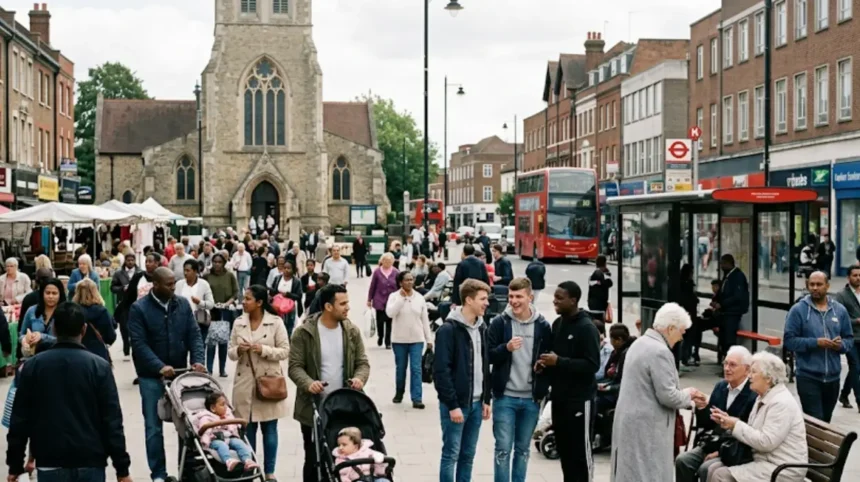
The London Borough of Havering had an estimated population of 276,274 in mid-2024, rising from 262,086 in 2021—an increase of more than 14,000 residents over three years. This makes Havering one of the faster-growing Outer London boroughs, with growth outpacing both the London and England averages.
- What Is the Current Population of Havering in 2026?
- How Has Havering’s Population Changed Over Time?
- Where Do People Live Within Havering?
- What Is the Population Density and Land Use Pattern?
- Who Makes Up Havering’s Population by Age?
- What Is the Ethnic Composition of Havering?
- What Are the Household and Housing Characteristics?
- What Are the Economic and Income Profiles?
- What Are the Health and Life Expectancy Statistics?
- What Are the Birth and Fertility Trends?
- What Are the Future Population Projections?
- Why Does Havering’s Population Growth Matter?
What Is the Current Population of Havering in 2026?
Havering’s population stood at 276,274 in mid-2024, the latest official estimate available in 2026, with steady growth continuing.
The Office for National Statistics (ONS) mid-2024 estimate records 276,274 residents in the London Borough of Havering. This figure represents a 5.4% increase since the 2021 Census, which counted 262,052 people. The annual average growth rate of around 4,700 people per year places Havering above the London average growth of 3.2% and the England average of 3.7% over the same period.
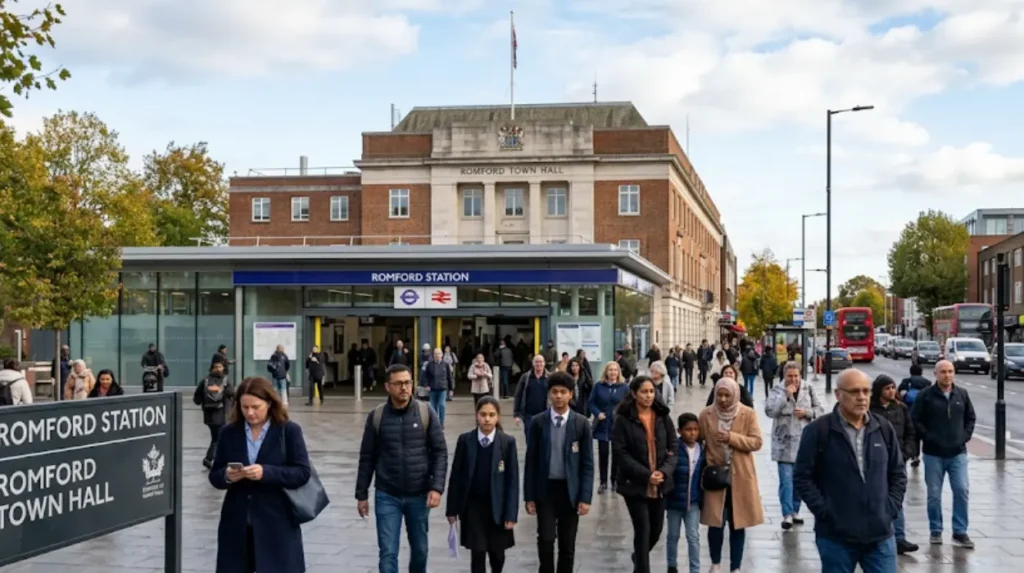
By 2026, the population remains in the 276,000–277,000 range according to council demographic profiles, with projections indicating continued but slower growth towards 277,529 by 2029. The borough’s administrative headquarters at Romford Town Hall serves a population spread across 20 electoral wards and 43.35 square miles.
How Has Havering’s Population Changed Over Time?
Havering grew from 224,250 in 2001 to 276,274 in 2024, with major jumps linked to suburban expansion and post-war housing programmes.
Historical census data shows consistent long-term growth punctuated by periods of rapid expansion. The population reached 224,250 in the 2001 Census, 237,232 in 2011, and 262,052 in 2021. The 14,188 increase between 2021 and 2024 continues a trend of significant growth over the past two decades.
Earlier historical data reveals dramatic 20th-century growth: from 49,681 in 1921 to 119,292 in 1941, then 187,022 in 1951, driven by suburban development and post-war housing needs. The creation of the London Borough of Havering in 1965 under the London Government Act 1963 consolidated the former Municipal Borough of Romford and Hornchurch Urban District into a single authority. Between 1981 and 2001, the population dipped slightly from 239,769 to 224,248 before resuming growth after 2001.
Where Do People Live Within Havering?
Most residents live in suburban towns like Romford, Hornchurch, and Upminster, with new growth concentrated in Beam Park and southern redevelopment zones.
The principal town of Romford functions as the main commercial and retail hub, with dense residential development around the railway station and Liberty Shopping Centre. Hornchurch and Upminster serve as secondary retail centres with extensive high streets. Named neighbourhoods include Ardleigh Green, Chase Cross, Collier Row, Elm Park, Harold Hill, and Rainham, each contributing to the borough’s continuous urban sprawl.
The southern part of Havering, adjacent to the River Thames, falls within the London Riverside section of the Thames Gateway redevelopment area, where large-scale housing projects drive population increases. Beam Park ward exemplifies this growth, projected to rise from 5,536 residents in 2022 to 9,436 by 2037—a 70% increase. St Alban’s ward also shows significant growth, from 9,011 in 2022 to 10,960 by 2037. In contrast, exurbs like Havering-atte-Bower, North Ockendon, Noak Hill, and Wennington retain green buffers of farmland and parkland.
What Is the Population Density and Land Use Pattern?
Havering has 6,373 people per square mile, making it the second-least densely populated London borough after Bromley.
With 276,274 residents across 43.35 square miles (112.27 km²), Havering’s population density stands at 6,373.4 per square mile (2,460.8 per km²). In 2021, the borough recorded 16.7 people per football pitch-sized piece of land, up from 15.1 in 2011, yet it remains the second-least densely populated local authority in London.
Nearly half of the borough’s area consists of protected open space, including parts of the Metropolitan Green Belt, which restricts intensive development. Approximately 23 square miles (60 km²)—more than half the borough—is designated Green Belt land. This pattern of garden suburb development with inter- and post-war private housing creates extensive but rarely intensive urbanisation. Plans to extend developments are frequently blocked to preserve open land, except in the southern Thames Gateway zone where large-scale residential communities are planned.
Who Makes Up Havering’s Population by Age?
Havering’s median age is 39 years, older than London’s 35 but younger than its 2011 median of 40, with growth strongest among older age groups.
The 2021 Census recorded a median age of 39 years in Havering, compared to 35 years for London overall and 40 years in Havering’s 2011 data. Population projections indicate the largest increases will occur among older age groups: the 65–84 cohort is predicted to rise from 39,348 in 2022 to 48,421 in 2037 (23% growth), while the 85+ group will increase from 7,107 to 8,746 (23%).
Working-age populations show modest growth: 18–24 years will increase by 12%, and 25–64 years by 4% between 2022 and 2037. Younger cohorts are projected to decline: 0–4 years by 10%, 5–10 years by 13%, and 11–17 years by 4%. Despite this, Havering experienced the largest net inflow of children aged 0–15 across all London boroughs from 2020 to 2023, with 2,506 children settling from elsewhere in the UK, particularly from Barking & Dagenham and Redbridge.
What Is the Ethnic Composition of Havering?
Havering remains London’s least ethnically diverse borough, with 75.3% White residents in 2021, down from 87.7% in 2011.
The 2021 Census recorded 197,314 White residents (75.3% of the population), down from 207,949 (87.7%) in 2011. White British residents accounted for 174,232 (66.5%) in 2021, compared to 197,615 (83.3%) in 2011. Despite this decline, Havering retains a significantly higher proportion of White residents than other Outer London boroughs and remains the least diverse borough in London.
Ethnic minority populations grew substantially: Asian or Asian British residents increased from 11,545 (4.8%) in 2011 to 28,150 (10.8%) in 2021. Black or Black British residents rose from 11,481 (4.8%) to 21,567 (8.2%). Mixed or British Mixed residents increased from 4,933 (2.1%) to 9,747 (3.7%). Other ethnic groups grew from 1,324 (0.6%) to 5,274 (2%). The Upminster ward remains the third least ethnically diverse in Greater London, with a Simpson’s diversity index of 1.10.
What Are the Household and Housing Characteristics?
Havering has 101,277 households, with 70.5% owning their homes—the highest home ownership rate of any London borough.
The 2021 Census recorded 101,277 households in Havering, a 4% increase (4,078) since 2011. Home ownership stands at 70.5% (71,355 households), higher than both the London average of 46.8% and the England average of 62.3%. Car ownership is also high: 21.5% of households have no cars or vans (compared to 42.1% in London), while 24.9% have two or more cars (higher than London’s 13.6%).
Overcrowding affects 7.9% of households (8,050), up from 7.4% (7,166) in 2011, consistent with rising affordability pressures. Havering’s affordability ratio of 11.3 in 2022 exceeds the national average of 8.9 but remains below London’s 13.6. Homelessness remains a concern: 861 homeless households with dependent children were owed a duty under the Homelessness Reduction Act, giving a rate of 27 per 1,000 households—among the highest in London.
What Are the Economic and Income Profiles?
Median household income for full-time workers is £44,790, equal to London’s average but higher than England’s, with 76.7% employment.
The median gross annual household income for full-time workers in Havering is £44,790, matching the London average of £44,780 and exceeding England’s £37,617. The overall employment rate stands at 76.7%, higher than London’s 75.4% and England’s 75.7%. However, 4.7% of working-age residents claim out-of-work benefits, lower than London’s 5.9% but higher than England’s 4.1%.
Child poverty affects over 18,000 children aged 0–15, representing 31.8% of the child population—lower than London’s 41.8% and England’s 36.3%. Almost 7,000 older people live in poverty (14.4%), significantly below London’s 29.0% and England’s 18.6%. Educational attainment shows mixed results: the average Attainment 8 score per pupil was 48.8 in 2023, better than England’s 46.1 but below Outer London’s 51.1. A 2017 study found 52% of adults lack Level 3 qualifications (A-Level equivalent), the worst rate in London.
What Are the Health and Life Expectancy Statistics?
Life expectancy at birth is 79.9 years for males and 83.5 for females, with 23% of life impaired by ill health or disability.
Male life expectancy at birth in Havering is 79.9 years, similar to London’s 79.8 and higher than England’s 79.1. Female life expectancy is 83.5 years, lower than London’s 84.1 but similar to England’s 83.1. Healthy life expectancy—years lived in good health—stands at 61.8 years for males and 61.1 for females, both fallen since the pandemic. Approximately 23% of male life expectancy (18.1 years) and 27% of female life expectancy (22.4 years) is impaired by ill health or disability.
At age 65, life expectancy is 18.9 years for males and 21.2 for females, with healthy life expectancy of 9.5 years for both sexes. Residents in the most disadvantaged areas experience significantly lower life expectancy: 8.9 years less for males and 5.1 years less for females compared to those in the least deprived decile. In 2021, 83% of residents reported ‘good’ or ‘very good’ health, higher than London’s 81.9% and England’s 81.7%, while 15% disclosed a disability or long-term illness, lower than London’s 16% and England’s 18%.
What Are the Birth and Fertility Trends?
Havering recorded 3,235 births in 2024, with a general fertility rate of 58 per 1,000 women aged 15–44, higher than London and England.
The number of births among Havering women in 2024 was 3,235, with projections indicating increases to 3,257 by 2030 and 3,345 by 2035. The general fertility rate (GFR) for 2024 stands at 58 per 1,000 women aged 15–44, exceeding both the London and England averages of 49 per 1,000. This higher fertility contributes to population growth despite projected declines in younger age cohorts.
The borough’s relatively young working-age population and family-oriented suburban character support sustained birth rates. Recommendations from the Joint Strategic Needs Assessment (JSNA) emphasise ensuring access to childcare, school places, and relevant health services to support the growing young and working-age population.
Explore More Help & Resources
Romford Mosque Plans What the Proposals Actually Say
Romford Market Place Hotel Development First Images and Plans
What Are the Future Population Projections?
Havering’s population is projected to reach 277,529 by 2029 and 278,934 by 2037, with growth concentrated in Beam Park and among older residents.
Official projections indicate Havering’s population will increase from 271,502 in 2024 to 277,529 in 2029 (4.8% growth) and 278,934 by 2037 (5.4%). The largest ward-level increases will occur in Beam Park, rising from 5,536 in 2022 to 9,436 in 2037 (70% growth), and St Alban’s, from 9,011 to 10,960 (22%).
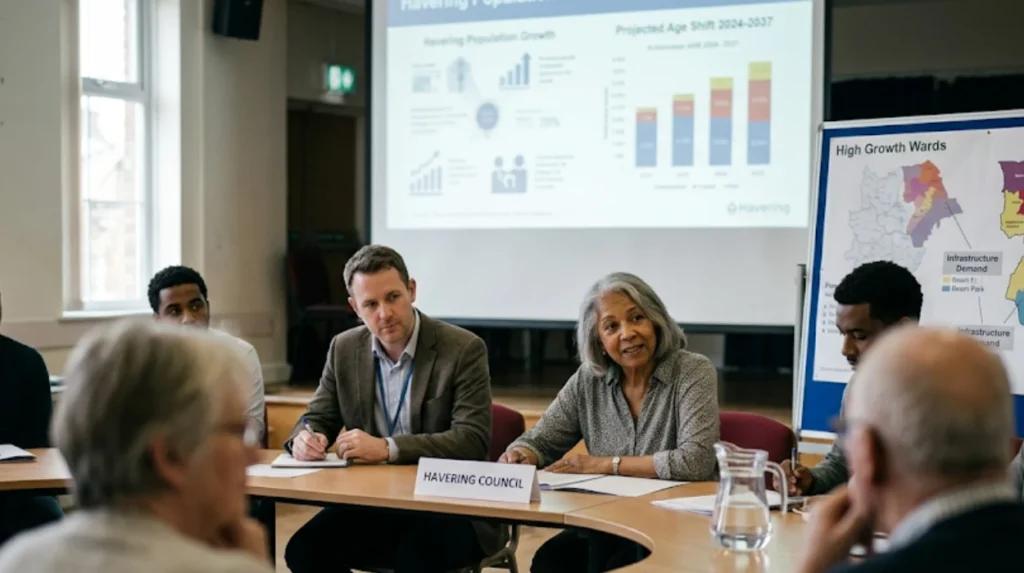
Age structure shifts will see significant growth among older populations: 65–84 years increasing by 23% and 85+ by 23% between 2022 and 2037. Working-age groups will see modest increases (18–24 by 12%, 25–64 by 4%), while younger cohorts decline (0–4 by 10%, 5–10 by 13%, 11–17 by 4%). These trends imply rising demand for elderly care services, adapted housing, and age-friendly infrastructure, alongside sustained pressure on schools and childcare in high-growth wards.
Why Does Havering’s Population Growth Matter?
Growth of 14,000 residents in three years strains housing, schools, GP surgeries, and council services, prompting infrastructure investment debates.
The addition of more than 14,000 residents between 2021 and 2024 has placed increased strain on council services, housing, and infrastructure. Local reporting highlights concerns that 12,850 new homes may outpace the capacity of GP surgeries (34–38 for 293,000+ residents), dentists, and schools. The population surge exceeds London and England averages, intensifying demands on transport, health, and education systems.
Recommendations from the JSNA call for coordinated action between the local authority, NHS, and partners to resource priority services, prevent escalation of need, and address inequalities linked to employment, poverty, and housing. Continued growth in Beam Park and southern redevelopment zones requires forward planning for transport improvements, social infrastructure, and community facilities to maintain Havering’s quality of life as it approaches 280,000 residents.
What is the current population of Havering?
The latest official Office for National Statistics (ONS) mid-year estimate puts the London Borough of Havering’s population at 276,274 (mid-2024), making it one of London’s faster-growing outer boroughs.