Key Points
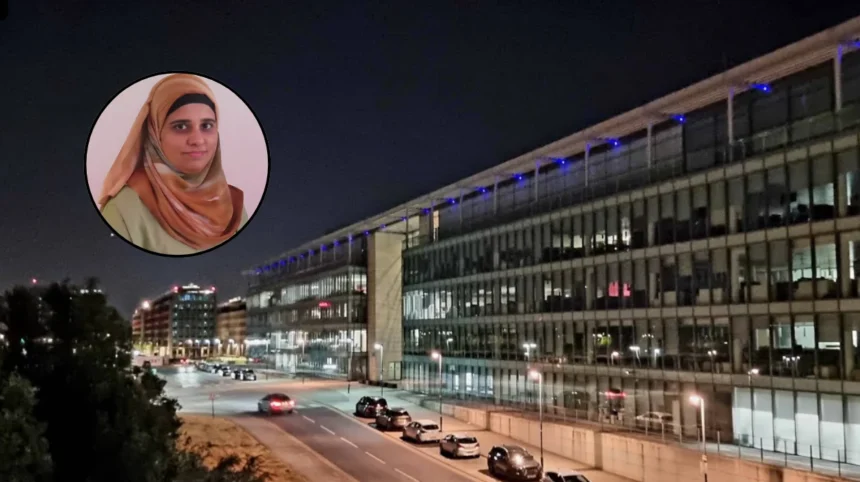
- Industry Recognition: Dr Umaima Haider, Senior Lecturer at the University of East London, has been named one of the UK’s TechWomen100 winners by WeAreTechWomen.
- Environmental Focus: Dr Haider has spent over ten years assessing and formulating sustainability strategies for more than 400 data centres across Europe and the Middle East.
- Local Development: The recognition comes as the Royal Docks in East London prepares to host one of the capital’s largest data centre campuses, approved by Newham Council.
- Sustainable Design: The planned facility comprises three data centre buildings equipped with non-evaporative water cooling systems and connections for a future district heating network.
- Leadership and Advocacy: Beyond academia, Dr Haider holds ambassadorial roles with the Nomad Futurist Foundation, Women in Tech Global Network, and Infrastructure Masons.
Docklands (East London Times) September 26, 2026 – A senior East London academic specialising in sustainable digital infrastructure has been named among the UK’s TechWomen100 winners, celebrating emerging female talent and leaders across the technology sector. Dr Umaima Haider, based at the University of East London’s Docklands campus, received the prestigious accolade in recognition of her decade-long efforts to reduce the environmental footprint of data infrastructure and address the soaring energy demands driven by artificial intelligence and cloud computing.
Why Has Dr Umaima Haider Been Recognised in the TechWomen100 Awards?
A panel of 20 independent judges selected Dr Haider as part of this year’s TechWomen100 cohort, an initiative organised by WeAreTechWomen to showcase professional achievements across disciplines including artificial intelligence, cybersecurity, and software engineering.
Addressing the purpose behind the annual awards, Dr Vanessa Vallely OBE, founder and Chief Executive Officer of WeAreTechWomen, highlighted that the initiative focuses primarily on “visibility, creating role models and showing other women what is possible” within industries traditionally dominated by men.
In response to receiving the accolade, Dr Haider, who serves as Senior Lecturer in Computer Science and Digital Technologies as well as Associate Director of the Centre for Work, Organisation and Technology at UEL, commented on the significance of the award:
“I’m honoured to be named among the TechWomen100, alongside inspiring women and leading experts from across the technology industry. As an academic and researcher, it is especially meaningful to have my work in sustainable digital infrastructure recognised beyond academia. I hope this recognition inspires more women to pursue technology, research and innovation – and to see themselves as the leaders shaping our digital future.”
Alongside her core academic commitments, Dr Haider promotes gender diversity and professional development within the tech sector through ambassadorial roles with the Nomad Futurist Foundation, the Women in Tech Global Network, and Infrastructure Masons.
How Is East London’s Infrastructure Evolving to Meet AI Demand?
Dr Haider’s recognition coincides directly with major infrastructure expansions taking place adjacent to her academic base. The Royal Docks area in Newham is set to become home to one of London’s largest data centre campuses, following successful planning approval granted by Newham Council.
Designed to accommodate the exponential surge in cloud computing requirements and complex AI processing, the planned development consists of three primary data centre buildings. The site will also incorporate an integrated facility dedicated to providing training pathways and technical career opportunities for local residents.
To mitigate environmental impact, the campus layout embeds several energy-saving measures:
- Cooling mechanisms designed to function without relying on water evaporation.
- Structural provisions allowing for direct connection to a future local district heating network.
At UEL, Dr Haider continues to lead specialized research and industry collaborations targeted at creating energy-efficient, resilient digital systems. Her background includes evaluating and shaping sustainability frameworks for over 400 data centres spanning Europe and the Middle East, alongside contributing directly to UK policy discussions surrounding digital infrastructure regulation.
Background of the Particular Development
Data centres form the physical foundation of the digital economy, housing the servers, storage hardware, and networking gear required to process online services. The recent rapid proliferation of generative artificial intelligence models has dramatically accelerated electricity and cooling demands across the sector, as AI computational workloads require significantly more power per rack than traditional web hosting.
In response to national digital strategies and commercial demand, urban hubs across the United Kingdom—particularly within Greater London and the M4 corridor—have seen increased development applications for large-scale data facilities. Newham Council’s approval of the Royal Docks campus reflects broader regional initiatives to integrate digital technology hubs into urban regeneration projects, while simultaneously balancing municipal carbon-neutrality targets and localized power grid constraints.
Prediction: How This Development Can Affect the Local Community and Tech Sector
The expansion of data centre infrastructure in East London, combined with research into sustainable operations, is projected to bring notable economic and operational shifts for local residents and industry stakeholders:
- For the Local Community in Newham: The inclusion of an onsite training facility is likely to enhance access to specialized technical qualifications, helping bridge local employment gaps in STEM fields. Furthermore, the district heating integration provisions offer a prospective long-term benefit by supplying excess thermal energy from server halls directly into local residential or commercial heating networks.
- For the Technology and Energy Sectors: Dr Haider’s research and national recognition emphasize a broader industry shift toward strict resource optimization. As policy makers refine energy standards for data centres, technical methodologies developed at institutions like UEL are expected to serve as benchmarks for future infrastructure approvals across the UK.