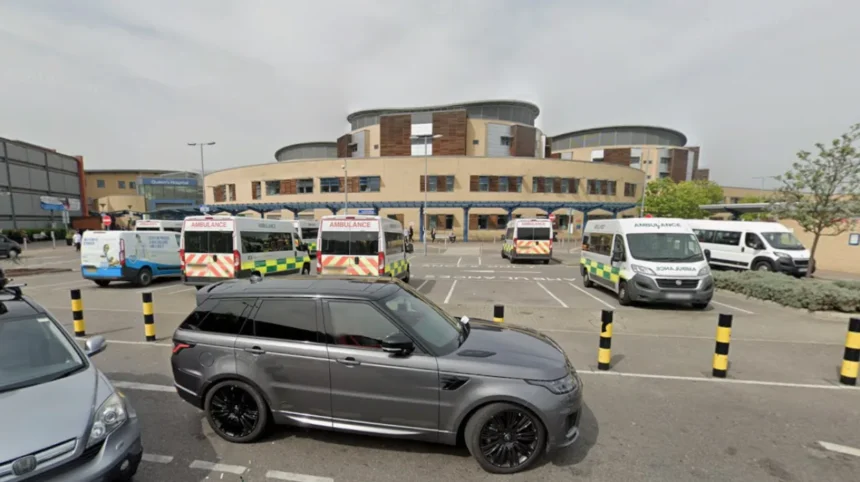
Key Points
- Acute Capacity Under Pressure: Queen’s Hospital, opened in 2006, was built to serve a significantly smaller population than the estimated 280,787 residents now living in Havering and 238,295 in Barking and Dagenham.
- Catchment Area Demographics: Barking, Havering and Redbridge University Hospitals NHS Trust (BHRUT) manages care for an aggregate regional population of approximately 800,000 people.
- A&E Overcrowding: Designed for roughly 325 patients per day, the Queen’s Hospital Emergency Department regularly handles more than double its intended capacity.
- Record Demand: In March 2026, BHRUT recorded its highest monthly volume on record, registering 31,214 emergency attendances across its sites—averaging over 1,000 per day between Queen’s and King George hospitals.
- Corridor Care Mitigation: While corridor care remains an issue, BHRUT reported a reduction of approximately 10,000 hours in corridor care at Queen’s in February 2026 compared to February 2025.
- Major Funding Request: BHRUT is actively seeking £42 million in capital investment to transform and expand the overcrowded emergency facilities at Queen’s Hospital.
Havering (East London Times) September 16, 2026 – Is the existing acute healthcare infrastructure in east London capable of meeting the demands of its expanding local population? Operational data from Barking, Havering and Redbridge University Hospitals NHS Trust (BHRUT) indicates that Queen’s Hospital in Romford is coping with levels of patient demand vastly exceeding its original design limits. Constructed nearly two decades ago to serve a different demographic footprint, the hospital’s Accident and Emergency (A&E) department was originally configured to process approximately 325 patients per day. Present operational logs reveal that the department routinely accommodates more than twice that number, leading health administrators, local council representatives, and residents to examine whether the area requires a fundamental expansion of its hospital footprint.
- Key Points
- Why Has Patient Demand Far Exceeded Original Capacity Expectations at Queen’s Hospital?
- What Impact Has Departmental Overcrowding Had on Patient Care Protocols?
- How Is the NHS Planning to Restructure Emergency Care Infrastructure in Romford?
- Does East London Require a New Hospital Facility or Broader Community Expansion?
- Background
- Prediction
Why Has Patient Demand Far Exceeded Original Capacity Expectations at Queen’s Hospital?
When Queen’s Hospital opened its doors in 2006, it was commissioned as a state-of-the-art acute medical facility equipped with 939 beds and more than 4,500 individual rooms. It was designed to function as a regional tertiary hub for acute healthcare across east London and Essex. However, demographic shifts over the past two decades have altered the load placed upon its acute infrastructure.
According to 2025 population estimate metrics cited in regional demographic reports, the London Borough of Havering now houses 280,787 residents. Simultaneously, the neighbouring London Borough of Barking and Dagenham has grown to 238,295 residents. Combined, these two immediate boroughs account for over 519,000 citizens.
Furthermore, the operational perimeter for BHRUT extends beyond these immediate borders. As detailed by BHRUT management, the Trust, which oversees both Queen’s Hospital in Romford and King George Hospital in Goodmayes, provides acute medical services to an aggregate catchment population of approximately 800,000 people across Havering, Barking and Dagenham, and Redbridge.
This demographic growth has resulted in unprecedented pressure on emergency intake corridors. Data published by BHRUT shows that in March 2026, the Trust registered its busiest operational month on record. Across its hospital sites, emergency attendances reached 31,214 over the 31-day period, representing an average intake exceeding 1,000 emergency patients every 24 hours across Queen’s and King George hospitals.
What Impact Has Departmental Overcrowding Had on Patient Care Protocols?
The surge in emergency attendances relative to the original 325-patient daily threshold has manifested in clinical space constraints. As acknowledged by BHRUT executive reports, the surge in urgent demand has frequently forced staff to deliver treatment to patients within corridor spaces inside Queen’s Hospital when main ward bays and treatment rooms reached maximum occupancy.
In official statements issued regarding operational performance in March 2026, BHRUT representatives characterised the reliance on corridor care as an “unfortunate” direct consequence of persistent spikes in emergency intake, notably localized at the Queen’s Hospital site.
To mitigate these physical space limitations, BHRUT implemented targeted operational adjustments throughout late 2025 and early 2026. Official Trust performance figures demonstrate that these interventions yielded a measurable decline in off-bed waits. Specifically, BHRUT reported that patients spent roughly 10,000 fewer cumulative hours receiving treatment within corridor environments at Queen’s Hospital during February 2026 when evaluated against figures recorded in February 2025.
Despite this reduction in corridor hours, Trust leadership maintains that procedural redesigns alone cannot resolve the structural mismatch between daily patient volume and physical building space.
How Is the NHS Planning to Restructure Emergency Care Infrastructure in Romford?
To address the long-term structural deficit between physical space and patient numbers, BHRUT has put forward plans for capital re-development. The Trust is formally campaigning for £42 million in funding to execute a comprehensive transformation of the existing Emergency Department at Queen’s Hospital.
The £42 million proposal aims to reconfigure and expand the internal footprint of the current A&E site, modernising triage areas, expanding acute intake bays, and enhancing patient throughput capacity. Trust executives argue that the modern acute intake landscape requires specialized zones for rapid assessment, minor injuries, and high-dependency resuscitation units that were not fully anticipated when the building was drafted prior to its 2006 opening.
However, healthcare planners and local community representatives note that while a £42 million reconfiguration will modernise the immediate intake zones, questions remain over whether alterations limited to the emergency department can offset broader system-wide capacity constraints across the region.
Does East London Require a New Hospital Facility or Broader Community Expansion?
The sustained strain on Queen’s Hospital has generated broader debate among NHS planners, local authority leaders, and public health officials regarding the overall long-term capacity requirements for east London. Several key avenues of inquiry are currently under consideration by regional healthcare strategists:
- In-Site Physical Expansion: Determining whether the physical campus of Queen’s Hospital contains sufficient land footprint to construct additional inpatient wards or dedicated surgical blocks.
- Efficacy of the £42 Million Transformation: Evaluating whether the proposed A&E restructuring will offer long-term relief or function primarily as a mid-term remedy while population figures continue to rise.
- Bed Capacity Alignment: Assessing whether the original 939-bed complement can adequately serve an 800,000-person catchment area given modern lengths of stay and admissions rates.
- Community and Diagnostic Diversion: Deciding whether allocating resources toward community diagnostic centres, urgent treatment centres (UTCs), and step-down social care beds offers a more cost-effective method to relieve acute hospital pressures.
- New Acute Construction: Evaluating whether central government funding should ultimately be requested to plan a third acute hospital facility within the BHRUT operational boundary to re-balance regional healthcare distribution.
Background
Queen’s Hospital was commissioned under a Public Private Partnership (PFI) initiative during the early 2000s to replace older, fragmented hospital sites in the region, including the former Oldchurch and Rush Green hospitals. Opening in December 2006, it was designed to centralize acute, maternity, and trauma care into a single complex.
At the time of its design in the late 1990s and early 2000s, demographic modeling for outer east London anticipated lower population growth trajectories than what occurred over the subsequent two decades. Urban regeneration initiatives, residential developments along major transport corridors, and shifting regional migration patterns significantly accelerated population growth across Havering, Barking and Dagenham, and Redbridge. Consequently, emergency department attendances systematically outpaced initial forecasts within a decade of the facility’s opening, prompting successive interior redesigns and procedural overhauls leading up to the current £42 million capital funding bid.
Explore More Havering News
Havering Leaders Tour New Modular Homes Scheme at Waterloo Road Romford 2026
Five Havering Venues Apply For Outdoor Seating Renewal In Romford 2026
Prediction
If the population across Havering, Barking and Dagenham continues on its current growth trajectory without substantial structural additions to regional acute healthcare capacity, residents within the BHRUT catchment area will likely experience sustained operational pressure across emergency and elective services.
For local residents and patients:
- Wait Times: Emergency wait times could remain vulnerable to periodic spikes during winter months and peak demand periods, as an A&E built for 325 daily patients continues to absorb more than 1,000 daily joint attendances alongside King George Hospital.
- Elective Care Delays: Persistent emergency overcrowding often necessitates the temporary conversion of elective surgical beds into emergency overflow beds, potentially increasing waitlists for routine, planned procedures.
- Access to Specialized Care: If the £42 million funding bid is secured and executed, emergency patient flow is anticipated to stabilize, reducing reliance on corridor care. However, if structural growth in local housing outpaces broader clinical bed capacity, local health commissioners will face increasing pressure to shift primary care and diagnostic services out of acute hospitals and into community hub networks to maintain regional healthcare access.