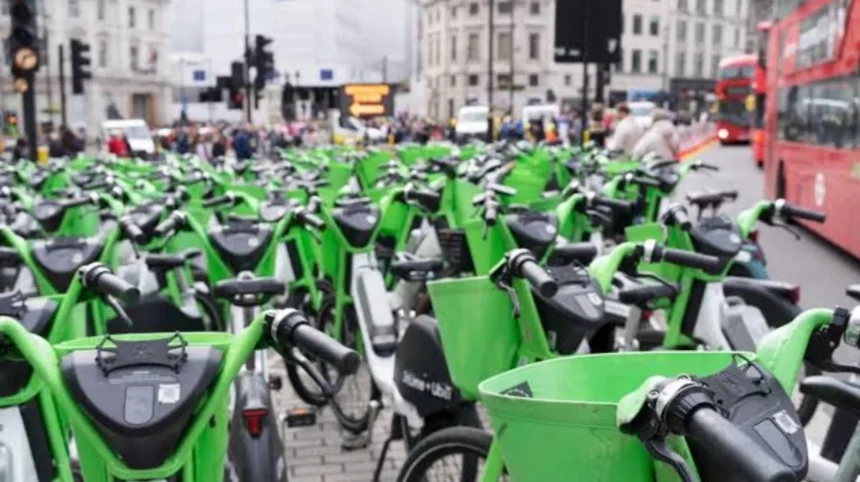
- National Standards Introduced: The UK government has announced new national standards designed to eliminate “wild west” e-bike parking across towns and cities.
- Enhanced Council Powers: Local councils will receive expanded regulatory powers to set binding rules for shared e-bike operators and riders.
- Pavement Accessibility: Schemes must establish designated parking plans to keep footways clear for wheelchair users, visually impaired pedestrians, and parents with prams.
- Tackling Antisocial Usage: Proposals target broader safety issues, including pavement riding, underage usage, and operating e-bikes while intoxicated.
- Mandated Operator Compliance: Shared e-bike companies will be required to comply with local parking frameworks and enforce rider compliance via technological and operational controls.
London, UK (East London Times) November 5, 2026 – The UK government has launched a sweeping national initiative aimed at curbing poorly parked electric bicycles and tackling antisocial riding habits that have increasingly disrupted pedestrian spaces across urban centres. Under new proposals set out by the Department for Transport, local authorities will be granted enhanced statutory authority to regulate shared e-bike operators, mandating structured parking arrangements and stricter operational oversight to make public spaces safer and more accessible.
- Why Is the UK Government Intervening in E-Bike Operations?
- What Powers Will Local Councils Receive Under the New Regulations?
- How Will the Measures Protect Pedestrians and Vulnerable Road Users?
- What Additional Antisocial Behaviours Are Being Targeted?
- What Is the Background of This Particular Development?
- What Is the Prediction for How This Development Will Affect Urban Residents and Operators?
Why Is the UK Government Intervening in E-Bike Operations?
The decision to establish unified national standards follows years of growing public frustration over abandoned rental e-bikes obstructing footpaths, bus stops, and building entrances. While micro-mobility schemes have expanded rapidly across major towns and cities, the absence of a single regulatory framework has created widespread inconsistency in how schemes are managed.
The new measures are designed to eliminate what ministers described as a “wild west” environment in the micro-mobility sector. By establishing formal statutory powers, the government intends to equip local councils with the tools needed to hold commercial operators directly accountable for how their fleets are deployed, maintained, and parked.
What Powers Will Local Councils Receive Under the New Regulations?
Under the proposed legal framework, local councils will gain the authority to mandate specific operational terms before any shared e-bike firm is permitted to deploy vehicles within their administrative boundaries. Councils will be empowered to set binding contractual conditions, cap total fleet sizes, and designate mandatory parking zones.
How Will Mandatory Parking Zones Function?
Rather than allowing riders to leave vehicles anywhere at the conclusion of a journey, local transport authorities will require operators to enforce parking exclusively within designated bays or marked areas.
- Geofencing Integration: Operators will be required to use precise GPS and geofencing technology that prevents users from ending their rental period or stopping the charging clock unless the bike is logged inside an authorized parking bay.
- Physical Infrastructure: Councils will have the discretion to convert existing road space or car parking bays into dedicated micro-mobility hubs, ensuring that footways remain dedicated strictly to pedestrian use.
- Financial Penalties for Non-Compliance: Operators failing to enforce parking rules or failing to remove incorrectly parked bikes within specified timeframes will face financial penalties or the revocation of their operating licenses.
How Will the Measures Protect Pedestrians and Vulnerable Road Users?
A primary objective of the national standard is restoring unhindered access to pavements, which have frequently been rendered impassable by haphazardly discarded bikes. Representatives for disability rights organizations and pedestrian advocacy groups have consistently highlighted that poorly parked e-bikes pose serious hazard risks, particularly to visually impaired individuals, wheelchair users, and parents pushing prams.
Transport Secretary Heidi Alexander stated that shared e-bike schemes have revolutionised the way people travel around towns and cities, but acknowledged that unregulated growth has generated unacceptable hazards on public footpaths. Alexander emphasized that the upcoming rules will ensure local authorities possess the exact mechanisms needed to keep walkways clear and protect vulnerable pedestrians while supporting clean urban transport options.
What Additional Antisocial Behaviours Are Being Targeted?
The regulatory reform extends beyond static parking clutter to encompass dynamic road safety risks associated with e-bike usage.
Tackling Pavement Riding and Underage Use
The Department for Transport proposals outline targeted strategies to curb dangerous riding behaviours on pedestrian walkways:
- Pavement Riding Enforcement: Enhanced coordination between local authorities, operators, and law enforcement will aim to penalize individuals who illegally operate motorized e-bikes on footpaths intended solely for pedestrian use.
- Age Verification Controls: Shared operators will be obligated to tighten age verification protocols on their mobile applications to prevent underage individuals from unlocking and riding the vehicles.
- Intoxication Prevention: Measures will address riding while under the influence of alcohol or drugs, placing responsibility on operators to implement software prompts, night-time usage restrictions, or educational warnings within user apps.
What Is the Background of This Particular Development?
The rapid proliferation of commercial e-bike rental schemes began across the United Kingdom over the past decade as part of broader efforts to promote active travel, reduce urban traffic congestion, and lower carbon emissions. While early dockless bike initiatives offered convenience, the lack of centralized regulation led to widespread friction between operators, non-riding residents, and municipal authorities.
Several local authorities previously attempted to manage the issue using voluntary codes of practice or temporary licensing agreements under highway legislation. However, because national legislation had not kept pace with the technology, councils lacked direct statutory powers to fine operators or enforce strict operational standards uniformly. The current intervention represents the first comprehensive attempt to establish national legal benchmarks for shared micro-mobility regulation across England.
What Is the Prediction for How This Development Will Affect Urban Residents and Operators?
The introduction of unified national standards is anticipated to bring structural changes to urban transportation management, altering how riders, non-riders, and commercial providers interact with micro-mobility infrastructure.
Impact on Pedestrians and Vulnerable Groups
For pedestrians, visually impaired citizens, and mobility-impaired residents, the enforcement of mandatory parking bays is expected to significantly reduce physical hazards on footpaths. Clearer walkways will improve mobility confidence in high-density urban areas, reducing accidents caused by tripping over discarded equipment.
Impact on E-Bike Operators and Riders
For commercial e-bike providers, the standards will impose higher compliance costs related to geofencing accuracy, fleet maintenance, and prompt removal of improperly parked units. Operators will need to work directly with municipal planners to finance and establish designated parking locations.
For everyday commuters and casual riders, the changes will eliminate the absolute convenience of doorstep “dockless” drop-offs. Riders will be required to build extra time into their journeys to locate authorized bays at their final destinations, bringing the e-bike experience closer to traditional docked cycling infrastructure while retaining fleet flexibility.