


Key Points
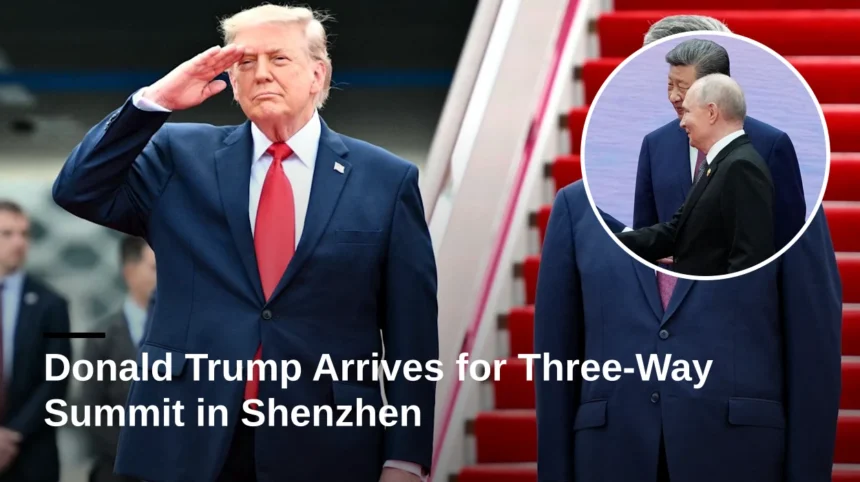
- United States President Donald J. Trump arrived in Shenzhen, China, on November 18, 2026.
- Chinese President Xi Jinping personally welcomed Mr Trump at Shenzhen Bao’an International Airport.
- Mr Trump is due to attend the Asia-Pacific Economic Cooperation meeting and meet Mr Xi and Russian President Vladimir Putin.
- The planned three-way talks are scheduled for November 19 and are expected to address nuclear disarmament and the war in Iran.
- Technical outages in the United States have placed pressure on the Trump administration as it seeks to project technological strength.
Shenzhen (East London Times) November 18, 2026 – United States President Donald J. Trump arrived in Shenzhen, China, on Wednesday for the Asia-Pacific Economic Cooperation meeting and planned talks with Chinese President Xi Jinping and Russian President Vladimir Putin. Mr Xi greeted Mr Trump at Shenzhen Bao’an International Airport, a rare diplomatic courtesy that underscored the importance Beijing places on relations with Washington. The leaders are expected to meet on November 19, with nuclear disarmament, the war in Iran and technology competition among the issues surrounding the visit.
Why has Donald Trump arrived in China?
Mr Trump travelled to Shenzhen after a visit to the Philippines, where he attended an Association of Southeast Asian Nations leaders’ meeting and met Philippine President Ferdinand Marcos Jr. His China visit forms part of a wider diplomatic trip in Asia and includes attendance at the Asia-Pacific Economic Cooperation leaders’ meeting.
Reports from Yahoo News, The Associated Press and National Public Radio said Mr Trump intends to reinforce the United States’ position as a leading technology power during the visit. The Associated Press also reported that technical outages in the United States had left the administration responding to domestic concerns while preparing for the diplomatic meetings.
What meetings are planned with Xi Jinping and Vladimir Putin?
Mr Trump is expected to hold talks with Mr Xi and Mr Putin in Shenzhen on November 19. Chinese Foreign Ministry spokesperson Mao Ning previously announced the China-Russia-United States summit for that date. The Associated Press reported that Mr Trump also plans a separate meeting with Mr Putin, alongside the planned three-way discussion.
National Public Radio reported that the leaders are expected to discuss nuclear disarmament and the war in Iran. The meeting is described in several reports as unprecedented because it would bring the American, Chinese and Russian leaders together in one summit.
How did Xi Jinping respond to Trump’s arrival?
China’s Ministry of Foreign Affairs said Mr Xi welcomed Mr Trump at Shenzhen Bao’an International Airport and looked forward to discussions on China-United States relations, Asia-Pacific cooperation and global issues. The ministry said Mr Xi supported moving the relationship towards strategic stability on the basis of respect, fairness and reciprocity.
According to the ministry’s account, Mr Trump thanked Mr Xi for welcoming him personally and thanked China for the arrangements. Mr Trump said he was pleased to visit China again and expressed confidence that the visit would advance bilateral relations.
The Associated Press reported that Mr Xi’s airport welcome reciprocated a gesture made by Mr Trump during Mr Xi’s state visit to Washington in September.
What is the background to the Shenzhen summit?
The summit is taking place on the sidelines of the Asia-Pacific Economic Cooperation meeting in Shenzhen, a major Chinese technology centre. China announced the three-leader meeting on November 16 through a Foreign Ministry spokesperson. Mr Trump arrived in China after diplomatic engagements in the Philippines, while Mr Xi’s airport welcome marked an unusual protocol decision. The visit also comes as the Trump administration seeks to present the United States as a leading technology power while addressing technical problems at home.
How could the visit affect Trump Arrives in China’s audience?
For audiences following Trump Arrives in China, the visit provides a direct test of whether high-level engagement can produce measurable progress on security and bilateral relations. The airport welcome may signal an effort to maintain dialogue between Washington and Beijing, but its practical effect will depend on the outcome of the leaders’ meetings. Any confirmed agreements on nuclear disarmament, the war in Iran or technology cooperation would likely shape subsequent coverage. No such final outcomes had been reported by the latest available updates.

