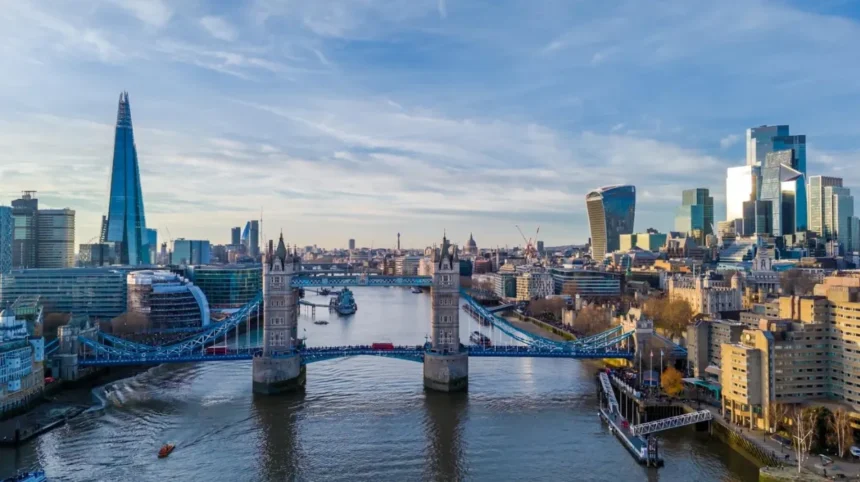
Tower Hamlets is one of London’s most historically layered boroughs. It combines the medieval Tower of London, Victorian Tower Bridge, former docks, Canary Wharf, Brick Lane, Whitechapel, Spitalfields, major markets, contemporary galleries, waterways and large public parks. Its attractions sit within a compact part of East London with extensive public transport connections.
- Why should tourists visit Tower Hamlets?
- Which historic attractions should tourists see in Tower Hamlets?
- What can visitors learn about Tower Hamlets’ docklands history?
- How should tourists explore Brick Lane and Spitalfields?
- Which markets are worth visiting in Tower Hamlets?
- Where can tourists experience contemporary art and culture?
- Where can visitors enjoy parks and open spaces?
- What should tourists see around Canary Wharf?
- How can tourists travel around Tower Hamlets?
- How can tourists build a one-day Tower Hamlets itinerary?
- What should families do in Tower Hamlets?
- Is Tower Hamlets suitable for food-focused tourists?
- What makes Tower Hamlets important for London’s future?
- What is the best way to experience Tower Hamlets as a tourist?
For tourists, Tower Hamlets works best as a destination rather than simply a route between central London attractions. The borough shows how London developed through monarchy, migration, trade, industry, maritime commerce, culture and financial services. The same streets contain centuries-old buildings beside modern towers.
The borough also has strong cultural diversity. London Museum describes Tower Hamlets as an area whose story reaches back to Roman times and whose communities include successive migrant populations. Its transformation from docklands to a major financial district is especially visible around the Isle of Dogs and Canary Wharf.
Its scale makes it possible to combine major attractions with independent neighbourhood exploration. A visitor can begin beside the Thames, explore a royal fortress, walk through historic docklands, eat around Brick Lane, visit an art gallery and finish beside the canals or in Victoria Park.
Why should tourists visit Tower Hamlets?
Tower Hamlets gives visitors a concentrated experience of London history, culture, food, architecture and waterfront life, combining the Tower of London, Tower Bridge, Brick Lane, Spitalfields, Docklands, Canary Wharf, museums, markets, galleries and public parks.
Tower Hamlets occupies a strategically important part of East London beside the River Thames. Its southern edge contains the Tower of London and Tower Bridge. Further east, former commercial docks define areas such as Wapping, Limehouse and the Isle of Dogs.
The borough has also experienced significant population growth. The Office for National Statistics recorded a population of approximately 310,300 in the 2021 Census, up from approximately 254,100 in 2011. The 22.1% increase was the largest percentage increase among English local authorities during that census period.
This demographic history helps explain the borough’s cultural character. Brick Lane, Whitechapel and Spitalfields contain visible evidence of successive communities, while Canary Wharf represents the transformation of former industrial land into a major business district.
Tourists therefore find several distinct London experiences within one borough. Heritage visitors can focus on medieval and Victorian landmarks. Food-focused visitors can explore markets and restaurants. Art visitors can visit Whitechapel Gallery. Families can use parks and museums. Business travellers can combine Canary Wharf with evening cultural activities.
Which historic attractions should tourists see in Tower Hamlets?
The strongest historic attractions include the Tower of London, Tower Bridge, St Katharine Docks, historic streets around Wapping and Spitalfields, and surviving dock buildings that explain how maritime trade shaped East London.
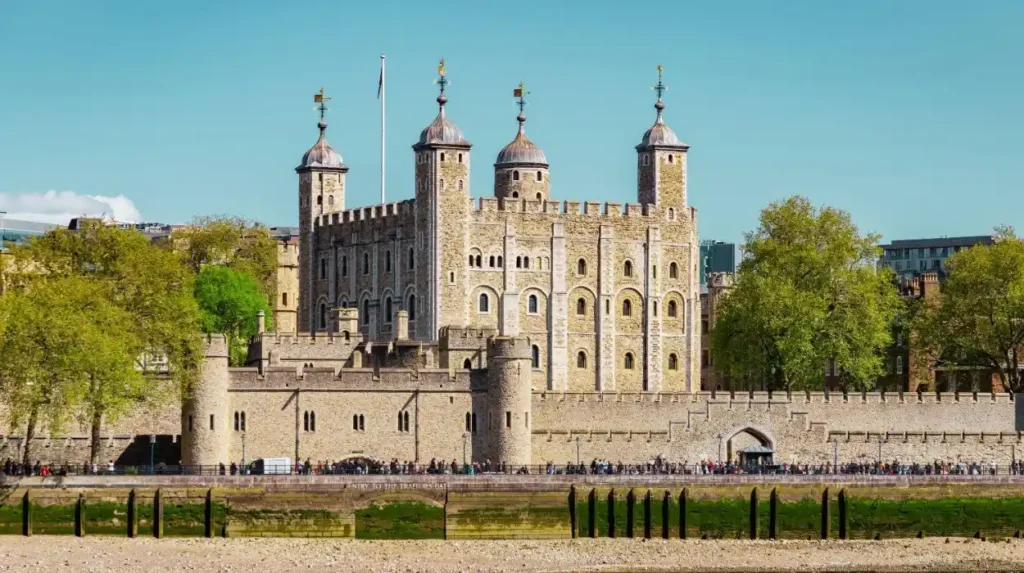
The Tower of London is the borough’s most internationally recognised historic attraction. The White Tower was built by William the Conqueror after the Norman Conquest and became the centre of a fortress-palace complex that developed between the 11th and 16th centuries. UNESCO identifies it as an outstanding example of Norman military architecture and a rare surviving medieval fortress palace.
Visitors can explore the White Tower, battlements, Crown Jewels displays, Bloody Tower and other public areas. Historic Royal Palaces states that general admission includes the open public areas and the Yeoman Warder Tour, subject to availability.
Tower Bridge provides a different historical experience. The bridge opened in 1894 after construction from 1886. Its distinctive bascules lift to allow tall vessels to pass along the Thames. The original hydraulic system used steam-powered pumping engines. Modern bridge lifts use oil and electricity.
The bridge also demonstrates the commercial importance of the Thames. During the Victorian period, the Pool of London was one of the world’s busiest port areas. Cargo ships carried commodities including sugar, tea and cotton into the docks and warehouses along the river.
St Katharine Docks adds another layer. The docks opened in 1828 after redevelopment authorised by Parliament. Engineer Thomas Telford and architect Philip Hardwick worked on the project. The surviving dock buildings and quay structures form an important historic environment beside the Tower of London. Historic England lists the dock’s quay walls and several associated structures.
As you explore these modern visitor destinations, you are crossing land with a deep heritage. Read about the full [Insert Anchor Text for History Article Here] to understand its origins.
What can visitors learn about Tower Hamlets’ docklands history?
Tower Hamlets’ docklands history is best understood through West India Docks and London Museum Docklands, where visitors can examine surviving warehouses, maritime trade, cargo handling, migration, industrial change and the area’s transformation into modern Canary Wharf.
London Museum Docklands occupies No. 1 Warehouse at West India Quay. The building was originally part of the West India Docks, which opened in 1802 as London’s first enclosed dock system. The warehouse stored imported commodities including sugar, rum and tea.
West India Docks were constructed to manage cargo arriving from the Caribbean. The site became closely connected with the wealth generated by Britain’s colonial trade and the enslavement of African people. London Museum explicitly documents this connection, including the relationship between sugar production, enslaved labour and London’s commercial development.
The dock complex was enormous. London Museum records that the docks were almost one kilometre long and provided moorings for up to 500 vessels. Warehouses were positioned around the docks to protect valuable cargo and support efficient loading and unloading.
The surviving No. 1 Warehouse provides physical evidence of this system. Its beams, scales, security features and dockside loading arrangements reveal how goods moved from ships into storage.
The docks eventually faced technological and commercial pressure. Containerisation required larger facilities than London’s traditional docks could provide. Shipping activity moved further east, contributing to the closure of West India Docks in 1980. The former docklands then became the basis for the modern Canary Wharf development.
London Museum Docklands is therefore important for tourists because it explains the relationship between the historic waterfront and today’s skyline. The museum also provides a free entry point for visitors who want substantial historical content without adding another major admission cost to a London itinerary.
How should tourists explore Brick Lane and Spitalfields?
Brick Lane and Spitalfields are best explored on foot because their streets combine historic architecture, markets, food businesses, religious buildings, creative venues, street art and evidence of successive Huguenot, Jewish and Bangladeshi communities.
Brick Lane has a long history of migration and commercial activity. Tower Hamlets Council records that the street existed by the 1500s and originally developed around brickmaking associated with early Flemish settlers. Large-scale urban development accelerated during the 17th century.
French Huguenot refugees arrived from the 1680s after fleeing religious persecution. They brought silk-weaving skills that helped establish Spitalfields as a major centre for silk production. Surviving houses and street layouts still provide evidence of this period.
Later migration changed the area’s identity again. Jewish communities established themselves in the area from the 17th century onwards. Brick Lane subsequently became strongly associated with London’s Bangladeshi community.
One of the clearest examples of this layered history is Brick Lane Jamme Masjid. London Museum records that the building began as a French Protestant church in 1743 before becoming a synagogue in 1898 and later a mosque.
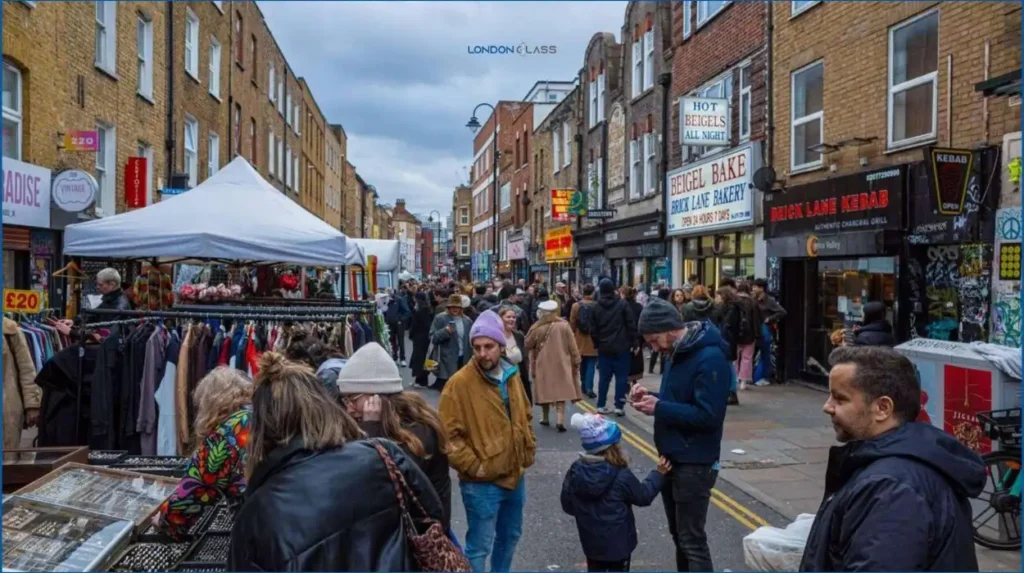
Brick Lane Market also has a long commercial history. Tower Hamlets Council dates the market’s development to the 18th century and identifies its modern Sunday trading with fashion, food, art, household goods and other products.
Spitalfields provides further architectural interest. Christ Church Spitalfields, designed by Nicholas Hawksmoor and completed in 1729, stands as one of the area’s major historic landmarks.
Visitors should treat Brick Lane as a neighbourhood rather than a single attraction. The most useful approach is to walk between Brick Lane, Cheshire Street, Spitalfields Market, Fournier Street and nearby Whitechapel streets.
Which markets are worth visiting in Tower Hamlets?
Tower Hamlets has a major concentration of London street markets, including Brick Lane, Columbia Road, Roman Road, Whitechapel, Petticoat Lane, Bethnal Green Road, Chrisp Street, Sclater Street and Watney Market.
Tower Hamlets Council identifies ten street markets across the borough. They include Brick Lane, Bethnal Green Road, Chrisp Street, Columbia Road, Petticoat Lane, Roman Road, Roman Road Square, Sclater Street, Watney Market and Whitechapel Market.
Brick Lane is particularly suitable for visitors interested in food, vintage clothing, fashion and creative goods. Columbia Road has a distinct focus on flowers and plants. The council describes Columbia Road separately from the other markets because of its specialist character.
Roman Road Market provides another neighbourhood-focused experience in Bow. Whitechapel Market provides a long-established commercial environment in the southern part of the borough.
Market opening days differ, so tourists should check the relevant market’s current information before travelling. Sunday is especially important for Brick Lane and Columbia Road.
Markets also work well as itinerary anchors. A visitor can combine Brick Lane Market with Spitalfields and Whitechapel, while Columbia Road can be combined with Bethnal Green and Victoria Park.
Where can tourists experience contemporary art and culture?
Whitechapel Gallery, Wilton’s Music Hall and the borough’s wider creative districts provide major cultural experiences, connecting contemporary visual art with historic performance spaces and the long-established creative identity of London’s East End.
Whitechapel Gallery was founded in 1901 by Samuel and Henrietta Barnett. Its original purpose was to bring high-quality art to East London’s communities. The gallery became an important platform for international and British artists.
Its exhibition history includes major artists such as Pablo Picasso, Jackson Pollock, Mark Rothko, Frida Kahlo, Lucian Freud and Gilbert & George. The gallery’s 2026 programme marks its 125th anniversary.
The gallery is particularly useful for tourists because it provides a direct cultural connection between the East End’s historic communities and international contemporary art.
Wilton’s Music Hall offers another distinctive experience. The Grade II* listed building describes itself as the world’s oldest Grand Music Hall. It hosts theatre, music and other performances within its historic structure.
The cultural experience extends beyond formal institutions. Whitechapel, Spitalfields and Brick Lane contain galleries, studios, creative businesses and street art. Their concentration reflects the area’s long association with artists and cultural communities.
Tourists should therefore consider an evening performance as part of a Tower Hamlets itinerary rather than limiting the borough to daytime sightseeing.
Where can visitors enjoy parks and open spaces?
Victoria Park is Tower Hamlets’ largest park and one of its most important recreational destinations, while Mile End Park, canal routes and riverside spaces provide additional opportunities for walking, cycling, relaxation and outdoor activities.
Victoria Park covers 86 hectares and opened in 1845. Tower Hamlets Council describes it as London’s oldest public park and records more than nine million visitors each year. It was originally created for the benefit of the working population of the East End.
The park also has a strategic position within East London’s green infrastructure. It connects with Mile End Park, the Regent’s Canal and routes towards Queen Elizabeth Olympic Park.
For tourists, Victoria Park provides a substantial break from dense urban sightseeing. Its size supports walking, sports, events and general recreation.
Mile End Park provides another green corridor between residential districts and the canal network. Its proximity to Regent’s Canal makes it suitable for visitors combining parkland with waterside walking.
Limehouse Basin offers a more maritime form of outdoor sightseeing. The Canal & River Trust describes it as the gateway between the Thames and more than 2,000 miles of navigable canals and rivers. The former dock is now a marina with narrowboats, yachts, cafés and walking space.
The basin is also accessible from Limehouse DLR station, making it practical for visitors who want to add a waterfront walk without travelling far from central London.
What should tourists see around Canary Wharf?
Canary Wharf shows the modern transformation of Tower Hamlets, replacing former dockland industrial activity with a major financial district while retaining docks, waterways, public spaces, restaurants, shops, transport interchanges and contemporary architecture.
Canary Wharf occupies land that was once part of the West India Docks. The docks closed in 1980 after changes in shipping technology and cargo handling. Redevelopment during the late 20th century created the modern financial district.
The contrast is particularly clear at West India Quay, where historic warehouses stand close to contemporary office towers. London Museum Docklands occupies one of the surviving warehouses.
Canary Wharf is also a useful destination for visitors interested in modern architecture. The district contains high-rise office buildings, large public spaces, waterways and pedestrian routes.
It has a strong food and leisure offer as well. Restaurants, cafés, shops and public spaces provide options for visitors after museum visits or walking tours.
Canary Wharf also works particularly well for domestic business travellers. Its transport connections allow visitors to combine meetings with cultural attractions, riverside walks and evening dining.
How can tourists travel around Tower Hamlets?
Tourists can travel efficiently through Tower Hamlets using the Underground, Elizabeth line, DLR, London Overground, buses, walking, cycling and River Bus services, with major interchanges at Whitechapel, Canary Wharf, Limehouse, Shadwell and Tower Hill.
The borough is one of London’s strongest transport-connected sightseeing areas. Whitechapel has connections with the Elizabeth line, District line, Hammersmith & City line and London Overground services.
Canary Wharf is an especially important interchange. Transport for London lists DLR, Elizabeth line and Jubilee line services at Canary Wharf. The station also provides access to buses, Santander Cycles and other transport options.
The DLR is particularly useful for reaching Docklands locations. Limehouse provides access to the waterfront, while Canary Wharf connects the financial district with wider London.
River transport adds another sightseeing option. TfL’s RB1 route includes Tower Pier and Canary Wharf Pier, while RB4 links Canary Wharf with Rotherhithe.
Walking is also valuable. Several major attractions sit within practical walking distances of one another. Tower of London, Tower Bridge and St Katharine Docks form a compact southern cluster. Brick Lane, Spitalfields and Whitechapel form another. West India Quay, Canary Wharf and the dock network form a third.
Visitors should use TfL’s current journey planner before travelling because engineering works and temporary service changes affect London transport.
How can tourists build a one-day Tower Hamlets itinerary?
A one-day itinerary should group nearby attractions to reduce travel time, starting with the Tower of London and Tower Bridge, continuing through St Katharine Docks and Spitalfields, then finishing with Brick Lane, Whitechapel or Canary Wharf.
Start in the morning around the Tower of London. Allow substantial time for the fortress, Crown Jewels and historic buildings.
Continue towards Tower Bridge. Visitors who enter the attraction can explore the high-level walkways and engineering history. The bridge’s walkways reopened as a visitor attraction in 1982 after being closed to the public since 1910.
Walk towards St Katharine Docks for a change of environment. The marina provides a quieter waterfront setting surrounded by historic dock architecture.
Continue north-east towards Spitalfields. Explore Christ Church Spitalfields, historic streets and the market environment before continuing into Brick Lane.
Finish the afternoon around Brick Lane and Whitechapel. Food businesses and markets make the area suitable for an evening meal.
An alternative route begins at Whitechapel Gallery, continues through Brick Lane and Spitalfields, then moves east towards the Docklands Museum and Canary Wharf. This route places greater emphasis on art, food, architecture and industrial history.
What should families do in Tower Hamlets?
Families can combine the Tower of London, London Museum Docklands, Victoria Park, canal walks, markets and accessible public spaces to create an itinerary that balances formal attractions with outdoor activities and shorter walking sections.
London Museum Docklands provides family-oriented experiences alongside its historical galleries. Its Mudlarks gallery is designed around play and exploration, allowing children to engage with the story of London’s docks.
Victoria Park provides substantial open space for children and families. Its 86 hectares create room for recreation and longer walks.
The Tower of London provides a more structured historical visit. Families can explore the fortress and its exhibitions while learning about monarchy, imprisonment, military history and the Crown Jewels.
For a lower-cost day, combine free outdoor spaces with free museum galleries. London Museum Docklands has free entry, while Limehouse Basin provides free public access.
Is Tower Hamlets suitable for food-focused tourists?
Tower Hamlets is particularly suitable for food-focused visitors because its markets and neighbourhoods support a wide range of cuisines, with Brick Lane and Whitechapel offering especially strong connections to the borough’s Bangladeshi heritage and wider migrant communities.
Food is closely connected to the borough’s migration history. Brick Lane’s Bangladeshi identity is particularly visible through restaurants, cafés, shops and food businesses.
Market environments provide additional opportunities to sample different foods without following a formal restaurant itinerary. Brick Lane Market is especially associated with food alongside fashion and art.
Spitalfields and Whitechapel provide further dining options. Canary Wharf offers a contrasting modern restaurant environment focused on office workers, residents and visitors.
Visitors should remember that individual businesses and market stalls operate on different schedules. Checking opening times before travelling is important, especially for Sunday markets and evening dining.
Explore More Area Guide
Tower Hamlets Sightseeing Guide: Top Places to See, East London 2026
Discover Tower Hamlets: Essential Places to See | London 2026
What makes Tower Hamlets important for London’s future?
Tower Hamlets remains important because its historic docklands, growing population, financial district, cultural institutions, transport infrastructure and public spaces demonstrate how East London continues to combine heritage conservation with urban development.
The borough’s development reflects several major phases of London’s history. The medieval Tower represents royal and military power. The docks represent international trade and industrialisation. Brick Lane and Whitechapel demonstrate migration and cultural change. Canary Wharf represents post-industrial redevelopment and global finance.
Its population growth also demonstrates continued urban pressure. The ONS recorded a 22.1% population increase between 2011 and 2021, taking the population beyond 310,000.
Transport investment strengthens the borough’s role as an accessible part of London. Whitechapel and Canary Wharf connect several major transport modes, while river services add another route through the capital.
The preservation of historic buildings alongside new development is equally significant. West India Quay retains surviving dock warehouses beside modern towers, while St Katharine Docks preserves elements of the 19th-century dock environment.
For tourists, this combination creates a destination with unusually strong historical depth. Tower Hamlets is not simply an extension of central London. It is a place where royal history, maritime commerce, migration, culture, finance and urban regeneration remain physically visible within the same borough.
What is the best way to experience Tower Hamlets as a tourist?
The best approach is to divide Tower Hamlets into connected sightseeing zones: Tower and St Katharine Docks, Wapping and Limehouse, Whitechapel and Brick Lane, Spitalfields, Canary Wharf and the wider Docklands, plus Victoria Park and Mile End.
Each zone provides a different experience. The Tower and Tower Bridge focus on major heritage attractions. Wapping and Limehouse emphasise historic waterfronts and canals. Whitechapel and Brick Lane combine migration history, markets, food and contemporary culture.
Spitalfields provides historic architecture and shopping. Canary Wharf demonstrates modern redevelopment and finance. Victoria Park supplies green space and recreation.
This structure also prevents tourists from spending too much time crossing London between unrelated attractions. Public transport should connect the zones, while walking should be used inside each cluster.
Tower Hamlets rewards visitors who combine major landmarks with local streets. The Tower of London provides global historical significance, while Brick Lane, West India Quay, Limehouse Basin and Victoria Park reveal the everyday geography surrounding those headline attractions.
The result is a comprehensive East London experience covering royal history, maritime heritage, migration, markets, food, art, architecture, green space, waterways and modern business districts in one highly connected part of London.
Is Tower Hamlets worth visiting as a tourist?
Yes. Tower Hamlets is worth visiting because it combines major London landmarks, historic sites, markets, museums, cultural attractions, waterfront areas, parks and modern architecture. The Tower of London, Tower Bridge, Brick Lane, Spitalfields and Canary Wharf are among its main visitor highlights.