Tower Hamlets is one of East London’s most historically layered boroughs. It stretches from the City fringe and Whitechapel to Stepney, Bethnal Green, Mile End, Poplar, Limehouse, Wapping and the Isle of Dogs. Its attractions include museums, former industrial buildings, historic churches, cemeteries, canals, ecological spaces and distinctive houses.
- What are the most unusual places to visit in Tower Hamlets?
- Why is Tower Hamlets historically important for curious travellers?
- What makes Dennis Severs’ House unusual?
- Why should travellers visit the Ragged School Museum?
- What can visitors discover at Tower Hamlets Cemetery Park?
- What is unusual about St George in the East in Stepney?
- Why is Mile End Ecology Park an unusual urban attraction?
- What can curious travellers see at the Museum of London Docklands?
- Which unusual historic places in Whitechapel and Spitalfields deserve attention?
- How can visitors combine unusual Tower Hamlets attractions into one day?
- When is the best time to explore unusual places in Tower Hamlets?
- Why should curious travellers explore beyond Tower Hamlets’ famous landmarks?
The borough is particularly suitable for travellers who want experiences beyond London’s best-known landmarks. Its unusual places reveal the social, industrial, religious, architectural and environmental history of the East End.
Tower Hamlets Council describes the borough as the heart of London’s East End, with evidence of human activity extending back thousands of years. The borough also contains the historic docklands that helped connect London with international trade.
For curious travellers, the most rewarding places are often those where the physical setting explains the history. A Victorian school beside Regent’s Canal, a cemetery transformed into a nature reserve and a Georgian house presented as a historical installation all demonstrate this connection.
What are the most unusual places to visit in Tower Hamlets?
The most unusual places in Tower Hamlets include Dennis Severs’ House, the Ragged School Museum, Tower Hamlets Cemetery Park, St George in the East, Mile End Ecology Park, Museum of London Docklands and several historic East End sites.
These attractions differ significantly from conventional London sightseeing. They focus on social history, industrial heritage, architecture, ecology and everyday life.
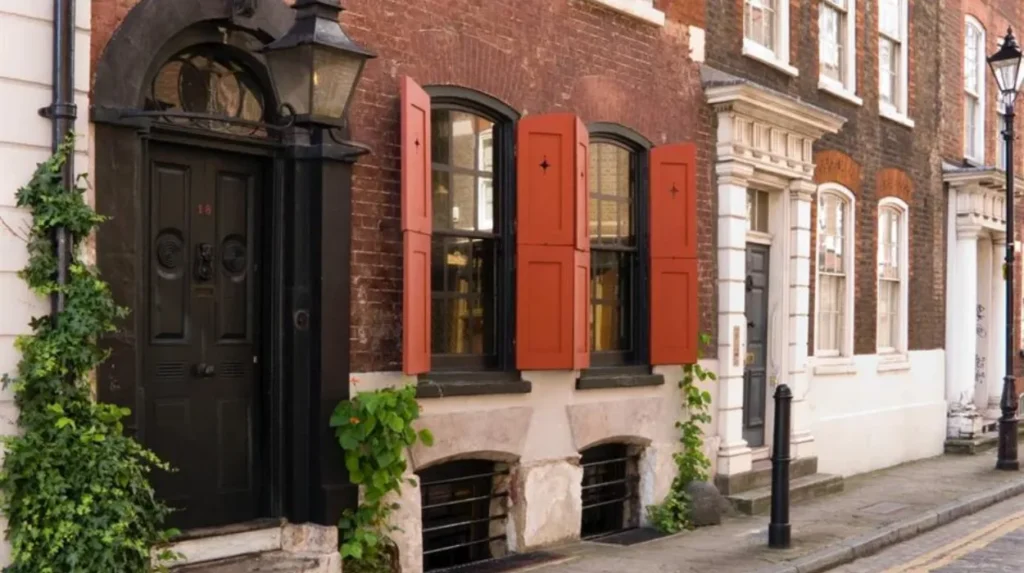
Dennis Severs’ House at 18 Folgate Street presents an eighteenth-century Georgian house as an immersive historical environment. The property was shaped by artist Dennis Severs, who lived there from 1979 until 1999. The rooms represent the fictional Jervis family, described as silk weavers.
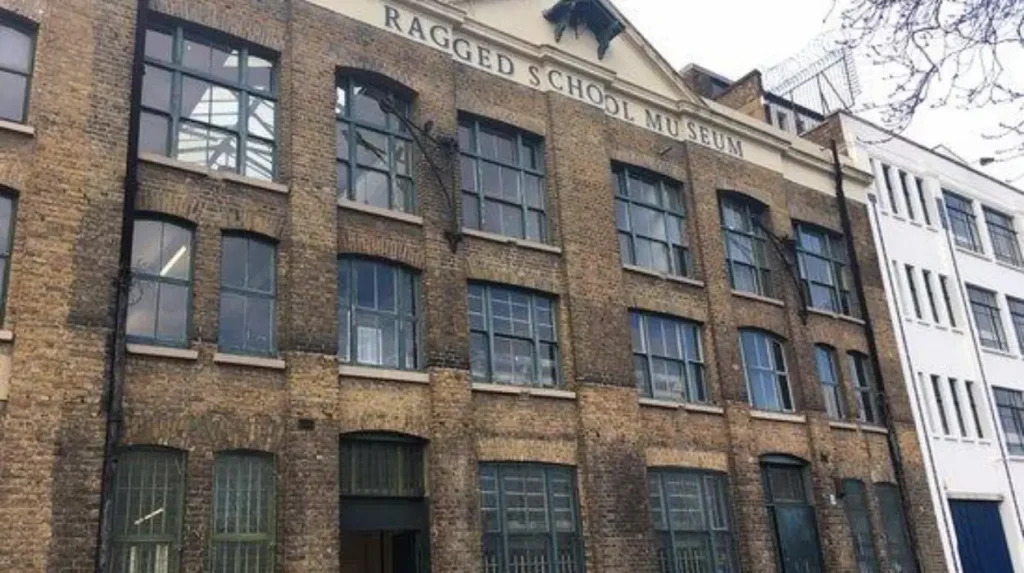
Ragged School Museum occupies former canalside buildings associated with Thomas Barnardo’s Victorian free school. The museum focuses on childhood, education, poverty and social conditions in the East End.
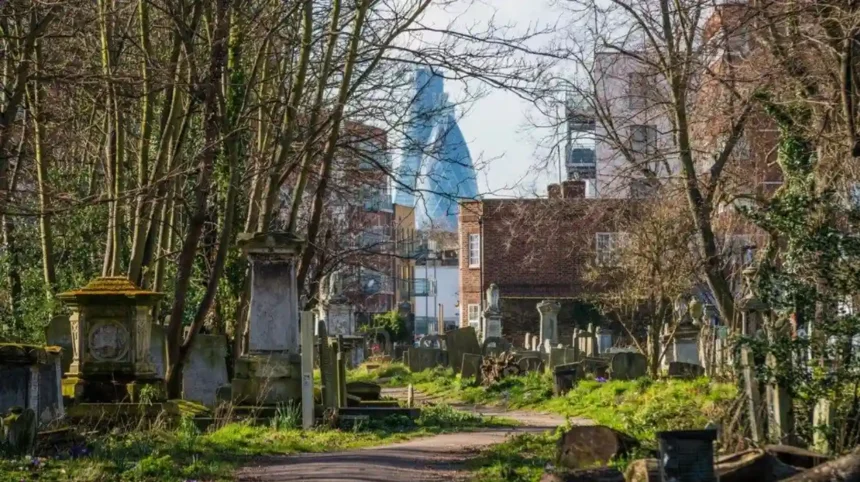
Tower Hamlets Cemetery Park combines Victorian funerary heritage with woodland, meadows and wildlife. It opened for burials in 1841 and became a public park after burials ended in 1966.
These locations provide different ways to understand Tower Hamlets. One explores domestic life, another education and poverty, while another combines death, conservation and urban ecology.
Why is Tower Hamlets historically important for curious travellers?
Tower Hamlets is historically important because its East End communities, docks, industries, religious institutions, markets and immigrant neighbourhoods shaped London’s commercial and social development over several centuries.
The borough occupies a strategic position beside the River Thames and east of the historic City of London. The Thames supported shipping, warehousing and international trade, while the surrounding neighbourhoods developed around commerce and industry.
The area also has much older origins. Tower Hamlets Council records evidence of human activity dating back thousands of years, including Stone Age and Bronze Age tools. Roman activity forms another important layer of the borough’s history.
During the eighteenth and nineteenth centuries, the East End experienced major population growth. Industrial employment, dock work, manufacturing and international trade attracted workers and communities from different parts of Britain and overseas.
The docks became especially important. West India Docks, for example, formed part of London’s major dock system and are now closely associated with Canary Wharf and the modern financial district.
The social history remains visible through surviving buildings. Churches, warehouses, schools, cemeteries, terraces and canals preserve evidence of earlier urban life.
As you explore these modern streets and attractions, you are crossing land with a deep heritage. Read about the full [Insert Anchor Text for History Article Here] to understand its origins.
What makes Dennis Severs’ House unusual?
Dennis Severs’ House is unusual because an eighteenth-century Spitalfields house is presented as an immersive historical environment, with rooms arranged to suggest the everyday life of a fictional family of silk weavers.
The house stands on Folgate Street in Spitalfields. It is a Georgian terraced property and operates differently from a conventional museum.
Dennis Severs acquired the house and developed its interiors as a detailed interpretation of domestic life. The fictional Jervis family provides the narrative framework. Their supposed occupations connect the house to Spitalfields’ silk-weaving history.
The rooms contain objects and arrangements designed to suggest an occupied home rather than a conventional exhibition. Visit London describes it as an eighteenth-century time capsule and notes that the installation extends across 10 rooms.
The experience focuses on domestic details. Beds, furniture, household objects, candles and room settings contribute to the historical presentation.
This makes the attraction useful for travellers interested in architecture and material culture. The building itself is important, but the interior arrangement provides additional information about the relationship between housing, work and community in historic Spitalfields.
The location also places visitors close to Commercial Street, Brick Lane, Old Spitalfields Market and other historic streets. These nearby areas provide additional context for understanding the transformation of the district.
Why should travellers visit the Ragged School Museum?
The Ragged School Museum preserves the history of Victorian education and poverty through former school buildings beside Regent’s Canal, including an authentic Victorian classroom used for educational programmes.
The museum occupies three canalside buildings at 46–50 Copperfield Road. The structures originally served as warehouses before becoming associated with the Copperfield Road Free School.
Thomas Barnardo arrived in London in 1866. He encountered severe poverty, overcrowding and limited educational opportunities in the East End. In 1867 he opened his first ragged school, providing free basic education.
The Copperfield Road Free School opened in 1877. It operated for 31 years and educated tens of thousands of children before closing in 1908.
The museum was established after local campaigners worked to save the buildings from demolition in the early 1980s. The Ragged School Museum Trust was established and the museum opened in 1990.
One of its distinctive features is the reconstructed Victorian classroom. The museum states that around 16,000 children experience its historical classroom each year through educational activities.
The building also sits beside Regent’s Canal. This creates an unusual combination of industrial heritage, educational history and waterside landscape.
For curious travellers, the attraction provides a direct connection between architecture and social history. The former warehouses show how buildings can acquire new functions as neighbourhoods change.
What can visitors discover at Tower Hamlets Cemetery Park?
Tower Hamlets Cemetery Park is a former Victorian cemetery that now combines historic graves, listed monuments, woodland, wildflower meadows and wildlife within a protected urban nature reserve.
The cemetery opened for burials in 1841. It became one of London’s major Victorian cemeteries and is recognised as one of the capital’s “Magnificent Seven” cemeteries.
Burials ceased in 1966 after an Act of Parliament closed the cemetery and established it as public open space. The Greater London Council managed it until 1986, when ownership transferred to the London Borough of Tower Hamlets.
The site now has several overlapping identities. It is a historic cemetery, a conservation area, a Local Nature Reserve and a Metropolitan Site of Importance for Nature Conservation.
The Friends of Tower Hamlets Cemetery Park formed in 1990 and have supported conservation, heritage and community work. The organisation also supports grave research and family history enquiries.
The landscape includes woodland paths, meadows and habitats for birds, butterflies and plants. Several listed monuments add architectural interest.
This makes the cemetery particularly distinctive within central and East London. Visitors can examine funerary monuments while also observing urban biodiversity.
The site demonstrates how former infrastructure can acquire a new public function. Its transformation from burial ground to protected green space reflects changing approaches to conservation and urban land management.
What is unusual about St George in the East in Stepney?
St George in the East is an eighteenth-century Grade I listed church designed by Nicholas Hawksmoor, with a surviving historic exterior and tower surrounding a later church built inside after wartime destruction.
The church stands on Cannon Street Road in Stepney. It was designed by architect Nicholas Hawksmoor and completed in 1729. Historic England lists it as Grade I.
Its history became particularly unusual during the Second World War. The interior was gutted, while the main walls and landmark lantern tower survived.
A smaller twentieth-century church was subsequently constructed within the historic outer structure. Historic England records that the present arrangement includes the later church inside the surviving eighteenth-century walls.
The result is an architectural layering that is easy to miss from outside. Visitors can see how one building contains evidence from different periods.
The church also forms part of a wider historic group that includes the rectory, walls, gates, railings, memorials and former churchyard.
St George’s Gardens occupies the former churchyard. Historic England also records the Raine Memorial, dating from 1725 and later alterations, within this setting.
The church is therefore valuable for travellers interested in architecture, wartime history and urban reconstruction. It demonstrates how historic buildings survive through adaptation rather than remaining unchanged.
Why is Mile End Ecology Park an unusual urban attraction?
Mile End Ecology Park is unusual because its lakes, reed beds, wildlife habitats and earth-sheltered Ecology Pavilion create a nature-focused environment within a densely developed part of East London.
Mile End Park stretches through Tower Hamlets and covers more than 10 hectares. It includes recreation facilities, arts spaces, ecological habitats and landscaped areas.
The Ecology Park contains a lake complex and reed beds. Tower Hamlets Council identifies water birds, amphibians, dragonflies and damselflies among the wildlife associated with the site.
The landscape also retains evidence of the former neighbourhood that occupied parts of the area. The Palm Tree pub remains within the park, adding another layer of local character.
The Ecology Pavilion is built into a grass bank beside the reed beds. Its earth-sheltered design reflects the environmental principles used when the park was developed.
The pavilion is also used for exhibitions, corporate events and community activities. It has a capacity of 220 people and provides a direct connection between a contemporary building and a natural landscape.
For visitors, the attraction is less about a single monument and more about the relationship between urban regeneration, landscape design and biodiversity.
What can curious travellers see at the Museum of London Docklands?
The Museum of London Docklands explains the history of the River Thames, London’s port and the Docklands through collections housed within a surviving historic warehouse at West India Docks.
The Museum of London Docklands occupies part of a Grade I listed warehouse at West India Docks.
The museum is significant because the building itself forms part of the story. Its historic fabric connects visitors directly with the dock system that once handled large volumes of imported and exported goods.
Tower Hamlets Council identifies the Museum of London Docklands as a major heritage collection within the borough. Its collections cover the River Thames, Docklands and London’s development as a port.
The surrounding West India Docks provide further context. Modern Canary Wharf sits beside the historic dock infrastructure, creating a clear contrast between nineteenth-century maritime commerce and twenty-first-century office development.
Visitors interested in unusual places can therefore use the museum as a starting point for understanding the wider docklands landscape.
The attraction is especially relevant to travellers examining how London developed through shipping, warehouses, global trade and later redevelopment.
Which unusual historic places in Whitechapel and Spitalfields deserve attention?
Whitechapel and Spitalfields contain unusual historic buildings, former religious sites, surviving streets and specialist museums that reveal immigration, religion, architecture, trade and everyday life in the historic East End.
The area has long been shaped by migration. Tower Hamlets’ heritage strategy identifies the Museum of Immigration and Diversity at 19 Princelet Street as an important heritage collection associated with the borough’s immigration history.
Spitalfields also preserves significant architectural evidence from the eighteenth and nineteenth centuries. Christ Church Spitalfields is one of the most prominent landmarks and was designed by Nicholas Hawksmoor.
The surrounding streets contain listed buildings and historic street furniture. Historic England, for example, lists a K6 telephone kiosk outside Christ Church Spitalfields as Grade II. The kiosk was designed by Giles Gilbert Scott in 1935 for the General Post Office.
This demonstrates how unusual sightseeing does not always involve entering a museum. Architectural details in streets, squares and churchyards can also provide historical evidence.
Whitechapel adds another layer through medical, religious, commercial and migration history. The Royal London Hospital Museum is identified by Tower Hamlets as a heritage collection documenting healthcare in the East End since the eighteenth century.
These locations are particularly useful for visitors who prefer walking-based exploration. A short route through Whitechapel and Spitalfields can connect religious buildings, historic streets, museums and surviving architectural details.
How can visitors combine unusual Tower Hamlets attractions into one day?
A one-day unusual Tower Hamlets itinerary works best when attractions are grouped geographically, such as Spitalfields and Whitechapel first, Mile End and Stepney next, then the docklands or riverside areas.
Start in Spitalfields with Dennis Severs’ House and the surrounding historic streets. Its opening arrangements and admission requirements change, so visitors should check current information before travelling. Visit London currently lists Friday-to-Sunday daytime visits and notes that the experience takes roughly one to two hours.
Continue towards Whitechapel for architectural and social-history sites. This section works well for travellers interested in immigration, healthcare, religion and historic urban development.
Move east towards Mile End for the Ragged School Museum and Mile End Park. The museum is beside Regent’s Canal, while the park contains ecological habitats, recreation facilities and the Ecology Pavilion.
Stepney provides another historic layer through St George in the East and its surrounding gardens.
Tower Hamlets Cemetery Park works particularly well as a separate stop because it requires time for walking. Its woodland paths and heritage monuments reward slower exploration rather than a quick visit.
Finish around the docks with the Museum of London Docklands and the West India Docks area.
This route creates a chronological and geographical progression from Georgian domestic life and Victorian social history to industrial heritage and modern regeneration.
Explore More Area Guide
Tower Hamlets Secrets: Hidden Places Beyond Tourist Routes
Best Places to Discover Tower Hamlets’ East London Character
When is the best time to explore unusual places in Tower Hamlets?
The best time depends on the attraction: indoor museums suit weekday and rainy-day visits, while cemetery parks, canals and ecological sites work best during daylight and stable weather conditions.
Indoor attractions provide reliable options throughout the year. Dennis Severs’ House, the Ragged School Museum and the Museum of London Docklands each offer structured historical experiences.
Outdoor locations require more attention to daylight and weather. Tower Hamlets Cemetery Park contains woodland paths and natural habitats, while Mile End Ecology Park includes lakes and reed beds.
Spring and summer provide longer daylight hours for walking. Autumn provides strong seasonal changes in woodland and park landscapes. Winter is suitable for combining a shorter outdoor walk with indoor museums.
Visitors should also check opening days before travelling. Smaller specialist attractions do not always operate on the same schedule as major London museums.
For photographers and architecture enthusiasts, daylight is particularly useful around churches, terraces, canals and historic dock structures.
Why should curious travellers explore beyond Tower Hamlets’ famous landmarks?
Exploring lesser-known Tower Hamlets locations reveals the borough as a layered historical landscape where trade, migration, education, religion, industry, architecture and nature remain visible within a modern London borough.
The unusual attractions are valuable because they explain the forces behind the better-known landmarks.
The docks explain London’s maritime economy. The Ragged School Museum explains Victorian education and poverty. Dennis Severs’ House provides insight into domestic life and the silk trade. Tower Hamlets Cemetery Park connects Victorian urban development with modern conservation.
Mile End Ecology Park shows how ecological design can operate within a densely populated urban environment. St George in the East demonstrates how historic architecture can survive major wartime damage and subsequent reconstruction.
Tower Hamlets Council records 52 publicly accessible open spaces of historic interest in its London Inventory of Historic Green Spaces. The borough’s parks therefore form a substantial part of its heritage infrastructure.
The borough also contains a mixture of protected buildings, conservation areas, museums and natural sites. Historic England maintains a dedicated Tower Hamlets heritage hub containing archival images and information about historic places.
For curious travellers, this means unusual sightseeing does not require leaving the established visitor areas entirely. The most distinctive experiences often sit within ordinary streets and neighbourhoods.
Tower Hamlets is best understood through its layers. Its unusual places show how London developed through commerce, migration, social reform, architecture, infrastructure and environmental change. Exploring these sites gives visitors a more detailed understanding of East London than a landmark-only itinerary.
What are the most unusual places to visit in Tower Hamlets?
Some of the most unusual places to visit in Tower Hamlets include Dennis Severs’ House, Ragged School Museum, Tower Hamlets Cemetery Park, St George in the East, Mile End Ecology Park and the Museum of London Docklands. These attractions cover domestic history, Victorian education, architecture, ecology and docklands heritage.