Tower Hamlets, in East London, contains an exceptional collection of historic churches, mosques, synagogues and other religious buildings that document centuries of migration, trade, worship and architectural development. From the medieval foundations of St Dunstan and All Saints in Stepney to the eighteenth-century churches of Nicholas Hawksmoor and the historic East London Mosque, the borough reveals how different religious communities shaped its neighbourhoods.
- Why Is Tower Hamlets Important for Religious Heritage in East London?
- Which Historic Churches Should Visitors Explore in Tower Hamlets?
- St Dunstan and All Saints, Stepney
- Christ Church Spitalfields
- St Anne’s Church, Limehouse
- St George-in-the-East
- St John on Bethnal Green
- How Did Nicholas Hawksmoor Influence Religious Architecture in Tower Hamlets?
- Which Religious Buildings Reveal Tower Hamlets’ Huguenot Heritage?
- Where Can Visitors Discover Jewish Religious Heritage in Tower Hamlets?
- Which Mosques Reflect the Islamic Heritage of Tower Hamlets?
- What Other Historic Religious Buildings Can Visitors Discover in Tower Hamlets?
- How Do Tower Hamlets’ Religious Buildings Reflect Migration and Cultural Diversity?
- How Can Visitors Explore Historic Churches and Religious Buildings in Tower Hamlets?
- Spitalfields and Brick Lane Heritage Walk
- Whitechapel and Stepney Heritage Walk
- Shadwell and Limehouse Heritage Walk
- What Architectural Features Should Visitors Look for in Tower Hamlets’ Religious Buildings?
- Medieval Church Architecture
- Georgian Baroque Architecture
- Victorian Religious Architecture
- Converted Religious Buildings
- How Are Historic Religious Buildings Protected in Tower Hamlets?
- When Is the Best Time to Visit Historic Religious Buildings in Tower Hamlets?
- Why Should Historic Churches and Religious Buildings Remain Important to Tower Hamlets?
These buildings are more than places of worship. They represent the arrival of Huguenot refugees, the growth of London’s maritime economy, the development of Jewish communities, the expansion of Muslim life and the changing identity of East London. Their architecture ranges from medieval parish churches and English Baroque designs to converted Huguenot chapels and purpose-built Islamic buildings.
Exploring Tower Hamlets through its religious heritage provides visitors with a detailed understanding of the area’s social and cultural history. It also creates opportunities to discover historic streets, conservation areas, traditional burial grounds and significant architectural landmarks.
Why Is Tower Hamlets Important for Religious Heritage in East London?
Tower Hamlets is important for religious heritage because its historic buildings document centuries of Christian, Jewish, Muslim and other religious communities. Its churches, mosques and synagogues reflect migration, industrial development, international trade and the borough’s changing cultural identity.
Tower Hamlets occupies a historically significant position east of the City of London. Its development was closely connected to the River Thames, the Port of London, maritime industries and expanding residential neighbourhoods.
During the medieval period, settlements such as Stepney, Poplar and Bow developed around parish churches and agricultural communities. As London’s population expanded eastwards, these settlements became increasingly connected to commercial activity, manufacturing and international migration.
Religious buildings developed alongside these changes. Medieval churches served established communities, while later buildings accommodated growing populations of immigrants and workers.
The borough’s religious heritage includes several important architectural and historical categories:
- Medieval Anglican churches, including St Dunstan and All Saints in Stepney.
- Georgian parish churches, including Christ Church Spitalfields and St Anne’s Limehouse.
- Victorian religious buildings, including churches established for expanding industrial neighbourhoods.
- Jewish heritage buildings, including Sandys Row Synagogue.
- Islamic heritage landmarks, including Brick Lane Jamme Masjid and the East London Mosque.
- Catholic and other Christian institutions serving different communities.
The Tower Hamlets Council heritage records identify nationally important buildings across the borough. Its conservation information also explains how historic structures contribute to architectural character and local identity.
The variety of religious buildings makes Tower Hamlets particularly valuable for understanding how religion, migration and urban development influenced East London’s growth.
Which Historic Churches Should Visitors Explore in Tower Hamlets?
Visitors exploring Tower Hamlets should prioritise St Dunstan and All Saints in Stepney, Christ Church Spitalfields, St Anne’s Limehouse, St George-in-the-East and St John on Bethnal Green. These churches represent medieval, Georgian and nineteenth-century architectural heritage.
The borough contains churches from different historical periods. Their locations provide a useful starting point for exploring its religious architecture and neighbourhood development.
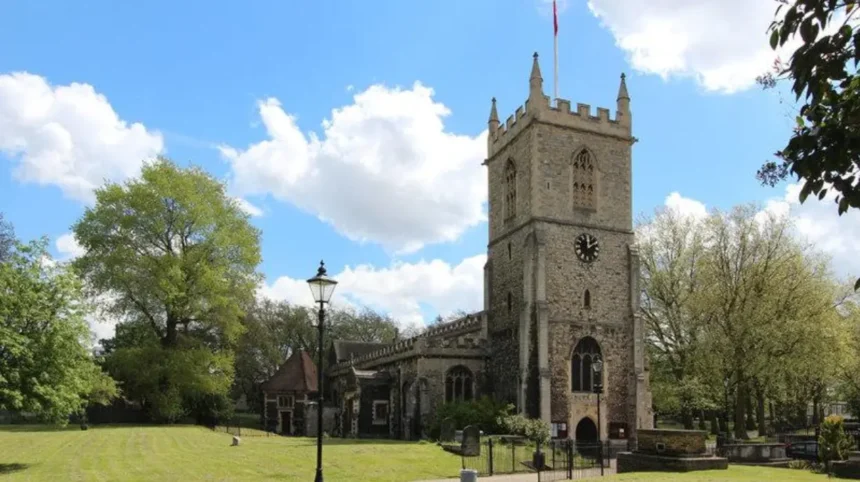
St Dunstan and All Saints, Stepney
St Dunstan and All Saints is one of the most historically significant churches in Tower Hamlets. Located on Stepney High Street, its origins extend back to the medieval period.
The church is particularly important because it predates the Tower of London. Its historical development reflects Stepney’s former position as a major settlement outside the historic City of London.
The building contains architectural features from different periods, reflecting centuries of religious activity and structural change. Its churchyard also preserves historic memorials associated with the area’s former residents.
St Dunstan’s provides an important connection to medieval East London. It demonstrates how parish churches served communities before the expansion of modern transport networks and industrial neighbourhoods.
Christ Church Spitalfields
Christ Church Spitalfields is one of the most recognisable historic religious buildings in East London. Designed by architect Nicholas Hawksmoor, the church opened on 5 July 1729.
Its construction formed part of the Fifty New Churches Act of 1711, a parliamentary initiative intended to provide additional Anglican churches for London’s expanding population.
The building represents English Baroque architecture through its monumental proportions, prominent tower, carefully arranged classical details and imposing exterior.
Christ Church also reflects the history of the Huguenot community in Spitalfields. French Protestant refugees settled in the neighbourhood after religious persecution in France, establishing textile businesses and contributing to the area’s economic development.
The church underwent a major restoration completed in 2004. Its redeveloped crypt opened in 2015, supporting its continuing role as a religious, cultural and heritage destination. Christ Church Spitalfields+1
St Anne’s Church, Limehouse
St Anne’s Church stands on Three Colt Street in Limehouse. It is another important architectural work associated with Nicholas Hawksmoor.
The church was built during the eighteenth century as part of the programme to provide new Anglican churches for London’s growing population.
Its distinctive tower and monumental design make it an important feature of Limehouse’s historic townscape. The building is Grade I listed, recognising its exceptional architectural and historical importance.
St Anne’s also has a continuing community function. Tower Hamlets Council records its availability for religious services, concerts, weddings and community activities.
The main church space accommodates approximately 450 seated visitors, while its crypt provides additional community facilities.
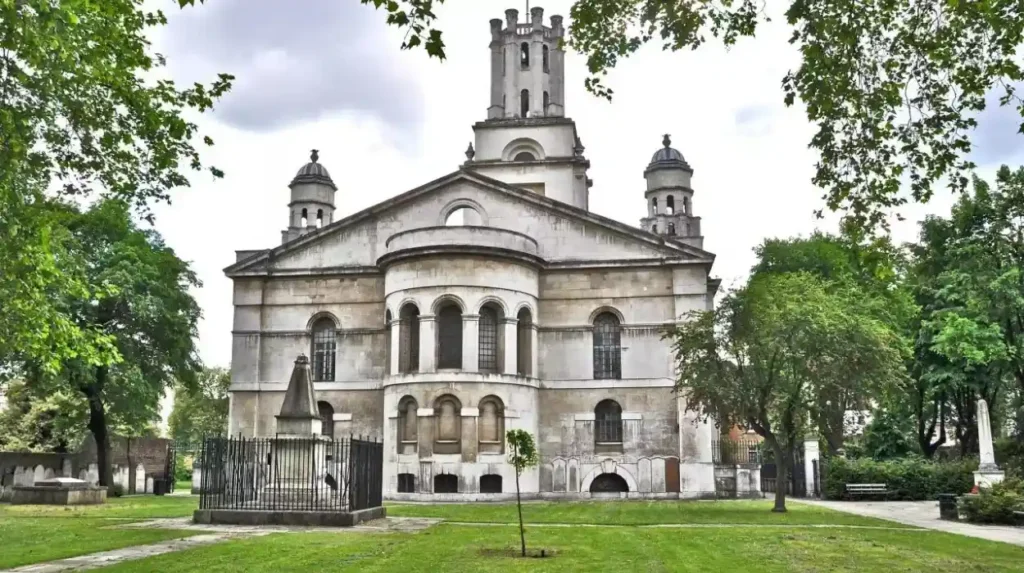
St George-in-the-East
St George-in-the-East is located near Cable Street and Shadwell. It is one of three important Tower Hamlets churches designed by Nicholas Hawksmoor.
Its architectural character reflects the monumental church-building programme of eighteenth-century London. The building’s historic setting also connects it with the development of working-class neighbourhoods near the docks.
The surrounding St George’s Gardens occupies the former churchyard. The gardens opened to the public in 1875 and cover approximately 1.19 hectares.
Visitors can explore the surviving historic walls, monuments, paths and landscaped grounds. Heritage interpretation panels explain the site’s historical development.
St John on Bethnal Green
St John on Bethnal Green is another major historic church in the borough. Designed by Sir John Soane, it represents nineteenth-century ecclesiastical architecture.
Soane was one of Britain’s most influential architects. His work included the Bank of England and the architectural development of major London institutions.
The church is recognised as a Grade I listed building. Its architectural significance places it among the borough’s most important historic religious landmarks.
Its location on Cambridge Heath Road connects it with Bethnal Green’s history as a densely populated East London neighbourhood.
Historic England identifies the building as a listed place of worship and records its heritage significance.
How Did Nicholas Hawksmoor Influence Religious Architecture in Tower Hamlets?
Nicholas Hawksmoor influenced Tower Hamlets through three major Georgian churches: Christ Church Spitalfields, St Anne’s Limehouse and St George-in-the-East. His monumental designs introduced distinctive English Baroque architecture and transformed the borough’s historic religious landscape.
Nicholas Hawksmoor (1661–1736) was an English architect associated with the development of monumental Baroque architecture. He worked alongside Christopher Wren and John Vanbrugh and contributed to several important architectural projects in England.
His work in Tower Hamlets developed during a period when London’s population was expanding rapidly. New residential districts required additional churches, particularly in areas experiencing commercial and industrial growth.
The Fifty New Churches Act of 1711 provided the legislative framework for constructing new Anglican churches in expanding parts of London. Hawksmoor became responsible for several buildings under this programme.
His three major Tower Hamlets churches demonstrate different applications of monumental architectural design.
Christ Church Spitalfields features a prominent tower and an imposing classical composition. St Anne’s Limehouse has a distinctive vertical profile that makes it visible within the surrounding neighbourhood. St George-in-the-East combines monumental architecture with a churchyard that now serves as public green space.
These buildings also illustrate the relationship between architecture and urban planning. Churches functioned as religious centres, public landmarks and important elements of neighbourhood identity.
Their continued preservation allows visitors to understand eighteenth-century architectural ambitions and the development of East London’s historic streets.
Which Religious Buildings Reveal Tower Hamlets’ Huguenot Heritage?
The former Huguenot chapel on Brick Lane is one of Tower Hamlets’ most important religious heritage buildings. Its conversion from a French Protestant church into a synagogue and subsequently a mosque documents centuries of migration and changing religious communities.
The Huguenots were French Protestants who faced religious persecution in France, particularly following the revocation of the Edict of Nantes in 1685. Many sought refuge in Britain and settled in London’s eastern districts.
Spitalfields became an important centre for Huguenot settlement. Refugees brought textile-making knowledge, specialist craftsmanship and commercial experience.
Their influence remains visible in the neighbourhood’s historic streets, former workshops and religious buildings.
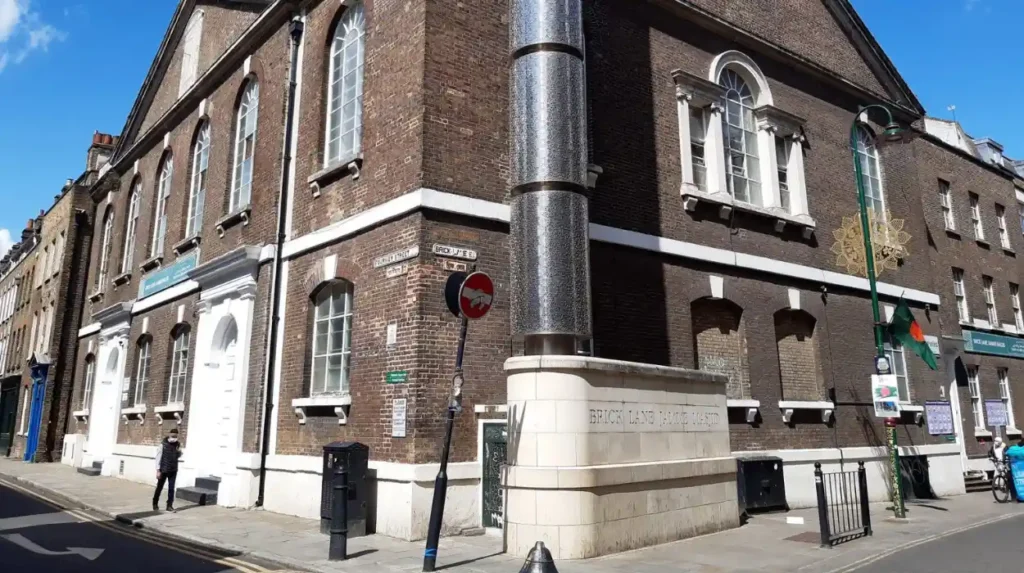
Brick Lane Jamme Masjid
Brick Lane Jamme Masjid is one of the most remarkable examples of religious architectural adaptation in London.
The building at 59 Brick Lane was originally constructed as a French Protestant chapel in 1743–44. It subsequently became a Methodist chapel before being converted into a synagogue in 1897. In 1976, it became a mosque.
This sequence reflects the changing communities of Spitalfields and Brick Lane.
The building’s different religious uses connect three important periods of East London’s migration history:
- Huguenot settlement, represented by French Protestant worship.
- Jewish migration, represented by the synagogue established for the local Jewish community.
- Bangladeshi migration, represented by the building’s continuing Islamic use.
The former chapel is particularly valuable because its architectural history documents changing religious needs without requiring visitors to explore separate historical sites.
Historic England identifies Brick Lane Jamme Masjid as a former Neuve Eglise, documenting its eighteenth-century Protestant origins and subsequent religious conversions.
Understanding the Huguenot Influence on Spitalfields
Huguenot heritage extends beyond individual religious buildings. The community influenced the economic and architectural development of the surrounding neighbourhood.
Textile workshops, residential buildings and commercial premises supported the silk-weaving industry. Many historic properties around Fournier Street and Commercial Street remain associated with this period.
Christ Church Spitalfields also provides an important architectural connection to this history.
As you explore modern Brick Lane and Spitalfields, you are crossing streets shaped by successive generations of migration. Read the full [Insert Anchor Text for the History of Spitalfields and Its Huguenot Heritage Article Here] to understand how these communities transformed East London.
Where Can Visitors Discover Jewish Religious Heritage in Tower Hamlets?
Visitors can explore Jewish religious heritage in Tower Hamlets through historic synagogues in Spitalfields and Whitechapel. Sandys Row Synagogue is an important surviving landmark, documenting the area’s nineteenth-century Ashkenazi Jewish settlement and religious traditions.
Jewish communities have played an important role in Tower Hamlets’ development. Their history includes successive waves of migration from continental Europe, particularly during the nineteenth and early twentieth centuries.
Spitalfields and Whitechapel became important centres of Jewish settlement. Immigrant families established businesses, religious institutions, educational organisations and community support networks.
Sandys Row Synagogue
Sandys Row Synagogue is a significant Jewish heritage building in Spitalfields.
Its history is associated with the arrival of Ashkenazi Jewish immigrants from Germany and other parts of central and eastern Europe. The congregation developed during the nineteenth century as the local Jewish population expanded.
The synagogue is especially important for understanding the religious and social organisation of immigrant communities.
Synagogues served several functions beyond prayer. They provided spaces for religious education, communal gatherings, ceremonies and the preservation of cultural traditions.
The building’s continuing association with Jewish worship connects contemporary religious life with the historical development of Spitalfields.
Jewish Heritage Around Whitechapel
Whitechapel also contains important connections to London’s Jewish history.
The neighbourhood developed as a centre for Jewish businesses, community organisations and religious institutions. Its historic streets reflect the presence of immigrant traders, craftsmen and families.
Visitors exploring Whitechapel can connect religious heritage with the wider history of migration, working-class life and commercial development.
The area’s Jewish history also provides context for understanding how different communities occupied the same neighbourhood at different periods.
Which Mosques Reflect the Islamic Heritage of Tower Hamlets?
The East London Mosque and Brick Lane Jamme Masjid are two major landmarks of Islamic heritage in Tower Hamlets. They represent different stages of Muslim settlement, religious organisation and community development in East London.
Tower Hamlets has one of Britain’s most significant Muslim communities. Its Islamic heritage reflects migration from South Asia, particularly Bangladesh, alongside wider developments in London’s religious and cultural life.
The borough’s Muslim population has influenced local businesses, education, community services and religious institutions.
East London Mosque
The East London Mosque in Whitechapel is one of Britain’s most prominent Islamic institutions.
Its history began in the early twentieth century, when Muslim residents and supporters established an organisation to provide a permanent place for Islamic worship in London.
The mosque developed alongside the growth of Muslim communities in East London. Its expansion reflects the increasing demand for religious facilities, educational activities and community services.
The institution serves worshippers through daily prayers, Friday congregational services and Islamic celebrations. Its wider activities include religious education and community support.
The mosque’s location in Whitechapel makes it an important destination for understanding the borough’s modern religious identity.
Brick Lane Jamme Masjid and Bangladeshi Heritage
Brick Lane Jamme Masjid represents another important part of the area’s Islamic history.
Its conversion into a mosque in 1976 reflects the growing Bangladeshi community in Spitalfields and neighbouring areas.
The building demonstrates how historic religious spaces adapted to meet the needs of new communities.
The mosque also provides an important link between the area’s earlier Huguenot and Jewish histories and its contemporary Muslim identity.
The Wider Network of Mosques
Tower Hamlets contains an extensive network of mosques serving residential neighbourhoods.
Tower Hamlets Mosques identifies 47 mosques across the borough. These include neighbourhood institutions providing daily prayers, Friday worship and community activities. Tower Hamlets Mosques
This network reflects the importance of local religious facilities in areas with established Muslim populations.
Visitors should distinguish between public heritage visits and religious attendance. Mosque access depends on the institution’s visitor arrangements, prayer schedule and religious activities.
What Other Historic Religious Buildings Can Visitors Discover in Tower Hamlets?
Tower Hamlets contains additional religious landmarks beyond its most famous churches and mosques. St Matthias in Poplar, St Mary’s Bow, St Peter’s in Wapping and historic Catholic institutions illustrate the borough’s wider Christian heritage.
The borough’s religious heritage includes smaller neighbourhood churches and buildings associated with different Christian denominations.
These sites provide a broader understanding of religious development outside the most frequently visited historic landmarks.
St Matthias, Poplar
St Matthias is an important historic church in Poplar. Its building and surrounding burial ground preserve connections with the area’s former residential and commercial communities.
Poplar developed as a major maritime and industrial district because of its relationship with the docks and shipbuilding industries.
The church’s historic setting provides evidence of the religious infrastructure that supported these communities.
St Mary’s Bow
St Mary’s Bow stands on Bow Road and forms part of the historic religious landscape of the Bow neighbourhood.
The area developed around established settlements and transport routes connecting East London with the wider capital.
The church remains an important neighbourhood landmark and illustrates the continuing presence of Anglican religious institutions in the borough.
St Peter’s London Docks
St Peter’s London Docks is located on Wapping High Street.
Wapping’s religious heritage developed alongside its maritime economy. Sailors, dock workers, merchants and their families contributed to the area’s changing population.
Churches in this district provided worship, community support and religious services for people connected with London’s port industries.
Catholic Religious Heritage
Catholic institutions also contribute to Tower Hamlets’ religious landscape.
St Anne’s Roman Catholic Church in Spitalfields and Our Lady of the Assumption in Bethnal Green represent different elements of Catholic heritage.
Their histories reflect the growth of Catholic communities and the establishment of religious facilities serving local residents.
These buildings broaden the historical picture beyond the Church of England and demonstrate the borough’s denominational diversity.
How Do Tower Hamlets’ Religious Buildings Reflect Migration and Cultural Diversity?
Tower Hamlets’ religious buildings reflect successive waves of migration, including French Huguenot settlement, Jewish immigration and Bangladeshi community development. Their changing uses demonstrate how religious institutions preserve cultural traditions while adapting to the needs of new generations.
Religious architecture provides a physical record of migration in East London. Churches, synagogues and mosques show where communities established permanent institutions and how neighbourhood identities changed over time.
Spitalfields provides a particularly clear example. French Protestant refugees established religious and commercial networks during the seventeenth and eighteenth centuries. Jewish immigrants subsequently developed businesses and religious institutions in the same neighbourhood.
During the twentieth century, Bangladeshi migration transformed Brick Lane and surrounding streets. Restaurants, textile businesses, community organisations and mosques became important elements of local life.
Whitechapel experienced similar changes. Its commercial streets and religious institutions reflect the development of Jewish, Muslim and other immigrant communities.
These historical changes explain why Tower Hamlets contains religious buildings with multiple cultural associations.
The buildings also demonstrate how migration influences architectural preservation. A former chapel converted into a synagogue and later a mosque retains evidence of several historical communities.
This heritage has practical significance for visitors. Exploring religious buildings alongside historic streets provides a better understanding of how East London developed as an international commercial and residential district.
How Can Visitors Explore Historic Churches and Religious Buildings in Tower Hamlets?
Visitors can explore Tower Hamlets’ religious heritage through walking routes connecting Spitalfields, Whitechapel, Stepney, Shadwell and Limehouse. These routes combine historic churches, former chapels, synagogues, mosques and important neighbourhood landmarks.
A walking itinerary provides a practical way to understand the geographical relationship between religious buildings and historic neighbourhoods.
Spitalfields and Brick Lane Heritage Walk
Spitalfields is an effective starting point because several important religious heritage sites are concentrated within a relatively small area.
Begin at Christ Church Spitalfields on Commercial Street. Explore its exterior, surrounding streets and the historic buildings associated with the Huguenot community.
Continue towards Fournier Street, where surviving Georgian properties provide architectural context for the area’s textile history.
Walk towards Brick Lane to discover the former Huguenot chapel, now Brick Lane Jamme Masjid.
Sandys Row Synagogue provides another important connection to the neighbourhood’s Jewish heritage.
This route connects three religious traditions within the historic environment of Spitalfields.
Whitechapel and Stepney Heritage Walk
Whitechapel and Stepney provide opportunities to explore medieval Christian heritage alongside modern Islamic institutions.
Start around the East London Mosque and explore the surrounding streets of Whitechapel.
Continue towards Stepney High Street to visit the exterior of St Dunstan and All Saints.
The contrast between the mosque and medieval church illustrates the different periods represented within Tower Hamlets’ religious landscape.
This route also connects visitors with the history of East London’s residential expansion and immigrant communities.
Shadwell and Limehouse Heritage Walk
A Shadwell and Limehouse itinerary provides a closer look at Hawksmoor’s Georgian church architecture.
Begin at St George-in-the-East and explore its surrounding gardens.
Continue towards Limehouse and visit St Anne’s Church on Three Colt Street.
The route also provides opportunities to explore historic dockside streets and understand how maritime employment influenced neighbourhood development.
Visitors should check church opening arrangements before travelling. Some buildings remain active places of worship and are not continuously open for sightseeing.
What Architectural Features Should Visitors Look for in Tower Hamlets’ Religious Buildings?
Tower Hamlets’ religious architecture includes medieval masonry, Georgian Baroque towers, classical facades, Victorian church designs, historic interiors and adapted religious spaces. These features reveal changes in architectural practice, building materials and community requirements.
Understanding architectural details helps visitors recognise the historical importance of individual buildings.
Medieval Church Architecture
St Dunstan and All Saints provides an important example of medieval ecclesiastical heritage.
Visitors should look for the building’s historic masonry, traditional church layout, tower and surviving memorials.
Medieval churches were important institutions within local settlements. Their structures often developed through several periods of rebuilding and restoration.
Georgian Baroque Architecture
The churches designed by Nicholas Hawksmoor represent a different architectural period.
Their monumental towers, symmetrical compositions and classical detailing reflect eighteenth-century architectural ambitions.
Christ Church Spitalfields is particularly important for understanding this architectural tradition.
Victorian Religious Architecture
Nineteenth-century religious buildings reflect the expansion of London’s urban population.
Churches built or substantially developed during this period served growing residential districts and new working communities.
St John on Bethnal Green provides an important example of this architectural development.
Converted Religious Buildings
Brick Lane Jamme Masjid is especially valuable for architectural interpretation.
Its former uses as a Protestant chapel, synagogue and mosque provide evidence of successive religious communities.
Visitors can understand how an existing building accommodated different religious requirements while remaining part of the neighbourhood’s historic streetscape.
How Are Historic Religious Buildings Protected in Tower Hamlets?
Historic religious buildings in Tower Hamlets receive protection through national listed-building legislation, local planning policies and conservation-area controls. These measures help preserve significant architecture, historic interiors and the character of surrounding neighbourhoods.
Heritage protection is essential because historic religious buildings contain architectural and archaeological features that are difficult to replace.
Tower Hamlets Council recognises buildings of national and local significance through its heritage planning framework.
Listed Building Grades
England uses three principal statutory listed-building grades:
- Grade I: Buildings of exceptional national architectural or historic interest.
- Grade II:* Particularly important buildings of more than special interest.
- Grade II: Buildings of special interest that warrant every effort towards preservation.
Christ Church Spitalfields, St Anne’s Limehouse and St George-in-the-East are important Grade I examples.
The council’s listed-building guidance explains that alterations affecting the special character of a listed building require the appropriate listed building consent. Unauthorised works can result in enforcement action.
Conservation Areas
Conservation areas protect the character and appearance of historically significant neighbourhoods.
In Tower Hamlets, historic streets around Spitalfields and Brick Lane contain buildings that contribute to the area’s architectural identity.
Protection extends beyond individual churches. It also considers the surrounding streets, historic buildings and townscape relationships.
Local Heritage Protection
The Tower Hamlets Local List recognises buildings and structures that hold particular architectural, historical or community value.
Locally listed properties are not necessarily protected through the same statutory process as nationally listed buildings. However, their heritage significance receives consideration during planning decisions.
These measures support the long-term preservation of religious architecture and ensure that development decisions consider historic character.
Explore More Area Guide
Visit London Museum Docklands: History, Warehouses & Attractions
Canary Wharf Public Art & Architecture | East London
When Is the Best Time to Visit Historic Religious Buildings in Tower Hamlets?
Weekday mornings and scheduled heritage opening periods provide practical opportunities to explore Tower Hamlets’ religious architecture. Visitors should check individual church, mosque and synagogue arrangements because worship schedules, community events and private activities affect public access.
Religious buildings operate differently from conventional tourist attractions. Their primary purpose is worship and community activity.
Christ Church Spitalfields publishes visitor opening arrangements and offers information about guided heritage tours. Its website also explains the availability of group visits and the requirement to arrange certain tours in advance.
St Anne’s Limehouse holds regular Sunday services and provides information about its facilities through Tower Hamlets Council.
Mosques and synagogues also have specific visitor arrangements. Visitors should contact the relevant institution before planning an interior visit.
Respectful visiting practices include:
- Wearing appropriate clothing inside religious premises.
- Observing photography restrictions.
- Avoiding disruption during prayers and services.
- Following guidance from religious staff and volunteers.
- Checking accessibility before travelling.
- Respecting restricted areas and private religious activities.
Some historic churches have uneven floors, steps and limited accessibility. St Anne’s Limehouse, for example, currently has no step-free access according to the council’s published information. towerhamlets.gov.uk
Advance planning helps visitors make the most of their heritage itinerary without interfering with religious activities.
Why Should Historic Churches and Religious Buildings Remain Important to Tower Hamlets?
Historic religious buildings remain important because they preserve architectural heritage, document migration and maintain community connections. Their continued use and conservation support cultural education, neighbourhood identity and the long-term character of East London.
Tower Hamlets continues to change through residential development, commercial investment and population growth.
Its historic religious buildings provide continuity within this changing urban environment. They connect modern residents with earlier generations and explain how communities established their identities.
Their importance extends across several areas.
Cultural education: Religious landmarks provide direct evidence of migration, religious traditions and historical events.
Architectural conservation: Historic buildings preserve craftsmanship, construction methods and architectural styles from different centuries.
Tourism: Heritage sites attract visitors interested in architecture, local history and multicultural London.
Community activity: Active religious institutions provide worship, education, charitable services and social support.
Urban identity: Churches, mosques and synagogues contribute to the distinctive character of neighbourhoods such as Spitalfields, Whitechapel, Stepney and Limehouse.
The future of these buildings depends on continued maintenance, appropriate restoration and responsible development.
Their historical significance also makes them valuable educational resources for schools, researchers and visitors studying London’s development.
Tower Hamlets offers an unusually clear opportunity to explore how different religious traditions shaped one East London borough. From the medieval church of St Dunstan to the Georgian architecture of Hawksmoor and the changing religious identity of Brick Lane, each landmark contributes to a wider understanding of London’s history.
Exploring these buildings together reveals a connected heritage of faith, migration, architecture and community life. It also demonstrates why preserving religious landmarks remains essential to understanding the cultural identity of East London.
What are the most famous historic churches in Tower Hamlets?
Some of the best-known historic churches include St Dunstan and All Saints in Stepney, Christ Church Spitalfields, St Anne’s Limehouse, St George-in-the-East and St John on Bethnal Green.