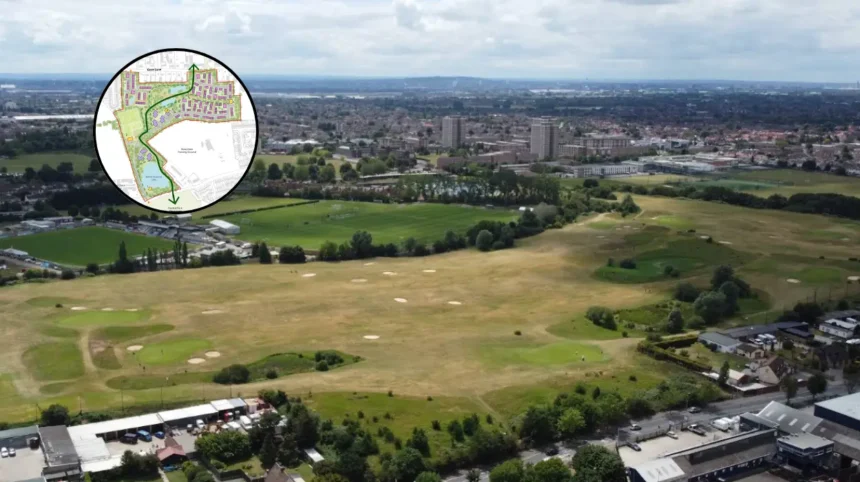
Key Points
- Development firm Homes4Life (also referred to as Homes For Life) has submitted a proposal to demolish Crowlands Heath Golf Course and build approximately 1,250 homes on the site
- The nine-hole golf course straddles two London boroughs: Havering (where two-thirds of the land sits) and Barking and Dagenham
- Roughly 230 of the proposed homes would be located on the Dagenham side of the site
- The developer claims 60% of homes would be social housing and 40% for “key workers,” particularly NHS staff
- Additional proposed amenities include a supermarket, a lakeside community space or cafe, and a “green” foot and cycle path through the development
- Barking and Dagenham Council cabinet members are set to approve the sale of the golf course to the developer next week (as of March 2026)
- Developers will still need planning permission from both Barking and Dagenham and Havering councils even if the sale is approved
- The site is located on Wood Lane in Dagenham
- Homes will be designed by Assael Architecture with a landscape-led masterplan featuring a pedestrian green route across the entire site
- The development aims to enhance biodiversity with consciously designed green areas
- The proposal intends to meet housing needs for both Havering and Barking and Dagenham boroughs
Barking and Dagenham (East London Times) June 13, 2026 – A transformative housing proposal has emerged that could reshape two East London boroughs, with development firm Homes4Life putting forward plans to demolish Crowlands Heath Golf Course and construct approximately 1,250 homes on the site. The nine-hole golf course, situated on Wood Lane in Dagenham, straddles the boundary between Havering and Barking and Dagenham boroughs, with two-thirds of the land located in Havering.
- Key Points
- How Many Homes Will Be Built and What Type of Housing Is Proposed?
- What Additional Amenities Are Included in the Development Plan?
- What Is the Current Status of Council Approval?
- Why Has This Proposal Been Put Forward?
- Background: The History and Significance of Crowlands Heath Golf Course
- Prediction: How This Development Could affect Local Residents and Communities
How Many Homes Will Be Built and What Type of Housing Is Proposed?
As reported by the Barking and Dagenham Post, the developer’s plans include building around 1,250 homes on the land currently occupied by Crowlands Heath Golf Course. Of these proposed homes, the developer states that 60% would be designated as social housing and 40% for “key workers,” particularly NHS staff. This breakdown represents a significant focus on affordable housing, addressing one of London’s most pressing challenges.
Roughly 230 of the homes would be located on the Dagenham side of the site, meaning the majority of approximately 1,026 homes would fall within Havering borough.
The developer’s alternative documentation mentions 1,106 homes, suggesting some refinement in the numbers between different versions of the proposal.
What Additional Amenities Are Included in the Development Plan?
Beyond residential units, the proposal includes several community amenities designed to support the new population.
As detailed in the Barking and Dagenham Post report, proposals include a supermarket, a lakeside community space or cafe, and a “green” foot and cycle path through the development. These amenities aim to create a self-contained community rather than just a housing cluster.
The development’s design, created by Assael Architecture, will feature a landscape-led masterplan involving a pedestrian green route across the entire site.
The plans emphasize enhancing biodiversity with consciously designed green areas, according to the official Crowlands consultation website.
What Is the Current Status of Council Approval?
The sale of the golf course is moving closer to confirmation. As reported by Barking Star on March 19, 2026, members of the Barking and Dagenham Council cabinet are set to approve the sale of Crowlands Heath Golf Course to Homes For Life next week. A company called Homes For Life wants to buy the golf course from the council to build over 1,000 homes.
However, approval of the sale does not guarantee the development will proceed. Developers will still need to receive planning permission from both Barking and Dagenham and Havering councils if the sale is approved. This dual-borough approval process adds complexity, as Havering holds jurisdiction over two-thirds of the site.
Why Has This Proposal Been Put Forward?
The proposal aims to address housing needs in both boroughs. According to the official Crowlands vision statement,
“Our plans for the site will provide entirely high-quality, affordable homes. These homes will help meet the housing needs of both Havering and Barking and Dagenham”.
The development represents an attempt to convert recreational land into residential space to tackle London’s housing shortage.
The golf course sale represents a significant decision for Barking and Dagenham Council, as the council currently owns the property and must decide whether to sell it for housing development rather than maintain it as recreational land.
Explore More Barking and Dagenham News
Vicarage Field Centre Slated for 2,100-Home Overhaul in Barking 2026
Council Launches Massive Housing Inspection Scheme in Barking and Dagenham 2026
Background: The History and Significance of Crowlands Heath Golf Course
Crowlands Heath Golf Course is a nine-hole golf facility located on Wood Lane in Dagenham, East London. The course’s unique geographical position straddles the boundary between two London boroughs: Havering and Barking and Dagenham.
Approximately two-thirds of the land sits within Havering borough, while the remaining third, including roughly 230 homes in the proposed development, falls within Barking and Dagenham’s Dagenham area.
The golf course has served as a recreational facility for local residents for an unspecified period, providing a nine-hole golfing experience in an increasingly built-up part of East London.
The site’s location on Wood Lane places it in a region that has undergone significant development changes over recent decades, with Dagenham itself being a post-war expansion area of London.
The council’s ownership of the property is significant, as Barking and Dagenham Council currently holds the golf course and must approve any sale to developers.
This ownership structure means the council has direct control over whether the property transitions from recreational use to residential development.
The strategic planning committee of Havering Council has also been involved, as evidenced by a developer presentation document dated January 22 regarding Crowlands Golf Course.
The site’s designation as golf course land represents one of the few remaining recreational green spaces in this part of East London, making any decision to convert it to housing particularly significant for local community facilities.
Prediction: How This Development Could affect Local Residents and Communities
The Crowlands Heath Golf Course housing proposal could significantly affect multiple audiences in distinct ways. For local residents in Dagenham and Havering, the development would fundamentally alter the character of their neighborhood.
The loss of a nine-hole golf course means the removal of an existing recreational facility that community members have used for years. Residents who currently enjoy the golf course or appreciate having green space nearby would face the transformation of this land into a高密度 housing development with over 1,200 homes.
For potential homebuyers and those seeking affordable housing, the development presents a notable opportunity. With 60% of homes designated as social housing and 40% for key workers particularly NHS staff, the project directly addresses the affordable housing crisis affecting London.
This could provide housing access for thousands of individuals who currently struggle to find affordable accommodation in East London. The inclusion of a supermarket, lakeside community space, and cycle paths suggests the development aims to create a functional community rather than just housing units.
NHS staff and key workers specifically benefit from the 40% allocation for key workers, which could provide housing proximity to workplace locations in East London hospitals and healthcare facilities. This targeted allocation addresses a critical need for healthcare workers who often face housing challenges in London.
Local councils in both boroughs face complex decisions. Havering Council, which controls two-thirds of the site, must balance housing needs against preservation of green space.
The dual-borough approval requirement means both councils must coordinate planning decisions, potentially creating delays or conflicts if the boroughs have different priorities regarding the development.
Environmental groups and biodiversity advocates may have concerns despite the developer’s claims of enhancing biodiversity with consciously designed green areas.
Transforming an established golf course into housing inevitably changes the ecological character of the site, even with new green spaces incorporated into the design.
The local economy could experience positive effects from the construction phase and the permanent addition of a supermarket and community facilities. However, the loss of golf-related business and recreational tourism应从 고려해야 합니다.
The development’s impact will ultimately depend on whether both councils grant planning permission, how the construction proceeds, and whether the promised amenities materialize as described in the proposal.