Tower Hamlets is one of London’s most dynamic boroughs for visitors seeking markets, museums, and historic neighbourhoods in a compact, walkable area. Its layered heritage spans Roman roads, Huguenot silk-weaving, Victorian docks, and 2012 Olympic regeneration, all accessible via the Elizabeth Line, London Overground, and the DLR.
- What makes Tower Hamlets a must-visit destination for tourists and leisure travellers?
- Which markets define the visitor experience in Tower Hamlets?
- Spitalfields Market
- Brick Lane Market and the Sunday Upmarket
- Columbia Road Flower Market
- Which museums and galleries offer the richest cultural experience?
- Museum of London Docklands
- Young V&A
- Whitechapel Gallery
- Museum of the Home
- Which historic neighbourhoods offer the most immersive walking experiences?
- Spitalfields and the Huguenot Quarter
- Wapping and the Thames Path
- Bethnal Green and the East End Core
- How can visitors plan a practical one-day or two-day itinerary?
- One-Day Itinerary (Sunday)
- Two-Day Itinerary
- What are the best family-friendly and budget-friendly options?
- How does Tower Hamlets connect past and present through its heritage sites?
- What transport and accessibility considerations should visitors note?
- What future developments will shape tourism in Tower Hamlets?
What makes Tower Hamlets a must-visit destination for tourists and leisure travellers?
Tower Hamlets delivers concentrated culture, shopping, and history for tourists with world-class museums, daily markets, and walkable historic streets. Visitors can experience Spitalfields Market, Brick Lane, the Museum of London Docklands, and the Young V&A in a single day, with strong transport links from central London and Heathrow.
The borough sits immediately east of the City of London and covers 19.7 square kilometres, with a population of approximately 320,000. It includes neighbourhoods such as Spitalfields, Whitechapel, Bethnal Green, Mile End, Wapping, and the Isle of Dogs (Canary Wharf).
Tourism infrastructure is well developed. The Museum of London Docklands records over 400,000 annual visitors, while Spitalfields Market attracts more than 10 million visitors per year. The Young V&A reopened in 2023 after a £13 million refurbishment and draws families and design enthusiasts.
Transport access is straightforward. The Elizabeth Line stops at Whitechapel and Liverpool Street, with journey times of 12 minutes to Paddington and 25 minutes to Heathrow. The London Overground connects Shoreditch High Street, Hoxton, Haggerston, Dalston, and Hackney Central. The DLR serves Canary Wharf, Mudchute, and Crossharbour.
Which markets define the visitor experience in Tower Hamlets?
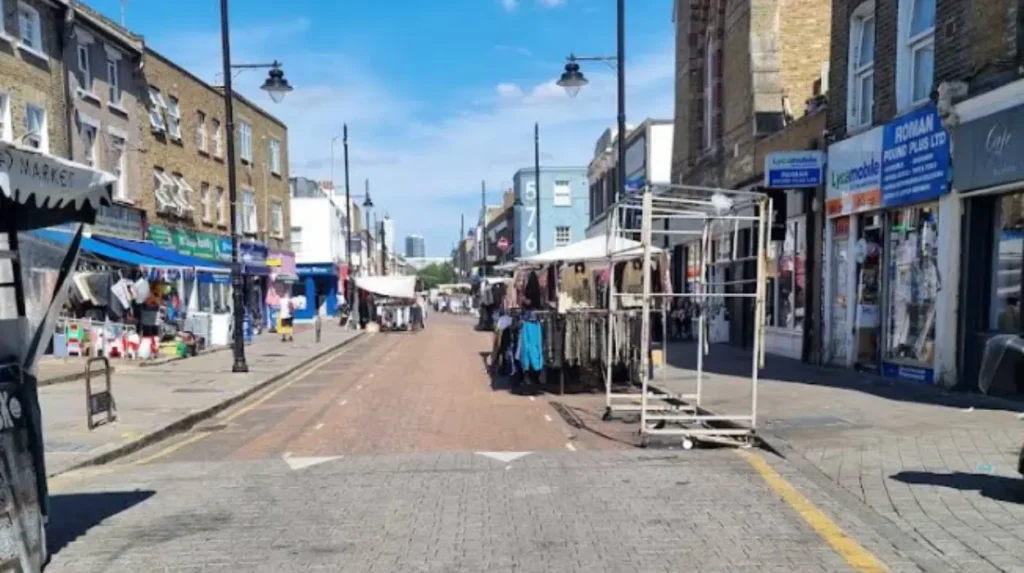
Spitalfields Market, Brick Lane Market, and Columbia Road Flower Market are the three flagship markets that anchor any Tower Hamlets visit. They operate on different days and offer distinct experiences: daily indoor shopping and food at Spitalfields, Sunday vintage and street food at Brick Lane, and Sunday morning flowers at Columbia Road.
Spitalfields Market
Spitalfields Market operates seven days a week from 10:00 to 17:00, with antiques traders on Thursdays and a general mix of fashion, homeware, and street food daily. The market sits in a covered Victorian building with an 1887 façade on Commercial Street, surrounded by preserved Georgian streets such as Fournier Street and Elder Street.
The market traces its origins to 1638, when King Charles I licensed the sale of “flesh, fowl, and roots” on Spittle Fields. King Charles II re-founded it in 1682 with a Royal Charter for Thursday and Saturday trading. It became a major wholesale fruit and vegetable market for 200 years before relocating to Leyton in 1991.
Today, Old Spitalfields Market hosts independent traders, craftsmen, artists, and food vendors. The surrounding streets retain the densest concentration of Huguenot silk-weaver houses in London, with many buildings dating to the early 18th century.
As you explore the modern site, you are crossing land with a deep heritage. Read about the full [history of Spitalfields Market and the Huguenot silk-weaving quarter] to understand its origins.
Brick Lane Market and the Sunday Upmarket
Brick Lane runs from Bethnal Green Road to Whitechapel High Street and functions as an open-air market, street art corridor, and dining strip. The Sunday Upmarket in the Old Truman Brewery operates from 10:00 to 17:00, with vintage clothing, vinyl, street food, and crafts. Independent shops and restaurants are open most days of the week.
Brick Lane Beigel Bake at 159 Brick Lane has served salt beef beigels since 1977, with prices from £7.90. The bakery operates 24 hours and is a fixture for night workers and tourists.
Street art covers Brick Lane, Fashion Street, Hanbury Street, and Shoreditch High Street. Works by Banksy, ROA, Stik, and other international artists appear alongside new commissions. A self-guided walk takes about 90 minutes and costs nothing.
Columbia Road Flower Market
Columbia Road Flower Market runs every Sunday from 08:00 to 15:00, with the street closed to traffic. The market features bucketfuls of flowers, bedding plants, shrubs, and occasional exotic specimens such as banana trees. Prices range from £1 for small bunches to over £50 for large plants.
Arriving before 09:00 gives the best selection, while arriving after 14:00 yields discounts as vendors clear stock. The street is lined with independent bakeries, delis, and galleries that are open on Sundays.
Which museums and galleries offer the richest cultural experience?
The Museum of London Docklands, Young V&A, Whitechapel Gallery, and Museum of the Home provide free or low-cost entry with dense, story-driven exhibits. Together they cover 400 years of Thameside history, childhood culture, contemporary art, and domestic life from 1600 to the present.
Museum of London Docklands
The Museum of London Docklands occupies a Grade I-listed 1802 warehouse at Hertsmere Road, E14 4AL. It is open daily from 10:00 to 17:00, with free entry and no booking required. The museum presents 400 years of Thames, port, and people history, from Roman times to Canary Wharf.
Exhibits include the Port of London Authority Archive, Metropolitan Fire Brigade footage, and captured Nazi footage exploring the port’s wartime role. Permanent galleries cover Sugar & Slavery, London, Port, People, and Docklands at War.
Young V&A
The Young V&A on Cambridge Heath Road, E2 9PA, is the Victoria & Albert Museum’s east London outpost. It houses the world’s largest collection of children’s toys, dolls’ houses, games, and costumes. It reopened in 2023 after a £13 million refurbishment and is open daily from 10:00 to 17:45, with galleries closing at 17:00.
Admission is free, with additional charges for some temporary exhibitions. The museum offers hands-on activities, workshops, and play spaces for children.
Whitechapel Gallery
The Whitechapel Gallery at 77–82 Whitechapel High Street, E1, has operated since 1901. It exhibits modern and contemporary art, with free general admission and ticketed exhibitions typically costing £12–£18. Opening hours are Tuesday to Sunday, 11:00–18:00, with late closing at 21:00 on Thursdays.
The gallery exhibited Picasso’s Guernica in 1938 and continues to premiere major works and launch careers. It includes a bookshop and ground-floor café.
Museum of the Home
The Museum of the Home at 136 Kingsland Road, E2 8EA, occupies 18th-century almshouses near Hoxton station. It is open free of charge and presents “Rooms Through Time”, a sequence of period interiors from 1600 to the present. A visit takes around 90 minutes.
The museum displays original furniture, paintings, textiles, and decorative arts. It reopened in 2021 after major redevelopment and is family-friendly.
Explore More Area Guide
Best Things to See and Do Around Tower Hamlets During Your London Trip
What Is Tower Hamlets Famous For? History, Culture & Modern Attractions Guide
Which historic neighbourhoods offer the most immersive walking experiences?
Spitalfields, Wapping, and Bethnal Green offer the most immersive historic walking experiences with preserved architecture, listed buildings, and layered stories. Each can be explored on foot in 60–90 minutes, with clear routes connecting markets, museums, and heritage sites.
Spitalfields and the Huguenot Quarter
Spitalfields retains the densest concentration of Grade II-listed Georgian houses in London, particularly on Fournier Street, Elder Street, and Princelet Street. The area was settled by French Huguenot silk-weavers after 1685, following the revocation of the Edict of Nantes.
Christ Church Spitalfields, designed by Nicholas Hawksmoor and completed in 1729, anchors the area. The church hosts markets, concerts, and events. The surrounding streets include independent shops, cafés, and the Townhouse Spitalfields tea room at 5 Fournier Street.
Wapping and the Thames Path
Wapping lies on the north bank of the Thames between Tower Bridge and Limehouse. The Thames Path offers continuous riverside walking with views of Tower Bridge, the Tower of London, and Canary Wharf. The Prospect of Whitby pub at Wapping Wall dates to 1520 and is London’s oldest riverside pub.
The area includes converted warehouses, narrow streets, and historic pubs. The London Museum Docklands is a 15-minute walk from Wapping Pier.
Bethnal Green and the East End Core
Bethnal Green sits between Shoreditch and Mile End, with E Pellicci café at 332 Bethnal Green Road operating since 1900. The café serves traditional British breakfasts and has Grade II-listed Art Deco interiors.
The area includes the Museum of the Home, Columbia Road, and the approach to Victoria Park. It is well served by the Central Line at Bethnal Green station.
How can visitors plan a practical one-day or two-day itinerary?
A one-day itinerary should focus on Spitalfields, Brick Lane, and one museum, while a two-day itinerary adds Bethnal Green, Victoria Park, and the Museum of London Docklands. Sunday offers the most market activity, while weekdays are quieter for museums and galleries.
One-Day Itinerary (Sunday)
Start at Columbia Road Flower Market (08:00–10:00), then walk to Spitalfields Market (10:00–12:00). Continue to Brick Lane for the Sunday Upmarket and lunch (12:00–14:00). Visit Dennis Severs’ House or the Museum of the Home in the afternoon (14:30–16:30). End with street art walking around Shoreditch High Street and Hoxton.
Two-Day Itinerary
Day 1: Spitalfields, Brick Lane, Whitechapel Gallery, and Dennis Severs’ House. Day 2: Museum of London Docklands, Canary Wharf riverside walk, Victoria Park, and Broadway Market (Saturday) or Columbia Road (Sunday).
Transport: Use the Elizabeth Line to Whitechapel, the Overground to Shoreditch High Street or Hoxton, and the DLR to Canary Wharf. A daily Travelcard (Zones 1–2) costs approximately £14.90 in 2026.
What are the best family-friendly and budget-friendly options?
Family-friendly and budget-friendly options include free museums, parks, and street art, with low-cost food markets and lidos. The Museum of London Docklands, Young V&A, Whitechapel Gallery, and Museum of the Home are all free. Victoria Park and London Fields offer free playgrounds and green space.
London Fields Lido is a heated outdoor pool open year-round, with adult entry around £6. The Pavilion Café by the lido serves food and drink.
Street art walking around Brick Lane, Shoreditch High Street, Fashion Street, and Hanbury Street is free and takes about 90 minutes. The Sunday Victoria Park food market allows families to graze through lunch without restaurant prices.
How does Tower Hamlets connect past and present through its heritage sites?
Tower Hamlets connects past and present through heritage sites such as Sutton House, Dennis Severs’ House, and the Museum of London Docklands. These sites present layered histories, from Tudor domestic life to 18th-century silk-weaving, Victorian docks, and 2012 Olympic regeneration.
Sutton House at 2–4 Homerton High Street, E9, was built in 1535 and is the oldest surviving domestic building in Hackney. It is managed by the National Trust and costs £8–£10 for adults, open Wednesday to Sunday. The house includes Tudor oak panelling and a preserved 1980s “squatters’ room”.
Dennis Severs’ House at 18 Folgate Street, E1, is a Georgian townhouse arranged as an 18th-century Huguenot family home. Visits are conducted in silence and last around 45 minutes, with tickets costing £15–£20. Evening candlelight sessions run from November to January.
The Museum of London Docklands presents 400 years of Thameside history, from Roman times to Canary Wharf. It includes galleries on Sugar & Slavery, London, Port, People, and Docklands at War.
What transport and accessibility considerations should visitors note?
Visitors should use the Elizabeth Line, London Overground, and DLR for efficient travel, with most sites accessible and step-free. The Elizabeth Line stops at Whitechapel and Liverpool Street, with journey times of 12 minutes to Paddington and 25 minutes to Heathrow.
The London Overground connects Shoreditch High Street, Hoxton, Haggerston, Dalston, and Hackney Central. The DLR serves Canary Wharf, Mudchute, and Crossharbour. Most museums and markets are step-free or have lifts, with accessible toilets available.
A daily Travelcard (Zones 1–2) covers all zones for around £14.90 in 2026. Contactless payment is accepted on all public transport.
What future developments will shape tourism in Tower Hamlets?
Future developments such as the London Museum at Smithfield (opening 28 November 2026) and ongoing Olympic Park regeneration will shape tourism in Tower Hamlets. The London Museum will consolidate collections from the Museum of London and the Museum of London Docklands, with a new riverside site at Smithfield.
The Queen Elizabeth Olympic Park continues to host events, concerts, and sports activities. The ArcelorMittal Orbit remains a key attraction, with viewing platforms and the world’s longest tunnel slide.
What is Tower Hamlets best known for?
Tower Hamlets is best known for the Tower of London, Tower Bridge, Brick Lane, Spitalfields Market, Canary Wharf, and its historic East End heritage. The borough combines world-famous landmarks, multicultural food, historic neighbourhoods, museums, and modern riverside developments within easy reach of central London.