Whitechapel is one of the most historically significant districts in London’s East End. Located within the London Borough of Tower Hamlets, the neighbourhood has developed through centuries of migration, trade, industrial growth, religious change and social reform. Its streets preserve evidence of London’s transformation from a medieval settlement outside the City walls into a major centre of international commerce and multicultural life.
- What Is Whitechapel and Why Is It Historically Important to London’s East End?
- How Did Whitechapel Develop From a Medieval Settlement Into an East London Neighbourhood?
- The origins of St Mary Matfelon
- Commercial development along Whitechapel Road
- Industrial expansion and population growth
- How Did Immigration Shape Whitechapel and the Wider East End?
- Huguenot and European communities
- Eastern European Jewish migration
- Bengali migration and cultural development
- What Is the Connection Between Whitechapel and the Historic Jewish East End?
- Fieldgate Street and Jewish religious heritage
- Petticoat Lane and the clothing trade
- The Poor Jews’ Temporary Shelter
- How Did Whitechapel Become Associated With Jack the Ripper?
- Victorian living conditions and social inequality
- The impact of Victorian newspaper coverage
- Understanding the history respectfully
- Which Historic Buildings and Landmarks Connect Whitechapel With East London’s Past?
- How Did Religion and Community Institutions Shape Whitechapel?
- What Does Altab Ali Park Reveal About Whitechapel’s Bengali Heritage?
- How Does Whitechapel’s Architecture Reflect the Wider History of the East End?
- Victorian commercial architecture
- Industrial buildings and workshops
- Religious and institutional architecture
- Modern regeneration
- How Can Visitors Explore Whitechapel’s Historic Connections With London’s East End?
- Start at Whitechapel Road
- Continue to Altab Ali Park
- Explore Fieldgate Street and the Jewish East End
- Continue towards Brick Lane
- Visit Whitechapel Gallery
- Why Does Whitechapel Remain Important to London’s East End Today?
The historic identity of Whitechapel is closely connected to the wider East End. Its development reflects the experiences of Huguenot refugees, Irish migrants, Eastern European Jewish communities, Bengali settlers and generations of working-class Londoners. Each community contributed to the district’s architecture, businesses, religious institutions, food traditions and cultural identity.
Today, visitors encounter this history through surviving historic buildings, markets, religious landmarks, museums, public spaces and community institutions. Whitechapel Road, Brick Lane, Fieldgate Street and Altab Ali Park provide important connections between historical events and contemporary East London.
Understanding Whitechapel also means understanding the wider history of the East End. The district demonstrates how migration, employment, housing, religion and urban development shaped one of London’s most recognisable neighbourhoods.
What Is Whitechapel and Why Is It Historically Important to London’s East End?
Whitechapel is a historic neighbourhood in the London Borough of Tower Hamlets, east of the City of London. Its importance comes from centuries of migration, manufacturing, market trading, religious development and social reform that helped shape the cultural identity of London’s East End.
Whitechapel developed along the historic route connecting Aldgate with Essex. Its main thoroughfare, Whitechapel Road, formed part of an important eastern approach to London. Travellers, merchants, workers and migrants used this route to reach the capital.
The neighbourhood takes its name from St Mary Matfelon, a medieval church with whitewashed walls. The church stood near the eastern end of Whitechapel High Street. Its religious and architectural history contributed to the development of the surrounding settlement.
Whitechapel became an important part of the East End because of its position outside the historic City boundaries. Land and housing attracted people seeking employment, affordable accommodation and access to London’s commercial economy.
Its history includes several important developments:
- Medieval religious settlement around St Mary Matfelon.
- Commercial expansion along Whitechapel Road.
- Industrial employment in manufacturing and clothing.
- Migration from Ireland, Europe and South Asia.
- Development of hospitals, educational institutions and religious buildings.
- Social reform movements addressing poverty and overcrowding.
The University College London’s Survey of London documents these developments through detailed architectural and historical research. Its Whitechapel studies explain how successive communities influenced the area’s buildings, streets and social institutions. University College London+1
Whitechapel therefore represents more than a single historical period. Its significance comes from the relationship between different generations of residents and the wider development of East London.
How Did Whitechapel Develop From a Medieval Settlement Into an East London Neighbourhood?
Whitechapel developed from a small medieval settlement along the eastern road from Aldgate. Its growth accelerated through expanding trade, population movement, industrial employment and housing construction, eventually transforming agricultural land and open spaces into a densely populated East London neighbourhood.
The earliest development of Whitechapel centred on the road leading towards Essex. The settlement grew outside London’s historic boundaries, where travellers and merchants established commercial activities.
The origins of St Mary Matfelon
The medieval church of St Mary Matfelon gave Whitechapel its name. The church served the local population and became an important religious landmark.
The original church was rebuilt and developed over several centuries. It became associated with the independent parish of St Mary Whitechapel in 1338.
The building experienced repeated reconstruction before its destruction during the Second World War. Its former location remains an important reference point when understanding the neighbourhood’s medieval origins.
Commercial development along Whitechapel Road
Whitechapel Road became an important commercial corridor. Coaching inns, shops, workshops and public houses served people travelling between London and eastern England.
By the seventeenth century, the surrounding settlement had expanded considerably. Commercial activity extended beyond the immediate roadside properties into adjoining streets and courtyards.
The growth of the Port of London and nearby commercial districts encouraged further development. More workers arrived in search of employment, increasing demand for housing and local services.
Industrial expansion and population growth
During the eighteenth and nineteenth centuries, Whitechapel became increasingly urbanised. Manufacturing, clothing production, food businesses and other trades supported the local economy.
The expansion of London’s docks encouraged residential development throughout the East End. Agricultural land gradually disappeared as streets, workshops and housing occupied the surrounding area.
Tower Hamlets Council’s historical conservation research identifies Whitechapel Road as an important part of this transformation. Its historic street pattern still provides evidence of earlier commercial development.
These developments established Whitechapel as a major residential and commercial neighbourhood within East London.
How Did Immigration Shape Whitechapel and the Wider East End?
Immigration shaped Whitechapel through successive waves of European and South Asian settlement. Huguenot, Irish, German, Eastern European Jewish and Bengali communities influenced local employment, religious buildings, languages, food businesses, housing patterns and the multicultural character of contemporary East London.
Whitechapel has experienced centuries of population movement. Its proximity to London’s docks, commercial districts and employment centres made it an important destination for newcomers.
Huguenot and European communities
Huguenots were French Protestants who faced religious persecution in France. Many migrated to Britain during the seventeenth century, bringing specialist skills in weaving, textiles and manufacturing.
Their settlement contributed to the development of London’s textile economy. Although Spitalfields became a particularly important centre of Huguenot silk weaving, their presence also influenced the wider East End.
German and Irish migrants subsequently became part of Whitechapel’s expanding population. Employment opportunities in sugar refining, manufacturing, construction and domestic services attracted workers from different backgrounds.
These communities established businesses, religious institutions and residential networks that contributed to the district’s changing character.
Eastern European Jewish migration
Jewish immigration transformed Whitechapel during the late nineteenth century. Between 1880 and 1914, approximately 150,000 Eastern European and Russian Jewish refugees arrived in Britain. Up to 70% settled in London’s East End.
Many escaped religious persecution, discriminatory laws and economic hardship. Whitechapel and neighbouring Spitalfields offered affordable accommodation, employment and established community connections.
The clothing industry became a major source of employment. Jewish workers established tailoring workshops, clothing businesses and market stalls around Petticoat Lane and surrounding streets.
Yiddish became widely spoken in local commercial and residential areas. Synagogues, community organisations, schools and charitable institutions supported the growing population.
The London Museum’s historical research documents this transformation through photographs, migration records and George Arkell’s 1899 map of the Jewish East End.
Bengali migration and cultural development
Bengali migration became increasingly important during the twentieth century, particularly after the Second World War and the partition of India in 1947.
People from Bangladesh, especially the Sylhet region, established families and businesses throughout Whitechapel and neighbouring districts.
Many migrants initially found employment in manufacturing, catering and clothing workshops. Over time, restaurants, grocery shops, community organisations and religious institutions became important parts of the local economy.
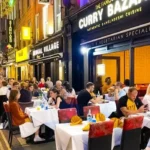
Brick Lane developed a particularly strong connection with British Bangladeshi culture. Its restaurants, food businesses and community establishments helped establish the street as an internationally recognised destination for South Asian food and heritage.
These successive migrations demonstrate why Whitechapel’s history cannot be understood through one community alone.
What Is the Connection Between Whitechapel and the Historic Jewish East End?
Whitechapel became a major centre of Jewish settlement during the nineteenth century when refugees from Eastern Europe established homes, businesses and religious institutions. Their influence remains visible through surviving synagogues, historic streets, clothing trade connections and the wider heritage of Spitalfields.
The Jewish East End developed around Whitechapel and neighbouring Spitalfields during a period of significant immigration.
Jewish families established community networks that provided accommodation, employment and religious support. These networks helped newcomers adjust to life in Britain.
Fieldgate Street and Jewish religious heritage
Fieldgate Street contains important evidence of Whitechapel’s Jewish history. The former Great Synagogue is a particularly significant surviving religious landmark.
Synagogues provided places for worship, education and community gatherings. They also reflected the religious traditions and architectural requirements of Jewish residents.
The wider neighbourhood contained numerous smaller religious establishments, including prayer rooms and community spaces.
Petticoat Lane and the clothing trade
Petticoat Lane, associated with the historic Middlesex Street market, became an important commercial centre for Jewish traders.
The clothing industry connected residential workshops with market trading and wider London’s retail economy.
Tailoring, garment production and textile businesses provided employment for many immigrant families. These industries also created opportunities for independent traders and small business owners.
The Poor Jews’ Temporary Shelter
The Poor Jews’ Temporary Shelter on Leman Street provided accommodation and assistance to newly arrived Jewish immigrants.
It offered temporary support to people who arrived in London with limited financial resources and few established connections.
The institution demonstrates how charitable organisations helped migrants establish themselves in Whitechapel. Its history also provides evidence of the community networks that supported immigration during the late nineteenth century.
The London Museum documents these institutions as important parts of the Jewish East End’s development.
How Did Whitechapel Become Associated With Jack the Ripper?
Whitechapel became internationally associated with the Jack the Ripper murders of 1888. The unidentified murderer targeted women in the East End, generating extensive newspaper coverage and creating a lasting historical connection between Victorian crime, urban poverty and Whitechapel’s public identity.
The Jack the Ripper murders remain among the most recognised events in Victorian London’s history.
In 1888, several women were murdered in the Whitechapel area and surrounding parts of the East End. Five victims are commonly identified as the canonical victims: Mary Ann Nichols, Annie Chapman, Elizabeth Stride, Catherine Eddowes and Mary Jane Kelly.
The murders attracted widespread attention because of their brutality, the uncertainty surrounding the killer’s identity and the limitations of Victorian policing.
Victorian living conditions and social inequality
Whitechapel experienced severe housing overcrowding and poverty during the nineteenth century.
Many working-class residents lived in small, densely occupied accommodation. Casual employment, low wages and limited social protection created difficult living conditions.
Women experiencing poverty faced particular risks, including insecure employment, homelessness and inadequate access to support.
The murders brought national attention to these social conditions. Newspaper reporting frequently sensationalised the neighbourhood and reinforced negative stereotypes about the East End.
The impact of Victorian newspaper coverage
Newspapers played an important role in establishing Whitechapel’s international reputation.
Reports about the murders circulated throughout Britain and overseas. Letters allegedly written by the murderer also contributed to public fascination, although the authenticity of several documents remains disputed.
The investigation exposed limitations in Victorian criminal investigation, communication and policing.
Understanding the history respectfully
Modern visitors encounter Jack the Ripper’s history through walking tours, historical publications and crime-related exhibitions.
However, Whitechapel’s heritage extends far beyond these murders. Its migrant communities, industrial buildings, social reform institutions and religious landmarks provide a broader understanding of Victorian East London.
Visitors researching the subject should distinguish documented historical evidence from speculation about the murderer’s identity.
Which Historic Buildings and Landmarks Connect Whitechapel With East London’s Past?
Whitechapel preserves important landmarks associated with industrial production, healthcare, religious history, migration and cultural development. The Royal London Hospital, Whitechapel Bell Foundry, Whitechapel Gallery, former synagogues and Altab Ali Park provide physical connections to different periods of East London history.
The neighbourhood’s historic buildings demonstrate how commercial activity and population change influenced its architectural development.
Whitechapel Bell Foundry
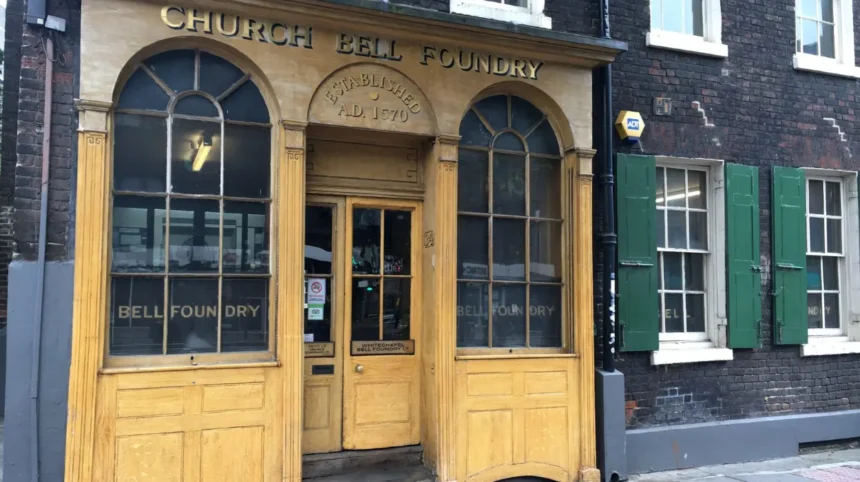
The Whitechapel Bell Foundry represents one of Britain’s most significant industrial heritage sites.
The foundry operated in Whitechapel from at least the 1570s. Its current historic site was established during the mid-eighteenth century.
The business produced internationally recognised bells, including Big Ben’s Great Bell and the Liberty Bell in Philadelphia.
Historic England lists the complex at Grade II* because of its architectural, industrial and national historical significance.
The building preserves evidence of traditional metalworking, specialist manufacturing and the industrial economy that shaped East London. The historic foundry closed its manufacturing operations in 2017, making the preservation of its premises particularly important.
The Royal London Hospital
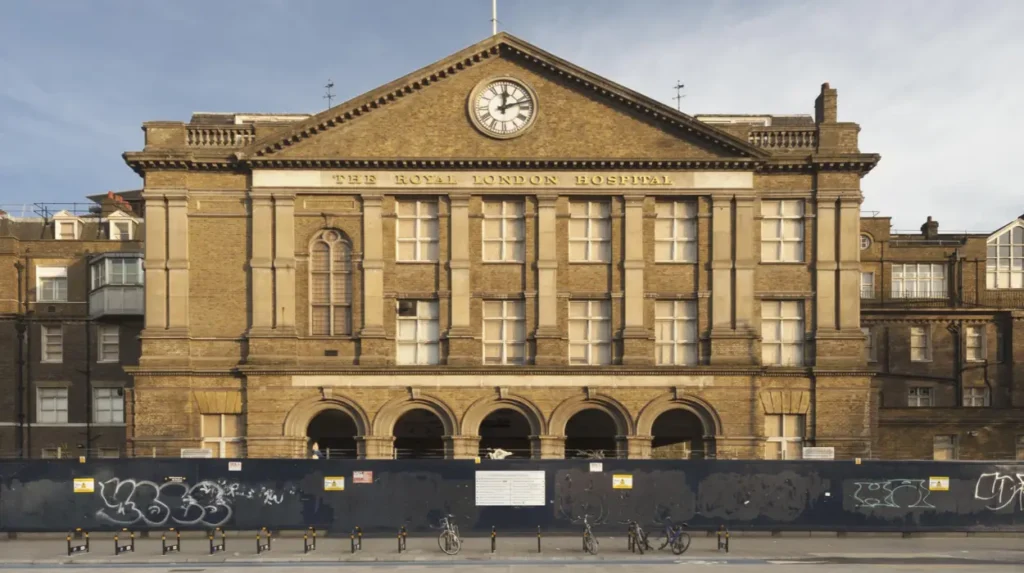
The Royal London Hospital has been central to Whitechapel’s history since the eighteenth century.
Its foundation stone was laid in 1752, and its first patients were admitted in 1757. Originally known as The London Hospital, the institution expanded to meet the healthcare needs of London’s growing population.
By the early twentieth century, it had become the largest voluntary general hospital in the United Kingdom, with more than 1,000 beds.
The hospital also contributed to medical education. Its medical school developed into an important centre for professional training and medical research.
The modern hospital opened in 2012 behind the historic buildings. The former hospital buildings were subsequently refurbished as Tower Hamlets Town Hall, which opened in 2023.
This transformation preserves the historic connection between healthcare, public services and Whitechapel Road. Barts Health NHS Trust
Whitechapel Gallery
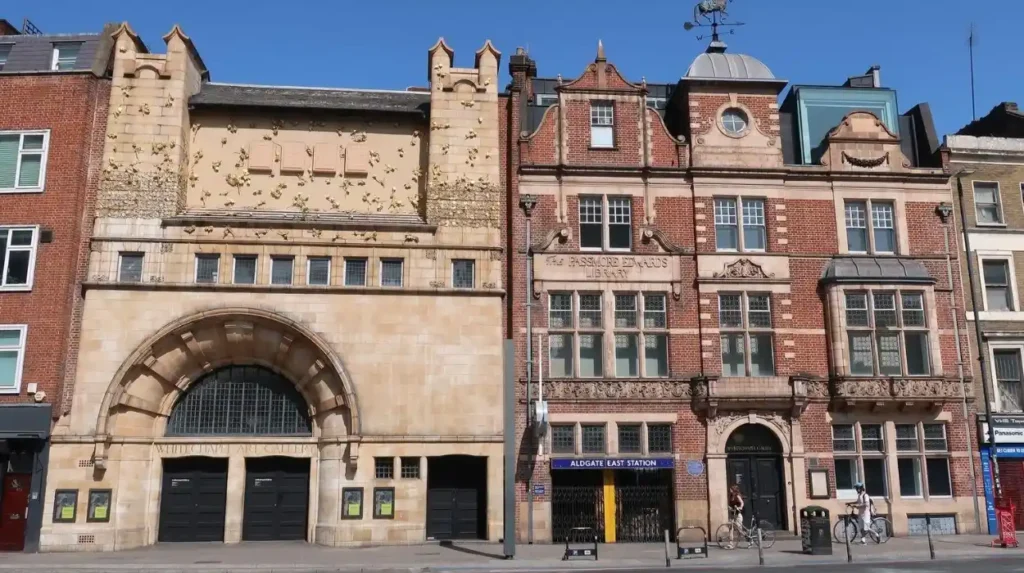
The Whitechapel Gallery opened in 1901.
Social reformers Samuel and Henrietta Barnett established the gallery to bring important works of art to East London’s working-class population.
Its original mission connected cultural education with social improvement. The gallery provided opportunities for local residents to experience international art without travelling to more affluent cultural districts.
The institution subsequently became an internationally recognised contemporary art venue. Its exhibition history includes influential artists and movements from Britain and around the world.
In 2026, the gallery celebrates its 125th anniversary, demonstrating its continuing relationship with East London’s cultural development.
Historic religious buildings
Whitechapel’s religious buildings demonstrate the district’s changing population.
Former churches, synagogues and mosques reflect different periods of migration and community development.
The former Great Synagogue on Fieldgate Street represents Jewish religious heritage. The East London Mosque represents the growth of Muslim community institutions during the twentieth century.
These buildings help visitors understand how religious organisations provided social support, education and cultural continuity for successive generations.
How Did Religion and Community Institutions Shape Whitechapel?
Religious institutions shaped Whitechapel by providing places of worship, education, social assistance and community organisation. Churches, synagogues and mosques reflect successive migration patterns and demonstrate how different communities established lasting cultural and religious connections throughout the East End.
Whitechapel’s religious history reflects its changing population. Different communities established places of worship according to their beliefs, traditions and social requirements.
The East London Mosque
The East London Mosque is one of the most significant Islamic institutions in the neighbourhood.
Its origins date to 1910, when Muslim leaders established the London Mosque Fund to create a permanent mosque in the capital.
In 1940, three houses on Commercial Road were purchased and converted into a mosque. The institution opened on 1 August 1941.
Following redevelopment, the purpose-built mosque opened on Whitechapel Road in 1985. The London Muslim Centre opened in 2004, expanding the institution’s community facilities.
The mosque subsequently developed additional facilities, including the Maryam Centre, which opened in 2013 and provides dedicated facilities for women.
The institution demonstrates the development of British Muslim communities and their contribution to East London’s religious and social landscape. East London Mosque+1
Brick Lane and changing religious identity
The Brick Lane Jamme Masjid is an important example of changing religious heritage in the East End.
The building at 59 Brick Lane has served different religious communities throughout its history.
It originally functioned as a Huguenot chapel before becoming a synagogue serving the Jewish community. In 1976, it became a mosque serving the growing Bangladeshi Muslim population.
This sequence illustrates how migration transformed existing buildings into institutions serving new communities.
The building represents an important connection between European religious migration, Jewish settlement and Bangladeshi cultural development.
What Does Altab Ali Park Reveal About Whitechapel’s Bengali Heritage?
Altab Ali Park preserves important connections to Whitechapel’s Bengali community, the history of St Mary Matfelon and the struggle against racial discrimination. Its memorials commemorate local history, the Bengali Language Movement and the contribution of British Bangladeshis to East London.
The Altab Ali Park stands on the former site of St Mary Matfelon’s churchyard.
The original church was heavily damaged during the Blitz in 1940. Its remaining archaeological features include parts of the church floor plan and several graves.
The park was renamed in 1998 to honour Altab Ali, a 25-year-old Bangladeshi clothing worker murdered in a racist attack on 4 May 1978.
His death became a significant moment in the history of British Bangladeshi political organisation and opposition to racism.
The Altab Ali memorial arch
An entrance arch designed by David Petersen commemorates Altab Ali and other victims of racist attacks.
Its Bengali-inspired decorative patterns represent the cultural connections between different communities in East London.
The Shaheed Minar
The park also contains a Shaheed Minar, a memorial associated with the Bengali Language Movement.
The original movement developed in East Pakistan, now Bangladesh, during the struggle to secure recognition for the Bengali language.
The Whitechapel monument replicates the memorial in Dhaka. It represents the historical importance of language, cultural identity and community heritage.
A public space connecting generations
Altab Ali Park provides a place for remembrance, recreation and community gatherings.
Its memorials connect the medieval history of Whitechapel with twentieth-century migration and contemporary British Bangladeshi identity.
Tower Hamlets Council also records the park as a Green Flag Award-winning public space.
How Does Whitechapel’s Architecture Reflect the Wider History of the East End?
Whitechapel’s architecture reflects centuries of changing economic conditions, migration and urban development. Historic industrial premises, Victorian commercial buildings, religious institutions, hospital structures and modern developments demonstrate how the neighbourhood adapted to successive generations of East London residents.
Whitechapel’s streets contain buildings from different historical periods. Their architectural styles reveal how commercial and residential requirements changed over time.
Victorian commercial architecture
Whitechapel Road retains evidence of its historical role as a commercial thoroughfare.
Historic shopfronts, traditional public houses and former business premises reflect the growth of local retail and manufacturing.
Many buildings developed around narrow plots and older street layouts. These patterns demonstrate how businesses adapted existing urban spaces to accommodate changing commercial needs.
Industrial buildings and workshops
The former Whitechapel Bell Foundry represents the district’s industrial heritage.
Its workshops and adjoining buildings demonstrate the importance of specialist manufacturing in East London’s economic development.
Other historic commercial properties reflect the clothing, food and textile industries that supported successive migrant communities.
Religious and institutional architecture
Religious buildings demonstrate how migration influenced the neighbourhood’s physical development.
Churches, synagogues and mosques provided permanent landmarks for communities establishing themselves in East London.
The historic hospital buildings also demonstrate the relationship between architecture and public services.
Modern regeneration
Whitechapel continues to experience significant redevelopment.
New housing, commercial properties, healthcare facilities and transport infrastructure have changed its urban landscape.
The Elizabeth line has improved connections between Whitechapel and other parts of London. Its station also forms part of the neighbourhood’s modern transport infrastructure.
However, redevelopment creates an important conservation challenge. Historic buildings and community landmarks require protection to maintain the area’s architectural and cultural identity.
The University College London Survey of London provides detailed historical documentation of Whitechapel’s buildings, streets and development patterns.
Explore More Area Guide
Best Places to Experience Traditional East End Culture in Tower Hamlets
Spitalfields Guide: Historic Streets & Markets | East London
How Can Visitors Explore Whitechapel’s Historic Connections With London’s East End?
Visitors can explore Whitechapel’s heritage through a walking route connecting Whitechapel Road, its historic religious buildings, Altab Ali Park, Brick Lane and nearby cultural institutions. These destinations provide practical opportunities to understand migration, architecture, industrial history and community development.
A walking visit provides a direct way to understand how different historical periods overlap within the neighbourhood.
Start at Whitechapel Road
Whitechapel Road provides a suitable starting point because it connects several important historical locations.
Visitors can examine the former Whitechapel Bell Foundry, the historic Royal London Hospital buildings and the surrounding commercial streets.
The road also provides access to Whitechapel Gallery and nearby public transport connections.
Continue to Altab Ali Park
Altab Ali Park offers an opportunity to understand the history of St Mary Matfelon and the Bengali community.
Visitors can examine the memorial arch, Shaheed Minar and remaining evidence of the medieval church.
The park also provides a quieter public space within the busy neighbourhood.
Explore Fieldgate Street and the Jewish East End
Fieldgate Street and its surrounding streets preserve connections to Whitechapel’s Jewish history.
Visitors can learn about the former Great Synagogue, Jewish migration and the development of the clothing industry.
Historic research and archival material provide additional context about the area’s nineteenth-century population.
Continue towards Brick Lane
Brick Lane connects Whitechapel’s history with the wider heritage of Spitalfields.
Its restaurants, independent businesses, historic buildings and religious landmarks demonstrate how successive migrant communities influenced East London.
Visitors interested in the development of the East End should also explore the wider Spitalfields area.
As you explore the modern streets and cultural destinations, you are crossing places shaped by centuries of settlement and social change. Read the full [Insert Anchor Text for East London’s Historical Background Article Here] to understand the wider origins of the neighbourhoods surrounding Whitechapel.
Visit Whitechapel Gallery
Finish the cultural part of the visit at Whitechapel Gallery.
Its exhibitions and historic building provide an opportunity to understand the relationship between art, education and social reform in East London.
Check the gallery’s current exhibition programme and visitor information before travelling.
For visitors with limited time, Whitechapel Road, Altab Ali Park and Brick Lane provide a practical introduction to the neighbourhood’s heritage.
Why Does Whitechapel Remain Important to London’s East End Today?
Whitechapel remains important because its historic buildings, migrant communities, cultural institutions and public spaces preserve the experiences of successive generations. Its heritage provides valuable insight into London’s industrial development, immigration, religious diversity, social reform and continuing urban transformation.
Whitechapel’s historical significance extends beyond its medieval origins and Victorian reputation. The neighbourhood represents the changing social and economic structure of East London.
Its historic streets demonstrate how migration influenced employment, housing, religious institutions and local businesses. Its markets preserve commercial traditions, while its cultural landmarks provide opportunities to understand the experiences of earlier generations.
The district also demonstrates the importance of preserving historic buildings during urban redevelopment. Former industrial premises, religious buildings and public institutions provide physical evidence of London’s changing identity.
For tourists, Whitechapel offers access to several important periods of British history within a relatively compact area. Residents benefit from cultural institutions and public spaces that maintain connections with local heritage.
Whitechapel’s history also remains relevant to discussions about immigration, social equality, multiculturalism and urban regeneration. These subjects continue to influence the development of London’s East End.
Understanding Whitechapel means recognising the contributions of its different communities and the historical events that shaped their lives. Its heritage remains an essential part of London’s wider cultural identity.
What is Whitechapel famous for historically?
Whitechapel is famous for its Victorian history, Jewish immigrant heritage, Bengali community, traditional markets, industrial buildings and association with the Jack the Ripper murders of 1888. It is one of the most historically significant neighbourhoods in London’s East End.